
Read time: 6 min
Table of Contents
- What SpaceX Actually Filed
- The Phase 1 and Phase 2 Numbers
- Why a Programmatic EIS, Not a Simple Permit
- The Monday-Friday Rule
- What the Environmental Review Will Examine
- The Public Comment Deadline
- What Happens Next
- Bottom Line
The Federal Aviation Administration has opened a formal environmental review into SpaceX’s request to fly Starship and Super Heavy up to 456 times a year from Starbase in Cameron County, Texas. The agency announced its intent to prepare a Programmatic Environmental Impact Statement and begin public scoping on the proposal.
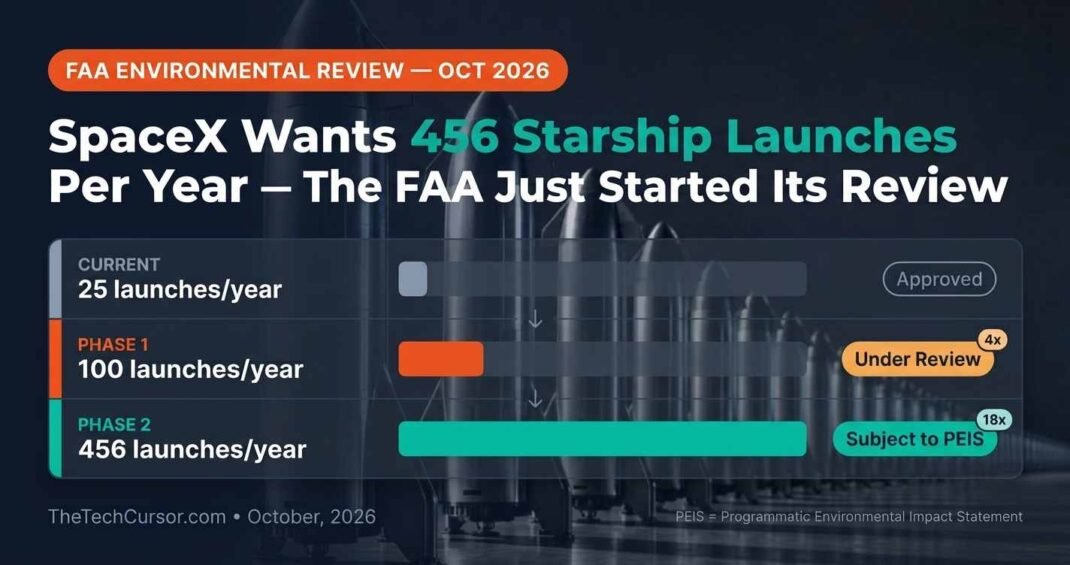
This is not an approval. It is the beginning of a multi-year regulatory process that will determine whether SpaceX can scale Starbase from 25 annual launches today to nearly daily rocket operations in the future.
1. What SpaceX Actually Filed
SpaceX submitted a request asking the FAA to study an annual ceiling of 456 Starship launches and 912 landings from Boca Chica. The landing total splits evenly — 456 Starship landings and 456 Super Heavy booster landings — reflecting a fully reusable flight cadence where both the upper stage and the booster return after every flight.
The FAA has not granted final approval. No timeline for that outcome has been established. What exists today is a regulatory process, not a green light. The distinction matters because early coverage of this story has conflated the filing with approval in ways that are not accurate.
2. The Phase 1 and Phase 2 Numbers
The proposal moves in two stages.
Phase 1 would raise the ceiling to up to 100 launches and 200 landings per year. That is roughly four times the current authorization. Phase 1 is expected to move through the review process faster than Phase 2 because it sits closer to current operating limits.
Phase 2 would raise the ceiling further to up to 456 launches and 912 landings annually. The FAA describes Phase 2 as achievable “within several years” — language that signals a gradual ramp tied to vehicle reliability, not an immediate switch.
| Level | Annual Launches | Annual Landings | Status |
|---|---|---|---|
| Current | 25 | 50 | In effect |
| Phase 1 | Up to 100 | Up to 200 | Under FAA review |
| Phase 2 | Up to 456 | Up to 912 | Subject to PEIS |
3. Why a Programmatic EIS, Not a Simple Permit
A Programmatic Environmental Impact Statement is broader and more time-consuming than a standard environmental assessment. Rather than evaluating one specific launch license, it examines cumulative effects over an extended planning horizon.
The FAA chose this path because it expects Starship operations at Boca Chica to keep scaling well beyond any single mission. The agency stated in its project documentation: “As the vehicle continues to mature and reliability improves, launch and landing rates are expected to increase. Starship and Super Heavy are designed to require minimal post-flight refurbishment.”
That statement frames the entire review. The agency is not evaluating a hypothetical maximum. It is preparing for a flight rate it expects SpaceX to approach as the Starship program matures from experimental flights toward routine operations.
4. The Monday-Friday Rule
One detail receives less attention than the raw launch count but says a great deal about how the FAA is balancing operational flexibility against community impact.
Under the Phase 2 proposal, launches could occur at any time of day — but only Monday through Friday. That restriction caps the realistic ceiling well below 456 divided by 365 days. Furthermore, it gives residents and regulators predictable downtime on weekends regardless of how fast the vehicle cadence grows.
Five-day-a-week operations spread across 456 annual launches would require roughly 1.75 launches per weekday if SpaceX ever reached the ceiling. That cadence is far beyond anything any launch provider has sustained from a single pad.
5. What the Environmental Review Will Examine
The PEIS covers seven distinct categories.
| Category | Primary Concern |
|---|---|
| Air quality | Cumulative emissions from engine combustion and testing |
| Wildlife | Disturbance to coastal and migratory species |
| Coastal resources | Beach and dune impacts from repeated operations |
| Water | Effects on wetlands and water quality |
| Noise | Acoustic impact on nearby communities |
| Aviation | Airspace closures and effects on commercial traffic |
| Cultural resources | Impacts on historically significant sites |
Each category will generate its own technical analysis before the FAA can issue a final PEIS. The agency has not published a projected completion date. Historically, federal environmental reviews of this scale take multiple years.
6. The Public Comment Deadline
The FAA set a public comment deadline of November 30, 2026, for stakeholders to weigh in on the scope of the review. That gives residents, environmental groups, aviation industry participants, and local government roughly six weeks to submit input on what the PEIS should examine and how deeply.
Scoping comment periods shape which issues receive the most detailed technical treatment in the draft PEIS that follows. Consequently, the volume and substance of comments filed before the deadline could meaningfully influence how long the full review takes and how restrictive the eventual operating conditions become.
7. What Happens Next
Based on the FAA’s stated process and comparable federal environmental reviews, several outcomes look likely — though none are confirmed.
Phase 1 moves faster than Phase 2. The more modest jump to 100 annual launches is closer to existing limits and will likely clear the review process before the full 456-launch ceiling is studied in depth.
Full Phase 2 implementation is years away. The FAA’s own language — “within several years” — signals that the agency is planning for a gradual ramp, not an immediate authorization. Vehicle reliability data from continued Starship flights will feed into that timeline.
Environmental groups will be active commenters. Wildlife and coastal protection organizations have engaged with every prior Starbase environmental review. The scale of this proposal will likely bring more comment volume than any previous filing.
Market reaction will track regulatory milestones. News of the environmental review opening, rather than an approval, triggered reported share price declines in SpaceX-linked securities this week. Subsequent PEIS milestones — draft publication, final review completion — will likely generate similar reactions as investors parse incremental progress against a multi-year timeline.
8. Bottom Line
SpaceX’s 456-launch request matters less as a precise near-term target and more as a signal of where the company believes Starship’s operational ceiling could eventually sit once the vehicle exits its test-heavy phase.
A reusable rocket designed to require minimal post-flight refurbishment only delivers on that design if regulators authorize a flight cadence that matches rapid turnaround capability. This filing is SpaceX asking the FAA to start building that regulatory runway now — years before the vehicle may be ready to use all of it.
The process is in its earliest stage. Public scoping, years of environmental analysis, and a formal PEIS stand between today’s filing and anything close to 456 Starship launches in a single year. Watch the Phase 1 outcome and the PEIS completion timeline as the two most meaningful near-term milestones.