Category: SEO | Google Ads | AI Search | Digital Marketing
Published: June 17, 2026
Read time: 8 min
Site: TheTechCursor
For two decades, paid search and organic SEO have been treated as separate worlds. Different teams, different budgets, different dashboards, different quarterly reports. The paid specialist managed bids and ad copy. The SEO team managed content and rankings. They rarely needed to talk to each other.
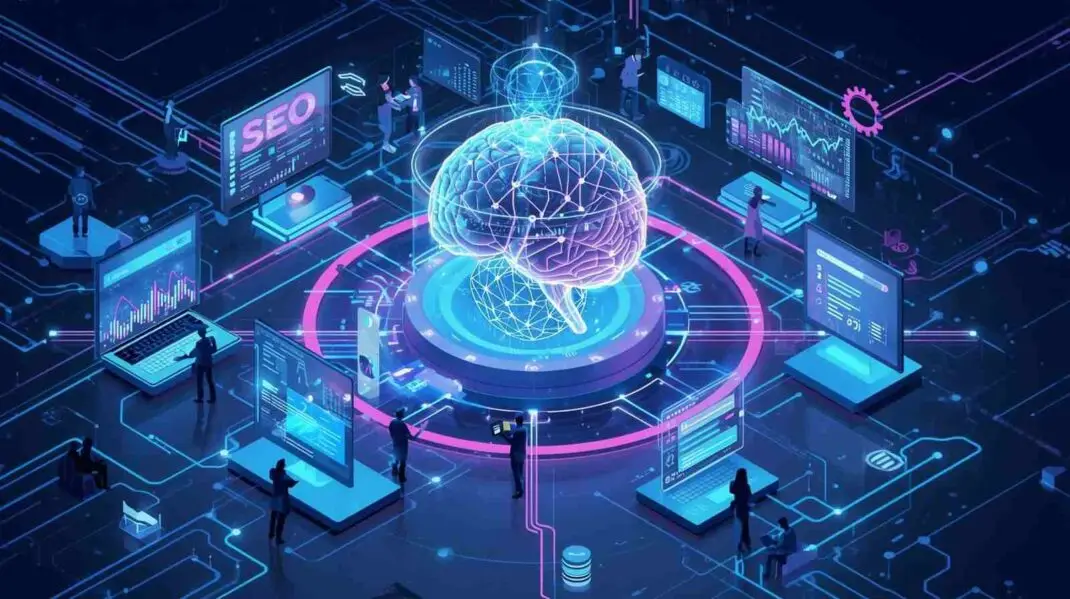
That separation is now obsolete — and the reason is Gemini.
The same AI system that powers Google’s organic search results, AI Overviews, and AI Mode is also the system deciding which ads to show, to whom, and at what price. Paid and organic are no longer two channels competing for the same click. They are becoming two different ways of training the same AI — and understanding this shift is becoming essential for anyone running a marketing strategy in 2026.
The Old Model: A Finite Search Results Page
For most of Google’s history, the search results page was a fixed, predictable surface. Ten organic blue links, a handful of ad slots, a knowledge panel on the side. Users landed, scanned, and clicked.
Under this model, paid and organic were genuinely separate disciplines. Titles, bids, and campaign structure were chosen manually by paid specialists. The organic team had no real role in those decisions, and the two sides operated independently because the systems behind them were independent too.
That began changing with automated campaign types like Dynamic Search Ads, which started reading organic pages to decide which ads to run and to whom. Performance Max extended that logic across every Google surface simultaneously — Search, YouTube, Gmail, Display, Maps, and Shopping — all driven by the same underlying engine reading your organic content and audience signals.
AI Max brought that same intelligence specifically into Search campaigns. Both PMax and AI Max now run on the same underlying brain: Gemini.
The New Model: Gemini Is Everywhere
Here is the part most marketers have not fully grasped yet. Gemini does not just power one or two Google products. It sits inside nearly every layer of the Google ecosystem:
- Discovery surfaces — Search, Maps, YouTube, Lens, News, Discover, Shopping
- Productivity tools — Gmail, Docs, Drive, Photos, Calendar
- Distribution platforms — Android, Chrome, Google Play, Pixel
- Transaction surfaces — Google Pay, Wallet, Flights, Hotels
- Assistive interfaces — AI Mode, AI Overviews, the Gemini app, NotebookLM
This is where the average connected consumer spends most of their day. Most of these surfaces either already carry ads or have the infrastructure to start carrying them soon.
The same pattern is playing out across the industry. Microsoft Advertising now sits inside Copilot across Bing, Edge, and Office. OpenAI launched ads inside ChatGPT earlier this year and has been rapidly expanding — including the product feed ads format covered in our recent coverage of OpenAI’s advertising expansion.
The takeaway: the ad engine travels everywhere the AI engine goes. As AI expands across more surfaces, advertising expands right alongside it.
Why “Ads Are Dying” Misses the Real Story
A common narrative in 2026 claims that AI is killing advertising — that as AI Overviews and AI Mode reduce the visible ad slots on a single search results page, advertising itself is in decline.
This misses something important. Ad density per individual session may be dropping as AI takes more control of the experience. However, that does not mean fewer ads overall — it means ads are spreading across a much larger number of surfaces than ever existed before.
Think of it this way: instead of one search results page carrying most of the ad load, dozens of AI-powered surfaces now each carry a smaller share. The total ad opportunity has expanded even as density on any single surface has decreased. Total ad revenue across the industry has continued growing throughout this transition — which is the clearest evidence that the overall advertising opportunity is expanding, not shrinking.
How Much Advertising Appears Depends on How Much Control Users Hand Over
There is a useful pattern worth understanding: the amount of advertising that appears in any AI interaction depends on how much decision-making the user has delegated to the machine.
Search mode — The user stays in control, actively choosing between options. The AI can surface ads because the user still has a decision to make.
Assistive mode — AI Overviews and AI Mode narrow the options presented to the user. A sponsored placement still has room to appear, but with less surface area than a traditional results page.
Agentic mode — When AI fully executes a decision on the user’s behalf — booking, purchasing, comparing — there is no longer a decision-making moment for an ad to influence. The ad essentially has no one left to persuade.
As more interactions shift toward fully agentic execution, advertising opportunities at that specific moment shrink. However, new surfaces continue opening up elsewhere in the ecosystem, offsetting that decline.
The Same AI Reads Your Organic Content and Your Ad Campaigns
This is the core insight that should change how marketers think about strategy.
In a paid campaign, you explicitly declare three things: your target cohort, the user’s intent, and your profit margin for that segment. Gemini uses these explicit declarations to make targeting and bidding decisions.
In organic content, you cannot declare these things directly. Instead, Gemini infers them from user behaviour — clicks, time spent on the page, and whether users return to search for the same thing again. These behavioural signals act as a proxy for the profit and intent signals that paid campaigns state explicitly.
Here is the critical point: it is the same underlying AI system reading both. The same knowledge graph, the same search index, and the same model evaluate your brand, whether the context is an organic ranking decision or a paid ad placement decision.
This means training Gemini’s understanding of your brand through strong organic content also improves how it handles your paid campaigns — because it is forming one unified impression of your brand, not two separate ones.
The Practical Strategy: Use Paid to Find What Works, Then Build Organic Around It
If paid and organic are being evaluated by the same underlying intelligence, the smartest approach is to treat them as one connected loop rather than two separate efforts.
Step 1: Run paid campaigns to discover what converts. A correctly structured paid campaign forces you to explicitly declare your audience, your goal, and your profit margin for each ad group. This data tells you precisely which combinations of audience and offer actually convert.
Step 2: Build organic content around those winning combinations. Rather than serving the same generic page template to every visitor, build content specifically for the cohorts that your paid data proved convert well. A page built precisely for a specific kind of visitor performs better — both for that visitor and for the signals it sends back to Gemini.
Step 3: Let the improved organic signal reduce your paid costs. When your organic content sends clear, consistent signals about who your content serves and at what value, Gemini needs to guess less when evaluating your paid ads. Less uncertainty for the AI translates into lower cost-per-click and creative that better matches your intended positioning.
This creates a genuinely valuable cycle: better-targeted organic pages improve behavioral signals, which improve organic visibility for the right audience, which simultaneously reduces paid costs because the AI has more confidence in how to represent your brand.
What Happens When Gemini Isn’t Convinced About Your Brand
If Gemini’s confidence in your brand is weak — due to thin content, inconsistent information, or limited authoritative signals — you pay a real cost on both sides simultaneously.
On organic, weak brand confidence shows up as the AI hedging on basic facts about your business or preferring to surface competitors in comparisons. On paid, that same lack of confidence shows up as a higher cost-per-click and ad creative that gets rewritten away from your intended positioning, because the AI is uncertain enough about your brand to play it safe.
The fix is the same on both sides: build clear, consistent, well-sourced information about your brand across your content. The stronger and more consistent the signal, the more Gemini trusts your brand — and that trust pays dividends in both organic visibility and paid efficiency.
Why Google Has an Advantage Microsoft and OpenAI Cannot Easily Match
This shift also explains a significant competitive dynamic in the AI advertising landscape. Google controls three things simultaneously: the AI model, the surfaces where that model operates, and the advertising platform that monetizes it — all tuned together as one integrated system.
Microsoft has many of the surfaces — Bing, Edge, Office — but its underlying AI model has not reached the same level of sophistication or scale. OpenAI has a genuinely powerful model and a fast-growing advertising business through ChatGPT. However, it lacks Google’s breadth of surfaces — no Gmail, no YouTube, no Maps, no Android.
Without that surface breadth, an advertising business has a harder time compounding at the same scale Google can achieve. For now, only Google has all three pieces working together as one unified system — which is a meaningful structural advantage as this transition continues.
What This Means for Your Marketing Strategy
For agencies and marketers managing both paid and organic work, the practical implications are significant:
Stop treating paid and organic as separate budgets and separate teams. The same AI system is evaluating both. Strategies that ignore this connection are leaving performance on the table on both sides.
Build content with explicit audience precision. Generic pages serving every visitor the same way force Gemini to guess at your intended audience and profit tier. Specific, well-targeted content removes that guesswork.
Use paid campaign data to inform organic content decisions. Your paid campaigns already declare exactly which cohorts and offers convert. Use that data directly to prioritize what organic content to build next.
Invest in brand clarity and consistency everywhere. Since the same AI forms one impression of your brand across both paid and organic contexts, inconsistent or thin brand information costs you twice — once in each channel.
Bottom Line
The line between paid and organic search is fading — not because advertising is disappearing, but because the same AI system now powers both. Gemini reads your organic content to inform how it serves your ads. It reads your ad performance data as another signal in understanding your brand.
For marketers, the strategic question is no longer “how do I optimize my paid campaigns” and “how do I optimize my SEO” as two separate problems. It is “how do I build the clearest, most consistent, most trustworthy brand signal that one AI system can read consistently — whether the context is a search result, an AI Overview, or a paid placement.”
Train the AI once, with consistent signals across your entire content footprint, and the benefits compound across both channels simultaneously.