
Published: July 11, 2026
Read time: 6 min
For every genuine AI marketing problem worth solving, it feels like ten vendors have appeared with a tool claiming to solve it. If your inbox looks anything like most marketing professionals’ inboxes in 2026, you are fielding AI vendor pitches daily.
After sitting through enough calls and evaluating enough tools, you start asking the same handful of questions — because those questions reliably separate tools worth deploying from tools worth skipping.
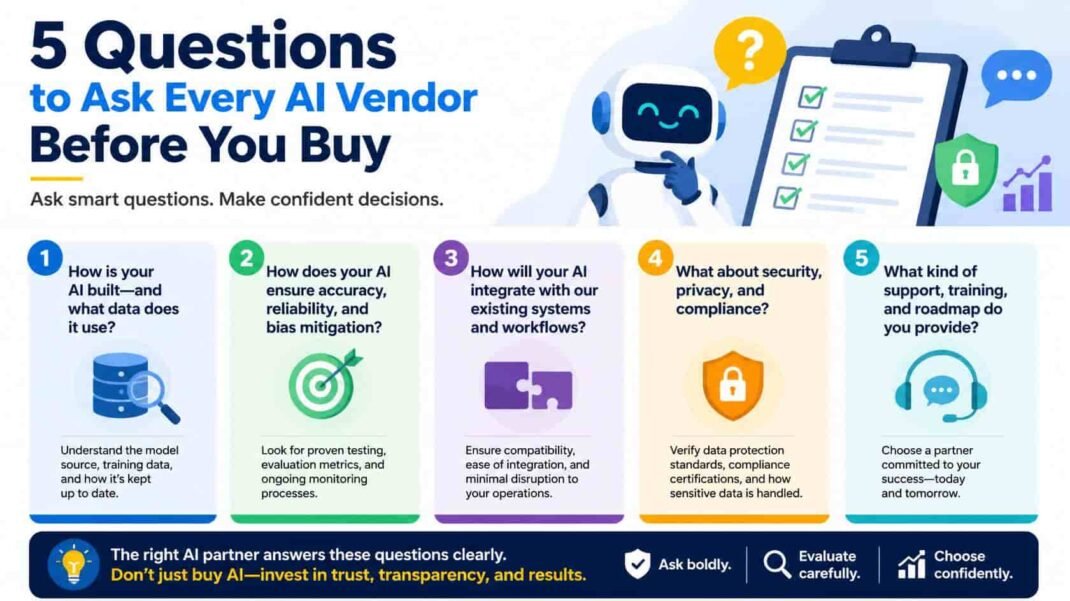
Here are the five questions that matter most, what good answers look like, and what red flags to watch for.
Table of Contents
- Why These Questions Matter Right Now
- Question 1: What Problem Does Your Tool Actually Solve?
- Question 2: What Expertise Do You Have In This Space?
- Question 3: What Case Studies and Real Results Can You Show?
- Question 4: Who Owns My Data — And How Is It Being Used?
- Question 5: What Does Implementation Actually Look Like?
- Do Not Let AI Hype Rush Your Decision
- Bottom Line
1. Why These Questions Matter Right Now
The AI tools market is moving faster than most marketing teams’ ability to evaluate it carefully. New platforms launch weekly. Established vendors add AI features to existing tools. And the pressure to adopt AI to remain competitive creates a genuine temptation to move before you have done enough due diligence.
That pressure is worth resisting. As covered in TheTechCursor’s guide on build vs buy AI SEO tools, many teams are discovering that AI tools look impressive in demos and underdeliver in practice — or that implementation requirements far exceed what the sales conversation suggested.
The five questions below cut through the noise. They work for AI SEO tools, AI ad platforms, AI content tools, and any other AI-powered marketing technology you are evaluating.
2. Question 1: What Problem Does Your Tool Actually Solve?
Why ask it: This question forces the vendor to connect their product to real business outcomes — not just feature lists. If they cannot clearly articulate the specific challenge their tool addresses and how solving it improves your business results, the tool was likely not built around a genuine customer problem.
What a good answer sounds like:
- “This tool identifies which pages have high impressions but low CTR, flags the likely cause, and suggests specific title and meta description changes — saving your team 4-6 hours per week of manual analysis”
- “Our platform tracks your brand’s citation rate across ChatGPT, Perplexity, and Google AI Overviews and tells you exactly which content changes drove visibility improvements”
Red flags to watch for:
- Feature-heavy language with no clear business outcome attached
- “It saves time” without a plan for how that time will be reinvested
- Inability to name a specific workflow problem the tool addresses
The follow-up: Always ask for a case study showing how the tool was used and what outcomes it delivered for an organization similar to yours in size, vertical, and team structure.
3. Question 2: What Expertise Do You Have in This Space?
Why ask it: Technical capability is necessary but not sufficient. A tool built by engineers who deeply understand the problem is fundamentally different from a tool built at a market opportunity without that deep expertise. The distinction shows up in edge cases, in the quality of recommendations, and in whether the tool actually fits how your team works.
What a good answer sounds like:
- A founding story where the team experienced the problem firsthand and built the solution out of genuine frustration
- A team that includes practitioners with hands-on experience in the specific discipline — media buying, SEO, content strategy — alongside technical talent
- Access to those practitioners during the sales process and post-sale
Red flags to watch for:
- A sales rep with no meaningful knowledge of the domain and no offer to connect you with someone who does
- A founding narrative built around a market opportunity rather than a problem actually experienced
- Generic answers about “leveraging AI to improve marketing performance”
Why it matters: A tool built by people who have never done the work tends to solve the problem as they imagine it, not as it actually exists in practice.
4. Question 3: What Case Studies and Real Results Can You Share?
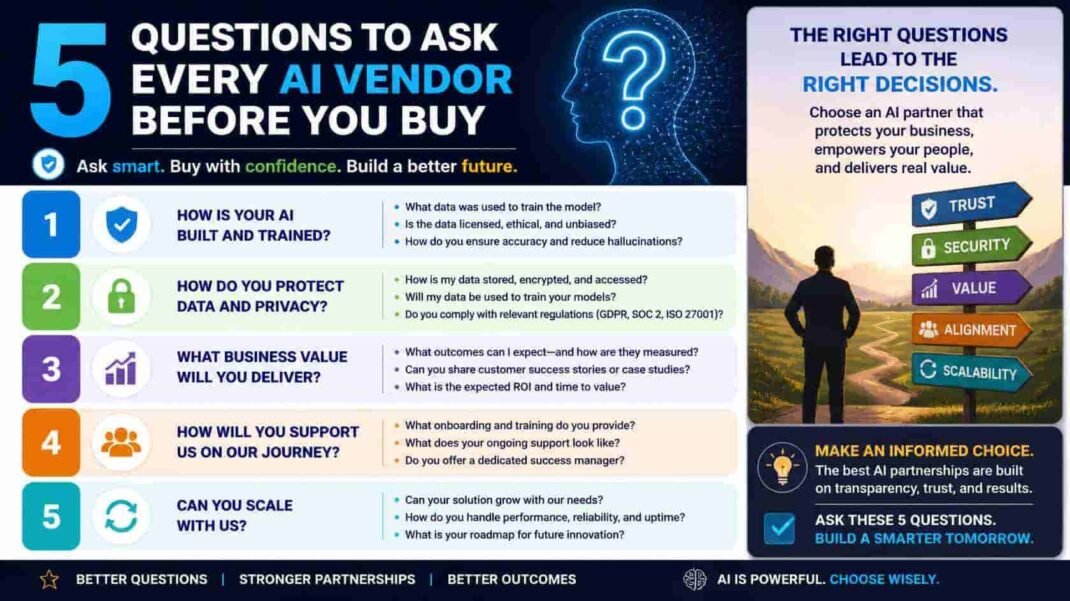
Why ask it: In a fast-moving category where many vendors are six to eighteen months old, case study evidence is the clearest signal of whether a tool delivers what it promises in real conditions — not just controlled demos.
What a good answer sounds like:
For established vendors: Specific case studies with real numbers from clients in a similar vertical, of similar size, with a similar use case. Percentages without baselines are worth probing — “improved CTR by 40%” means very different things depending on the starting point.
For early-stage vendors: Transparency is a green flag. “You would be one of our first clients in this vertical. Here is what we have seen in adjacent spaces and here is what that partnership would look like — including what flexibility we can offer on contract terms given you would be helping us build this out.”
Red flags to watch for:
- Vague testimonials without specific metrics
- Case studies from companies in completely different verticals or at dramatically different scales
- Early-stage vendors unwilling to be flexible on contract terms despite limited track record
Furthermore, if you would clearly be an early adopter, ask yourself honestly: does your team have the bandwidth to work through the inevitable rough edges? Early adoption can provide competitive advantage — but only if you have the capacity to engage meaningfully with the feedback loop.
5. Question 4: Who Owns My Data — And How Is It Being Used?
Why ask it: This is the question most buyers skip — and it is arguably the most important one. In the rush to find a competitive edge, marketing teams are sharing remarkably sensitive data with AI tools without fully understanding where it goes, how long it is retained, or whether it is being used to train models that benefit your competitors.
What a good answer sounds like:
- Clear, specific explanations of where your data is stored and for how long
- Explicit confirmation that your data is not used to train shared models or third-party models without your explicit consent
- If your data is used for model training, clarity that it only refines your own instance — not a shared model
- All of this in the contract — not just verbal assurance from a sales rep
Red flags to watch for:
- Vague or deflecting answers about data usage
- Terms of service that contradict or muddy what the salesperson told you verbally
- Any language suggesting your data contributes to improving the platform for other customers
- “We take data privacy seriously” without specific details
The non-negotiable: You own your data. Full stop. This needs to be explicitly stated in the contract. If a vendor resists including clear data ownership and usage language in the agreement, that resistance itself is a significant red flag.
6. Question 5: What Does Implementation Actually Look Like?
Why ask it: Most wasted MarTech spend can be traced to a single failure: underestimating what implementation actually requires. The demo showed a polished interface and impressive outputs. The reality involved weeks of integration work, training sessions, data migration, and team adoption challenges — none of which appeared in the sales process.
What a good answer sounds like:
- A specific, realistic timeline for getting the tool to full functionality
- Honest description of internal resources required — technical integration, team training, ongoing maintenance
- Clear explanation of what your team needs to do to get value from the tool — and what happens if you do not do those things
- Reference customers you can speak with about their actual implementation experience
What to honestly assess on your side:
- Does your team currently have the bandwidth to implement this properly?
- Do you have the technical resources required for integration?
- If the tool requires ongoing input from your team to deliver value, is that input realistic given current workloads?
The honest test: If you cannot realistically dedicate the time and resources the tool requires, it is not worth investing in right now — regardless of how impressive the capabilities are. A tool your team never fully adopts delivers exactly zero return on investment.
7. Do Not Let AI Hype Rush Your Decision
This is worth saying plainly: we are still in the early stages of AI tool adoption. Many tools that exist today will be significantly better — or significantly cheaper — in six to twelve months. Many tools that sound impressive now will not survive to prove it.
If a tool seems too expensive for its current track record, too rigid on contract terms given its early stage, or too complex to implement given your current team capacity, a more attractive solution will likely emerge in the near future.
When in doubt, ask for a free trial. If the integration work is not prohibitive, a hands-on trial is often the most reliable way to separate genuine value from compelling demos.
The competitive advantage in AI tools does not come from being first to sign a contract. It comes from choosing tools that actually solve real problems, implementing them well, and using the insights they generate to make better decisions. That requires patience in the evaluation process — especially when the vendor’s pitch is designed to create urgency.
8. Bottom Line
Five questions. Use them every time.
- What problem does your tool solve? — Does it connect to real business outcomes?
- What expertise do you have in this space? — Was this built by people who understand the work?
- What case studies and real results can you share? — Does it actually deliver in practice?
- Who owns my data and how is it being used? — Is this in the contract?
- What does implementation actually look like? — Can your team realistically do this?
The AI tools market will keep moving fast. These questions slow it down just enough to make a good decision.