
Published: July 12, 2026
Read time: 8 min
For decades, e-commerce optimization was built around one assumption: a human being would land on your product page and decide whether to buy. Optimize for that human — clear images, compelling copy, social proof, fast load times — and conversions followed.
That assumption is breaking down.
A growing share of purchase decisions are now being made — or heavily pre-filtered — by AI agents acting on behalf of consumers. These agents do not browse. They do not respond to compelling copywriting. They evaluate structured data, extract product attributes, cross-reference brand signals, and return a ranked shortlist to the human who asked them to shop.
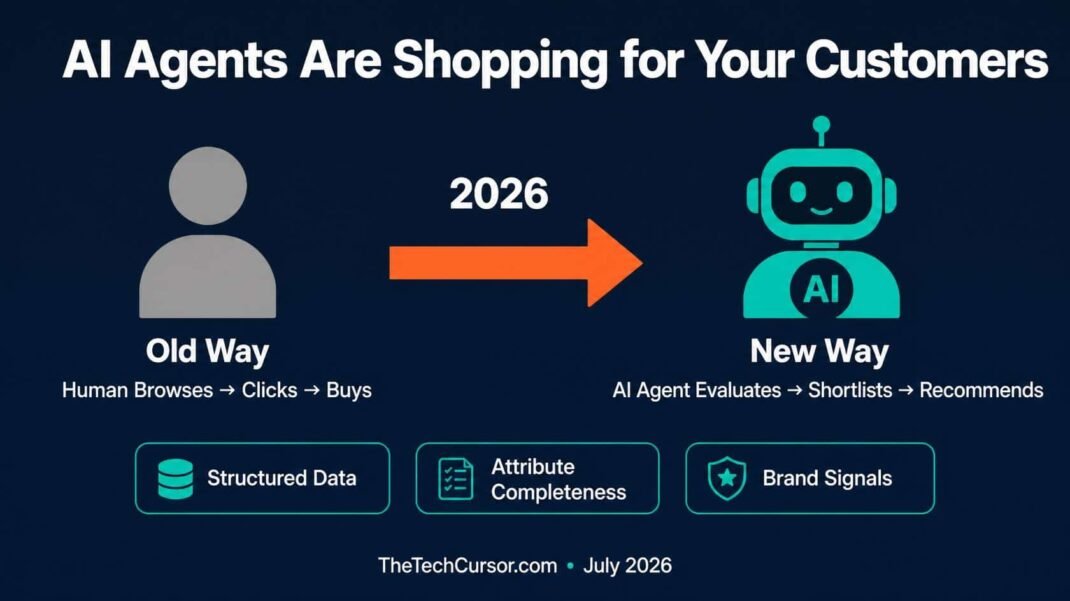
If your product pages are not built for AI agent evaluation, you are being filtered out before any human ever sees your products. Here is what that means — and what to do about it.
Table of Contents
- The New Shopper in the Room
- What “Infinite Shelf Space” Actually Means
- How AI Agents Evaluate Products — Not How Humans Do
- The Three Things AI Agents Need From Your Product Pages
- Structured Data Is No Longer Optional
- Content Completeness: The New Conversion Rate Optimization
- Brand Signals AI Agents Check Before Recommending
- Real-World Examples — Wayfair, Sephora, Patagonia
- What to Audit on Your Product Pages Right Now
- Bottom Line
1. The New Shopper in the Room
The shift started with AI-powered search. Google AI Overviews, ChatGPT, and Perplexity began handling shopping queries — surfacing product recommendations in conversational answers rather than ranked product listings. As covered in TheTechCursor’s analysis of AI referral traffic data, AI-referred retail visitors now convert at 54% higher rates than non-AI traffic because they arrive further along in their purchase journey.
However, the more significant shift is happening at the agent layer. AI agents — autonomous systems that take actions on behalf of users — are moving from research assistants to active participants in the purchasing process.
A user says: “Find me a sustainable yoga mat under $80 that ships in two days.” An AI agent searches, evaluates, compares, and returns: “Here are three options that match your criteria. The first has the best sustainability certifications. The second has the fastest shipping. The third is the most popular based on reviews.”
The human did not visit any product pages to reach that shortlist. The AI agent did — and it evaluated your products on criteria that are fundamentally different from how a human shopper would.
2. What “Infinite Shelf Space” Actually Means
Physical retail has always been constrained by shelf space. Even the largest stores carry a fraction of the available products in any category. This created buyer power for large brands that could afford premium shelf placement — and significant barriers for smaller brands trying to reach consumers.
Digital commerce expanded the shelf. Any brand could theoretically reach any consumer online. However, attention remained constrained — consumers could only browse so many search results, product listings, and category pages before making a decision.
AI agents eliminate that constraint in a new way. An agent can evaluate thousands of products in seconds, filtering against dozens of criteria simultaneously, without attention limitations.
This creates what researchers and retailers are calling “infinite shelf space” — a product evaluation environment where the constraint is no longer human attention but machine-readable data quality. The products AI agents can evaluate completely and confidently are the ones that make the shortlist. The products with incomplete or ambiguous data are filtered out — not because they are inferior, but because the AI cannot confidently assess them.
The implication: Brand size and traditional marketing spend matter less in an agent-evaluated environment. Data quality and content completeness matter more.
3. How AI Agents Evaluate Products — Not How Humans Do
Understanding how AI agents differ from human shoppers is essential for optimizing your product content effectively.
Human shoppers:
- Respond to emotional triggers — lifestyle imagery, aspirational copy, social proof
- Tolerate ambiguity and fill in gaps with assumptions
- Navigate messy, inconsistent product descriptions with relative ease
- Are influenced by visual hierarchy, colour psychology, and UX design
AI agents:
- Extract structured attributes — material, dimensions, certifications, compatibility, use cases
- Cannot tolerate ambiguity — missing attributes reduce confidence and lower recommendation probability
- Require explicit, machine-readable data to evaluate product fit against user criteria
- Are indifferent to design, imagery, and emotional copy — they extract data, not experience
A product description that works brilliantly for a human — “Our signature yoga mat brings a mindful touch to every practice, crafted from premium materials with a texture that grounds you” — is nearly useless to an AI agent. The agent needs: material type, dimensions, weight, grip specifications, sustainability certifications, and shipping timeline.
This does not mean abandoning human-oriented copy. It means ensuring that underneath the human experience, there is a complete layer of structured, explicit, machine-readable product information.
4. The Three Things AI Agents Need From Your Product Pages
Research from multiple e-commerce and AI labs consistently identifies three categories of information that determine whether an AI agent can confidently recommend a product:
1. Explicit attribute completeness Every product attribute relevant to purchase decisions must be present and explicit. Not implied. Not embedded in marketing copy. Explicitly stated in structured form — whether in product specifications, schema markup, or feed attributes.
For a yoga mat: material composition, dimensions (length, width, thickness), weight, grip level, sustainability certifications, care instructions, and intended use cases.
For a laptop: processor model and generation, RAM, storage type and capacity, display resolution and size, battery life, weight, operating system, and compatibility details.
Missing attributes are not neutral — they actively reduce recommendation probability because the agent cannot confidently match the product against the user’s stated criteria.
2. Use-case bridging As covered in TheTechCursor’s product feed optimization guide, AI agents match products to situations — not just categories. “Yoga mat” is a category. “Non-slip yoga mat for hot yoga in heated studios” is a situation that an agent can match against a specific user query.
Use-case bridging content — explicit statements that connect a product to specific situations, users, and needs — significantly improves the probability of a recommendation for long-tail and highly specific agent queries.
3. Trust and credibility signals: AI agents do not evaluate products in isolation. They cross-reference brand signals, review patterns, and third-party mentions to assess whether a product can be recommended with confidence. A product from a brand with no reviews, no third-party mentions, and no visible credentials faces a higher confidence threshold than an equivalent product from a brand with established social proof.
5. Structured Data Is No Longer Optional
Structured data — JSON-LD schema markup on product pages — is the clearest technical signal that a product page is designed to be machine-readable.
As covered in TheTechCursor’s schema markup guide, Google began rewarding structured data through rich results years ago. AI agents extend that reward further — using schema data as a primary source for extracting product attributes without having to parse and interpret unstructured prose.
Essential schema types for AI agent visibility:
- Product schema — name, description, brand, SKU, image
- Offer schema — price, availability, shipping details, return policy
- AggregateRating schema — average rating, review count
- Review schema — individual review content and ratings
The mismatch penalty: As covered in TheTechCursor’s product feed article, AI systems cross-reference your schema markup against your product feed data. Price, availability, and GTIN discrepancies between the two sources cause AI agents to register data inconsistency as a trust signal problem — potentially excluding the product from recommendation entirely.
6. Content Completeness: The New Conversion Rate Optimization
Traditional CRO focused on optimizing the human purchase experience — page speed, image quality, review placement, CTA copy. In an agent-evaluated world, content completeness is the equivalent optimization priority for AI recommendation probability.
Content completeness audit for AI agent optimization:
- Is every product attribute explicitly stated — not implied?
- Are use cases described in the product content?
- Are dimensions, materials, and specifications listed in a structured format?
- Are sustainability credentials, certifications, and compliance information present?
- Are compatibility details stated for products where compatibility matters?
- Are the return policy, shipping speed, and fulfilment details explicitly present on the product page?
- Is the review content recent, specific, and substantial?
For large catalogues, prioritize this audit by revenue impact: highest-revenue products first, then category leaders, then new product launches.
Furthermore, variant-level completeness is critical. As covered in TheTechCursor’s product feed guide, AI agents evaluate products at the SKU level — not the parent product level. A blue yoga mat in size large requires its own complete attribute set. Variant data that inherits incompletely from the parent product will be evaluated incompletely.
7. Brand Signals AI Agents Check Before Recommending
Product-level data quality is necessary but not sufficient. AI agents also evaluate brand-level signals before making recommendations — because recommending a product from an unknown or untrustworthy brand creates risk for the agent and the user.
Brand signals AI agents evaluate:
Review volume and recency: A product with 2,000 recent reviews is significantly more recommendable than an equivalent product with 12 reviews from three years ago. Recency matters because AI agents weight current user sentiment over historical patterns.
Third-party mentions and editorial coverage: Is your brand discussed on review platforms, comparison sites, and community forums? As covered in TheTechCursor’s article on AI brand usage vs citation, AI agents draw heavily on community content — particularly Reddit — when evaluating brand credibility. A brand with no third-party presence is an unknown quantity with higher recommendation risk.
Return policy and customer service signals: Clear, generous return policies visible on product pages reduce purchase risk — which AI agents factor into recommendations. An agent recommending a product from a brand with unclear or restrictive return terms is recommending a higher-risk purchase.
Sustainability and ethical sourcing credentials: For categories where these attributes influence purchase decisions — apparel, personal care, food — verified credentials (certifications, third-party audits) significantly increase recommendation probability for users whose purchase criteria include these factors.
8. Real-World Examples — Wayfair, Sephora, Patagonia
Three brands illustrate different aspects of AI agent optimization:
Wayfair — Attribute Completeness at Scale. Wayfair’s product taxonomy includes over 14 million SKUs. The company has invested heavily in structured attribute data — not because of AI agents specifically, but because completeness drives search relevance and conversion across every surface. That investment now pays dividends in AI agent evaluations, where Wayfair’s products are consistently completable because the data infrastructure was already in place.
Sephora — Use-Case Bridging in Beauty Sephora’s product descriptions explicitly address use cases, skin types, concerns, and occasions — “Ideal for dry, sensitive skin. Fragrance-free. Suitable for daily AM and PM use.” This specificity directly supports AI agent matching when users ask for products meeting specific personal criteria.
Patagonia — Brand Signal Infrastructure Patagonia’s investment in sustainability credentials, repair programs, and documented environmental impact creates a dense network of brand signals that AI agents can verify across multiple sources. When a user asks for the most sustainable outdoor jacket option, Patagonia’s brand signal infrastructure makes it a high-confidence recommendation regardless of whether a specific product page is perfectly optimized.
9. What to Audit on Your Product Pages Right Now
Use this checklist to assess your current AI agent readiness:
Structured data:
- Product schema implemented with all required fields
- The offer schema includes price, availability, and shipping details
- AggregateRating schema is present where reviews exist
- Schema values match product feed data exactly
Attribute completeness:
- All relevant product specifications explicitly stated
- Use-case bridging language is present
- Variant-level data is complete for each SKU
- Sustainability and certification information is present where applicable
Brand signals:
- Review volume and recency health across key products
- Third-party review platform presence established
- Return policy clearly visible on product pages
- Brand mentions in relevant community platforms
Technical:
- AI crawlers not blocked in robots.txt
- Page speed meets Core Web Vitals standards
- Product page content accessible without JavaScript execution
10. Bottom Line
The consumer who lands on your product page and reads your copy is still important. However, the AI agent that evaluates your product before any consumer sees it is becoming equally important — and it evaluates on completely different criteria.
Building for the AI agent layer does not require abandoning what works for human shoppers. It requires adding the explicit, structured, machine-readable information layer beneath the human experience that makes your products evaluable, comparable, and recommendable by autonomous systems.
Infinite shelf space is real. However, the products on that infinite shelf are ranked by data quality, not marketing spend. The e-commerce brands that understand this earliest will build the most durable advantage in an AI agent-mediated purchase environment.