
Published: July 18, 2026
Read time: 6 min
On July 17, 2026, Nick Fox — Senior Vice President at Google — posted a statement on LinkedIn that is generating significant debate in the SEO community. Google, he said, is “now sending billions of clicks to websites every week through AI features in Search alone.” Overall, Google Search sends “billions of clicks to the web every day.”
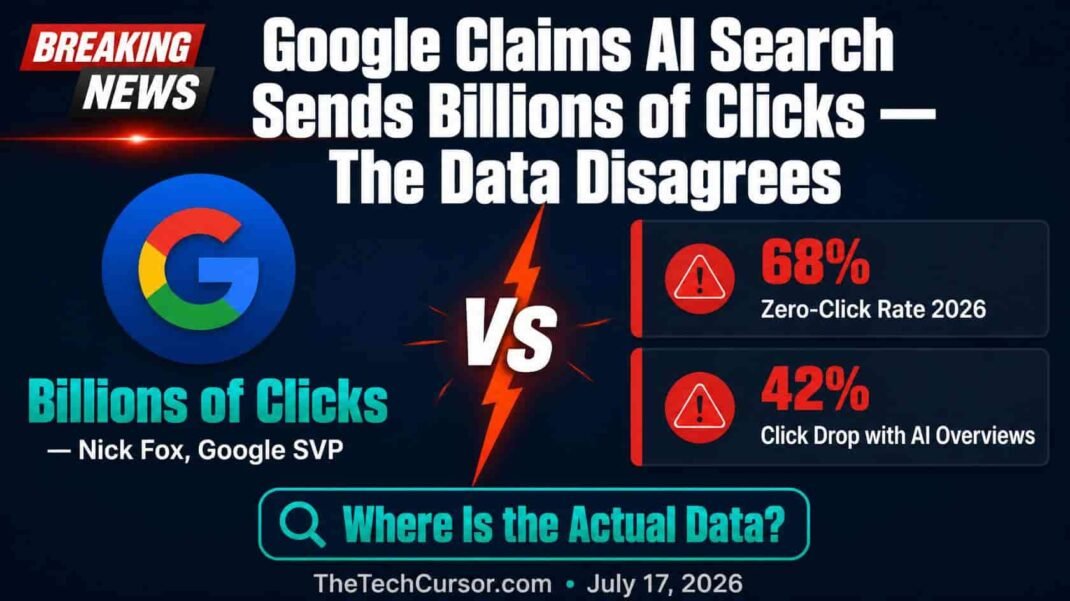
Furthermore, Fox pushed back directly against the narrative that AI search is killing organic traffic. “We’re actually seeing the opposite,” he wrote. “Turns out, when people can ask whatever questions are on their minds, they use Google Search more than ever.”
There is just one problem. The independent research does not fully support this picture — and Google still refuses to provide the click data that would resolve the debate definitively.
Table of Contents
- What Google Just Said
- The Counter-Data — What Independent Research Shows
- Why Both Things Can Be True Simultaneously
- The Missing Piece — Google Still Refuses to Share Click Data
- What Google Has Actually Done to Improve Clicks
- What This Means for Your SEO Strategy
- The Bottom Line — Trust But Verify
1. What Google Just Said
Nick Fox’s LinkedIn statement contains two distinct claims worth examining separately:
Claim 1: Google Search overall is sending billions of clicks daily. This is plausible and consistent with Google’s scale. Google processes over 8.5 billion searches per day. Even a small click-through rate produces an enormous absolute click volume.
Claim 2: AI features in Search alone are sending billions of clicks weekly. This is the more significant and more contested claim. Fox is asserting that AI Overviews and AI Mode — the features most frequently blamed for click losses — are net positive contributors to website traffic.
Fox’s framing is explicit: “We’re just getting started.” Google is presenting its AI search features not as a threat to the open web but as a traffic amplifier — expanding the volume of questions people ask and therefore the volume of clicks generated.
This is a meaningful shift in Google’s public positioning. It is the first time Google has offered a specific quantitative claim — billions weekly — about clicks driven by AI search features specifically.
2. The Counter-Data — What Independent Research Shows
The SEO community’s skepticism is grounded in real data from multiple independent sources.
The 68% zero-click finding: A 2026 zero-click study found that 68% of Google searches now end without a click to any website. That is the highest zero-click rate ever recorded — and it has risen steadily as AI Overviews have expanded. For context, zero-click rates were approximately 50% in 2020.
The 42% click reduction finding. A separate report found that Google AI Overviews cut search clicks by approximately 42% for queries where they appear. When an AI Overview resolves a query in the results page, more than four in ten clicks that would previously have gone to a website do not happen.
The practitioner experience: Beyond formal research, a significant and growing number of SEO professionals and site owners report measurable traffic declines that correlate with AI Overview expansion. These are not anecdotes — many are backed by Search Console data showing impression volumes holding steady while click-through rates fall.
These findings are not fabricated. However, they also do not necessarily contradict Google’s claim — which is where the nuance matters.
3. Why Both Things Can Be True Simultaneously
Here is the reconciliation that the debate often misses: Google’s claim and the independent research findings are measuring different things.
Google is measuring absolute click volume across a larger query base. As more people use Google Search — and as AI features encourage people to ask more questions — the total number of searches grows. If query volume increases by 40% and click-through rate falls by 30%, absolute click volume still increases. Google’s “billions of clicks weekly” claim may be accurate in absolute terms even if individual websites are receiving fewer clicks per impression.
Independent research is measuring click-through rate per query. The 68% zero-click rate and 42% click reduction figures measure what percentage of searches generate clicks — not absolute click volume. A falling CTR in an expanding query universe can coexist with a growing absolute click count.
The distribution of clicks is changing. Even if total clicks are growing, the distribution of those clicks may be concentrating on fewer websites. If AI features drive clicks toward highly-cited, authoritative sources and away from the broader long-tail of sites that previously captured informational traffic, the net effect for most site owners is negative — even as the aggregate click count grows.
As covered in TheTechCursor’s analysis of zero-click AI value, this distinction matters enormously for how site owners should interpret traffic data and adjust their strategies.
4. The Missing Piece — Google Still Refuses to Share Click Data
This is where the debate becomes genuinely frustrating for the SEO community — and where Google’s credibility on this topic is most strained.
Google recently launched AI Performance Reports in Google Search Console — a meaningful step toward transparency, as covered in TheTechCursor’s breakdown of the rollout. However, those reports show impressions, pages, countries, and devices. They do not show clicks from AI features.
Nick Fox’s statement is notable precisely because it is the first time Google has offered any quantitative claim about AI feature click volume. However, it remains an unverifiable assertion. The data behind the claim has not been shared. The methodology has not been explained. The definition of “click” has not been specified — does it include clicks within AI Mode conversations, or only clicks to external websites?
Barry Schwartz of Search Engine Land summed up the community’s response plainly: “If we are getting clicks, show us the data.”
Until Google provides verifiable, granular click data from AI features — ideally through Search Console — the “billions of clicks” claim cannot be meaningfully evaluated against the independent research showing declining CTRs and zero-click growth.
5. What Google Has Actually Done to Improve Clicks
To be fair to Google, the company has taken several concrete steps that suggest genuine attention to the clicks-to-the-web question:
Preferred sources feature: Google introduced a preferred sources system allowing users to designate specific websites they want to see more results from — a mechanism that can drive more consistent click traffic to trusted sources.
Recipe link improvements: Google updated AI Mode to better connect users with recipe creators — addressing a specific category where publisher click traffic had been significantly impacted by AI-generated content.
AI Overview link tweaks: Google has made multiple updates to how links appear within AI Overviews and AI Mode — including changes to link placement, formatting, and source attribution designed to encourage click-through.
These are meaningful steps. However, they are targeted at specific categories and use cases. They do not constitute a comprehensive solution to the broader click distribution question — and they are difficult to evaluate without the underlying data.
6. What This Means for Your SEO Strategy
For site owners and SEO professionals, Nick Fox’s statement has practical strategic implications — regardless of whether the underlying data is eventually verified.
Do not write off AI search as a traffic driver. The “AI is killing traffic” narrative, while grounded in real data, may be overstated as a universal truth. As covered in TheTechCursor’s article on zero-click AI value, AI impressions drive brand recognition, branded search lift, and assisted conversions that do not appear in standard traffic reports. The full picture of AI search value is broader than direct click measurement captures.
Focus on being a cited source, not just a ranked page. The brands benefiting most from AI search are those being cited within AI responses — not just those ranking in the blue links below AI features. As covered in TheTechCursor’s article on brand usage vs citation in AI search, being cited in an AI response is a fundamentally different visibility event than a traditional ranking — with different traffic patterns and different brand-building value.
Track AI-specific clicks separately. If Google eventually releases click data from AI features in Search Console, having a pre-established measurement framework will allow you to evaluate that data quickly. In the meantime, tracking AI referral sessions in GA4, monitoring branded search trends, and using Bing Webmaster Tools’ more transparent AI reporting gives you the most complete available picture.
Push for transparency. The SEO community’s persistent request for verifiable AI click data from Google is legitimate and important. The more site owners and SEO professionals articulate this need — through feedback channels, public commentary, and direct engagement with Google — the more pressure exists for Google to release the data that would resolve this debate.
7. The Bottom Line — Trust But Verify
Nick Fox’s statement represents the most specific quantitative claim Google has ever made about AI feature click volume. That specificity is worth noting — and worth taking seriously as a directional signal.
However, “billions of clicks weekly” is not verifiable with currently available data. The independent research showing 68% zero-click rates and 42% click reductions for AI Overview queries is real, methodologically documented, and comes from sources with no incentive to overstate the problem.
Both things are probably partially true. AI search is generating meaningful click volume in absolute terms while simultaneously reducing click-through rates per query. The distribution of those clicks may be shifting toward a smaller number of authoritative, frequently cited sources. And the experience of individual site owners — particularly those in informational content verticals — may diverge significantly from aggregate trends.
What is needed — and what Google has so far declined to provide — is click data from AI features in Search Console. Until that data exists, the debate will continue. And the most prudent response for site owners is to build for AI visibility, track every signal available, and hold Google accountable for the transparency it has promised but not yet delivered.
Pingback: Wikipedia's Traffic Loss & AI Overviews: What It Means - The Tech Cursor