
Category: Google | AI Overviews | SEO News | Legal
Read time: 6 min
Table of Contents
- What Happened in Court on Tuesday
- The Core of Penske’s Argument
- What Google Argued in Its Defence
- Why the Judge’s Reaction Matters
- The “Publishers Can Opt Out” Problem
- The OpenAI and Perplexity Comparison
- What Happens Next
- What This Means for Publishers and SEOs
- Bottom Line
The judge who ruled that Google holds an illegal monopoly in search just told Google’s lawyers that the AI Overviews situation regarding publishers “seems really unfair.”
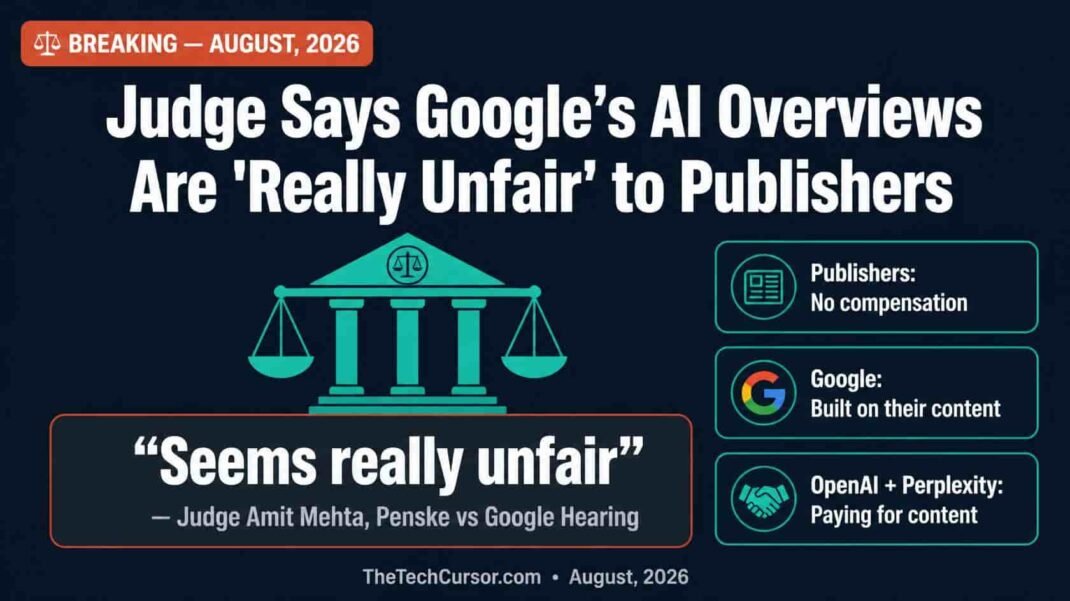
That statement — from Judge Amit Mehta during a Tuesday hearing in the Penske Media vs Google antitrust case — is one of the most significant judicial observations about AI search and its impact on publishers to emerge from any courtroom in 2026.
It is also far from the end of the case. But the direction of the judge’s thinking has become considerably clearer.
1. What Happened in Court on Tuesday
The Tuesday hearing addressed Google’s motion to dismiss Penske Media’s antitrust lawsuit — a case that has been ongoing since September 2025.
Penske Media — the publisher behind Rolling Stone, Variety, WWD, and dozens of other publications — is alleging that Google uses its monopoly position in search to force publishers into an arrangement where their content is used for AI training and AI Overviews without compensation.
The hearing’s purpose was for Judge Mehta to consider whether to grant Google’s motion to dismiss, which would end the case before it proceeds to full trial. Based on Mehta’s questions and comments at the hearing, that motion appears to face significant challenges.
Jason Kint, CEO of Digital Content Next — a trade association representing digital content creators — attended the hearing and detailed what transpired on X.
2. The Core of Penske’s Argument
Penske’s central claim is that Google’s monopoly position in search transforms what would otherwise be a voluntary arrangement into a coercive one.
The traditional exchange between Google and publishers has been straightforward: publishers allow Google to crawl and index their content, and in exchange Google drives traffic to their sites through search results. Both parties benefit. The publisher gets traffic. Google gets the content that makes search useful.
<cite index=”34-1″>Penske alleges that Google is using its monopoly position to force publishers to make their content available to Google for AI training and answers.</cite>
The argument is that AI Overviews fundamentally changed the terms of this exchange — without negotiation, without compensation, and without a meaningful ability for publishers to opt out without destroying their existing traffic. Google is now using publisher content not just to index and rank pages, but to generate AI answers that resolve queries without sending traffic back to the publishers whose content made those answers possible.
3. What Google Argued in Its Defence
Google’s legal team made two primary arguments in the hearing.
AI Overviews is a product improvement, not a new product: <cite index=”34-1″>Google’s attorneys explained that AI Overviews is a “product improvement” and described the traditional arrangement in which publishers let Google crawl their content in exchange for search traffic as a “vague historical course of dealing.”</cite>
By framing AI Overviews as a natural evolution of search rather than a separate product built on publisher content, Google argues that Penske cannot claim antitrust harm from a product improvement.
Publishers can always opt out: Google has also argued that publishers retain the ability to opt out of indexing entirely — and now have specific opt-out mechanisms for AI Mode and AI Overviews through Search Console settings. Therefore, according to Google, participation in the arrangement is voluntary.
Both arguments failed to convince the judge.
4. Why the Judge’s Reaction Matters
Judge Mehta’s pushback on Google’s arguments was pointed and specific.
<cite index=”34-1″>Mehta pushed back: the situation “all seems really unfair.” Mehta noted publishers lack control over how Google uses their content and described Google’s “product improvement” as being built “on the backs of the publishers.” Importantly, he said product improvements “are not immune from antitrust scrutiny.”</cite>
That last observation — that product improvements are not immune from antitrust scrutiny — directly undercuts Google’s primary defence. If the fact that AI Overviews represents a product improvement automatically shielded it from antitrust claims, Penske’s case would have no legal basis. Mehta’s comment signals he does not accept that framing.
Furthermore, Mehta’s observation that the arrangement is built “on the backs of the publishers” reflects an understanding of the economic reality that publishers have articulated for two years: the content that makes AI Overviews valuable belongs to publishers, and those publishers are seeing traffic decline as AI Overviews resolve queries without sending clicks.
5. The “Publishers Can Opt Out” Problem
Google’s opt-out argument is technically accurate — and practically insufficient, which is exactly what the hearing examined.
Publishers can opt out of Google indexing entirely by blocking Googlebot in their robots.txt. They can now also use Search Console settings to opt out of AI Mode and AI Overviews specifically. Google has presented these options as evidence that the arrangement is voluntary.
However, the opt-out is not genuinely voluntary when opting out destroys the publisher’s existing business. A publisher that blocks Google from indexing its content loses the organic search traffic that drives advertising revenue. A publisher that opts out of AI Overviews may avoid having its content used in AI answers — but may also lose whatever traffic crumbs AI Overviews send alongside the zero-click resolution of queries.
As covered in TheTechCursor’s analysis of Google’s claim that AI features send billions of clicks weekly, the independent research showing 68% zero-click rates and 42% click reductions for queries with AI Overviews suggests the traffic exchange has already shifted dramatically in Google’s favour.
The judge appeared to recognize this dynamic. An opt-out that requires the publisher to accept commercial destruction is not meaningful — and Mehta’s questions reflected skepticism about whether the theoretical ability to opt out translates to a practical ability to do so without severe harm.
6. The OpenAI and Perplexity Comparison
One of the most significant moments in the hearing came when Judge Mehta raised the contrast between Google’s approach and that of competing AI companies.
<cite index=”34-1″>The judge noted that other AI companies are paying for content whereas Google is using their search monopoly to ingest all of the internet and not pay a single dime for it.</cite>
This observation is legally significant because it undermines Google’s “product improvement” framing differently. If AI content ingestion requires compensation — as the market behaviour of OpenAI, Perplexity, and other AI companies demonstrates — then Google’s ability to obtain the same inputs at zero cost is not simply a feature of a better product. It may be an anticompetitive advantage derived from its monopoly position in search.
<cite index=”34-1″>Penske pointed to OpenAI and Perplexity as Google competitors paying for content while arguing Google uses its search monopoly to obtain the same inputs at zero — raising rivals’ costs and barriers to entry.</cite>
OpenAI has struck licensing deals with news publishers. Perplexity has launched a publisher revenue-sharing program. Both companies faced market pressure to compensate publishers — pressure that Google’s dominant search position allows it to avoid.
If the court accepts this framing, it transforms the publisher relationship from a business arrangement where both parties benefit into an anticompetitive practice where Google’s monopoly position allows it to extract value from publishers without fair compensation.
7. What Happens Next
Mehta has not yet ruled on Google’s motion to dismiss. A ruling could come in the coming weeks or months.
If Mehta denies the motion to dismiss, the case proceeds to discovery and potentially to trial — where Google would face examination of its internal documents and communications about AI Overviews and publisher relationships. Given that Mehta already ruled Google maintains an illegal monopoly in the 2024 United States v. Google case, the factual foundation for Penske’s antitrust claims is partially established.
If Mehta grants the motion to dismiss, the case ends — though Penske could appeal. Given Mehta’s questions and comments at Tuesday’s hearing, granting the dismissal appears less likely.
The broader implications extend beyond Penske specifically. A ruling that publisher antitrust claims against Google’s AI Overviews are legally viable could open the door to similar cases from other publishers — and to regulatory intervention that would require Google to compensate publishers for content used in AI training and AI answers.
8. What This Means for Publishers and SEOs
For publishers and SEO professionals, the Penske hearing is significant for several reasons that extend beyond its immediate legal outcome.
The traffic-for-crawling deal is under formal legal scrutiny. The arrangement that has defined the publisher-Google relationship for two decades — content in exchange for traffic — is now being examined by a court that has already found Google holds an illegal monopoly. The outcome of that examination will shape how publishers can and should think about their relationship with Google going forward.
Opt-out mechanisms are becoming more important. As covered in TheTechCursor’s earlier article on AI Overviews and zero-click search, publishers should understand their opt-out options in Search Console and make deliberate decisions about which AI features they participate in — rather than accepting the default arrangement passively.
The compensation question is not going away. The market behaviour of OpenAI and Perplexity — both of which have moved toward publisher compensation — suggests that content licensing is emerging as a standard expectation for AI companies using publisher content. If Google is compelled by an antitrust ruling or regulation to follow suit, the economics of publishing and SEO change significantly.
The broader AI content use debate is accelerating. The Penske case is one of multiple legal and regulatory challenges to the ways AI companies use publisher and creator content. The outcomes of these cases will collectively determine the legal and commercial framework within which AI search operates — with implications for every publisher, content creator, and SEO professional who depends on Google search for visibility and traffic.
9. Bottom Line
Judge Mehta’s observation that Google’s AI Overviews situation “seems really unfair” to publishers is not a ruling — but it is a clear signal about where the court’s thinking is heading. His pushback on Google’s “product improvement” defence, his recognition that the opt-out is not genuinely voluntary, and his observation about competing AI companies paying for content all suggest that Penske’s case has survived its most immediate legal challenge.
The case continues. The outcome is uncertain. However, the direction of travel is becoming clearer: the two-decade arrangement between Google and publishers — content in exchange for traffic — is under serious legal and commercial pressure. How it resolves will shape the future of search, AI, and the economics of digital publishing for years to come.