
Read time: 7 min
Salesforce announced on October 20, 2026, that it has signed a definitive agreement to acquire Braze, a leading customer engagement platform. The deal values Braze at approximately $5.66 billion in enterprise value. Braze shareholders will receive $47.50 in cash per Class A share.
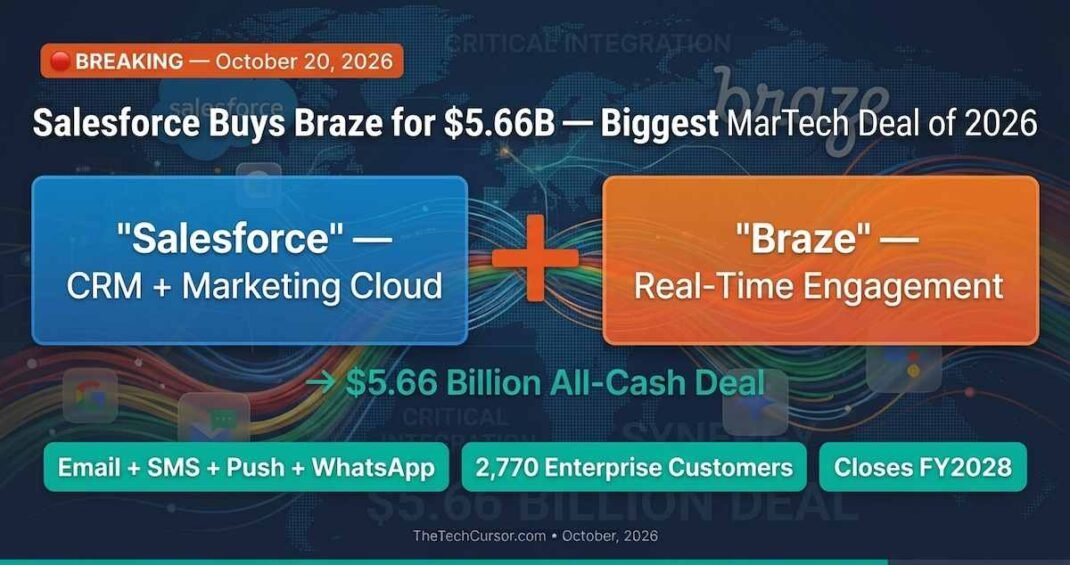
This is the largest marketing technology acquisition of 2026. It is also Salesforce’s biggest single marketing investment since it bought ExactTarget in 2013, the deal that created Marketing Cloud. Braze costs more than twice as much as ExactTarget did.
1. What Was Announced
Salesforce has agreed to acquire Braze for approximately $5.66 billion in enterprise value. The deal is expected to close during Salesforce’s fiscal year 2028, which begins in early February 2027. It still needs regulatory clearance and approval from Braze shareholders.
Investors reacted cautiously at first. Salesforce shares fell 2.6% in premarket trading after the announcement, which suggests some doubt about such a large acquisition. Braze shares, by contrast, jumped about 51%. The all-cash offer carried a 58% premium over Monday’s close of $30.04.
2. What Braze Actually Is
To see why this deal matters, you first need to know what Braze does and why it is valuable to Salesforce.
Braze helps marketers respond to customer behaviour in real time. It coordinates personalized experiences across mobile apps, websites, email, SMS, WhatsApp, and more. Its cloud-native, event-streaming architecture suits high-volume, real-time B2C engagement. It updates customer profiles continuously, adapts customer journeys as behaviour changes, and powers trillions of messages and journey actions each year.
The platform has roughly 2,770 to 2,790 customers, including Canva, Dairy Queen, Equinox, Instacart, Urban Outfitters, and Venmo.
The key phrase is “event-streaming architecture.” Traditional marketing automation tools send messages on predefined schedules or simple triggers. Braze, however, processes customer behaviour events as they happen. Consider a user who abandons a cart at 2:47 pm. That user can receive a perfectly timed push notification at 2:52 pm and a follow-up email at 3:15 pm. A WhatsApp message can follow the next morning. A single platform coordinates all of it, responding to behavioural signals as they occur.
In addition, BrazeAI extends these capabilities with AI-powered optimization across content, offers, channels, and timing. It helps marketers make each interaction more relevant.
3. The Deal Terms
Salesforce is buying Braze in an all-cash deal valued at $5.66 billion. The fixed payout removes any uncertainty about what the shares are worth between announcement and closing.
Braze shareholders therefore receive $47.50 per Class A share regardless of how Salesforce’s stock performs. The deal has no stock component, so shareholders carry no exposure to Salesforce equity risk.
Salesforce does not expect the deal to change its fiscal 2027 guidance, and it has not yet issued guidance for fiscal 2028. The structure thus avoids disrupting Salesforce’s near-term financial commitments. That matters to investors who are judging whether the acquisition price is defensible.
How the price compares
The price is steep by marketing software standards. It equals roughly 6.8x Braze’s trailing twelve-month revenue of $834 million. On forward numbers, it is about 6.2x Braze’s fiscal 2027 revenue guidance of $910 million to $913 million. The day before the announcement, Braze traded at only 3.7x revenue. Marketing software as a group traded around 3x.
Braze’s recent numbers help explain the premium:
- Revenue: The latest quarter, reported September 8, brought in $227.2 million, up 26% and about $6.9 million above consensus.
- Efficiency: Operating expenses grew just 6% year over year, to $170 million. Free cash flow hit a quarterly record of $21.7 million, and Braze held $413.9 million in cash.
- Customer growth: Customers paying $500,000 or more per year rose to 361 from 282. Net revenue retention reached 110% overall and 112% for large customers.
The deal looks less generous from Braze’s side, though. Despite the strong quarter, the stock fell 25.1% the week after earnings. Investors worried about moderating growth and AI revenue that remains small. The $47.50 price also sits below Braze’s 2021 IPO price of $65.
4. Why Salesforce Is Paying $5.66 Billion
Patrick Stokes, President of Applications and Marketing at Salesforce, laid out the strategic rationale in the announcement press release:
“Every interaction is an opportunity to wow your customers,” said Patrick Stokes. “Most of that wow comes from knowing your customer, and responding at just the right moment. Braze was built to turn live customer behavior into personalized engagement at scale. Bringing that capability together with Salesforce Marketing Cloud, CRM, and Data 360 will deliver that wow moment in every customer interaction.”
Salesforce is closing a gap between two things. Its CRM knows customers well. Acting on that knowledge at the right moment, across the right channels, is harder. Marketing Cloud provides the email and campaign layer. Real-time, event-driven engagement across mobile, SMS, and messaging apps, however, has been a weak spot.
Braze fills that gap directly. It is not a theoretical addition. It is a proven platform that already processes trillions of messages a year for major consumer brands.
5. Salesforce’s 2026 Acquisition Spree: $10.8B Spent
The Braze deal is not an isolated move. It is the third major acquisition Salesforce has announced in 2026, and the largest.
Salesforce has committed about $10.8 billion in disclosed prices across three deals this year:
- Contentful: $1.5 billion
- Fin: $3.6 billion
- Braze: $5.66 billion
That total excludes a reported $2 billion for Listen Labs, an AI customer research and simulation startup.
The pattern reveals a consistent strategy. Contentful is a headless CMS, so it covers the content layer. Fin is an AI customer service platform, which covers the service layer. Listen Labs offers AI-powered customer research and covers the insights layer. Braze brings real-time customer engagement, the activation layer.
Together, these deals assemble a complete AI-powered customer experience stack. That stack can compete directly with Adobe Experience Cloud, which has dominated the enterprise marketing technology conversation for several years.
6. How Braze Will Integrate With Salesforce
Salesforce plans to integrate Braze’s capabilities with Marketing Cloud, Data 360, Customer 360, and Agentforce. Each integration point addresses a specific capability gap.
- Marketing Cloud integration puts Braze’s real-time, event-driven engagement alongside Marketing Cloud’s campaign planning and email execution. Marketers will orchestrate complex journeys in a single workflow. One journey can combine Marketing Cloud email campaigns with real-time push notifications and SMS from Braze.
- Data 360 integration connects Braze’s customer behaviour data with Salesforce’s unified customer data platform. Braze tracks actions such as app opens, in-app purchases, and message engagement. These actions flow into the unified customer profile. Teams can then use them for segmentation and targeting across all Salesforce products.
- Agentforce integration is the most forward-looking of the four. Agentforce is Salesforce’s AI agent platform, which lets autonomous agents act on behalf of customers and marketers. Connecting Braze’s real-time behavioural signals to Agentforce makes proactive AI engagement possible. Agents could reach customers at the right moment based on behavioural triggers, without manual campaign setup.
7. What Happens to Braze Customers
For Braze’s 2,770 existing customers, the immediate question is practical. Will the acquisition disrupt a platform they rely on for millions of daily customer interactions?
Acquisitions like this usually follow a predictable pattern. Between announcement and close, which runs into fiscal year 2028, Braze operates independently. Customers should see no changes to their contracts, pricing, or platform functionality during that time.
After close, integration work begins. Platform integrations at this scale carry two customer-facing risks. First, Salesforce may de-emphasize Braze-native features in favour of Salesforce-native equivalents. Second, standalone Braze pricing may change as the platform joins Salesforce’s bundled offering.
Even so, the outlook is not all negative. Braze customers who also use Salesforce CRM, Marketing Cloud, or Service Cloud may find that integration greatly improves how they act on the data they already hold in Salesforce. This segment represents a meaningful portion of Braze’s enterprise customer base. For these customers, the acquisition may be genuinely positive.
8. The Competitive Landscape After the Deal
The Salesforce-Braze combination creates a more formidable rival to Adobe Experience Cloud in enterprise marketing technology. It also reshapes the competitive position of several standalone platforms.
- Adobe Experience Cloud is the most direct competitor to the combined Salesforce marketing stack. Adobe offers Campaign for cross-channel messaging, Target for personalization, and Analytics for behavioural data. The Braze deal closes gaps in Salesforce’s real-time mobile engagement, but Adobe has not left that area open.
- HubSpot mainly serves mid-market companies, not the enterprise segment where Braze and Salesforce Marketing Cloud compete. Consequently, the acquisition has limited direct impact on HubSpot’s position. Jefferies considers a HubSpot takeover unlikely, though a private equity buyer would be the more plausible route if one ever happens.
- Klaviyo is a specialist email and SMS platform focused on ecommerce. Braze overlaps with Klaviyo in mobile and SMS but serves larger enterprise customers. The Salesforce deal accelerates Braze’s move upmarket. That may reduce direct overlap with Klaviyo, yet it increases pressure on Klaviyo’s upper mid-market aspirations.
- Independent messaging platforms such as Iterable and OneSignal compete with Braze in specific segments. Braze combined with Salesforce’s distribution and enterprise relationships puts competitive pressure on independent alternatives across the board.
- Twilio may feel the effect too, according to Jefferies. Salesforce could rely less on outside messaging providers or push them to cut prices.
What analysts say
Jefferies reacted on October 21. It kept its Buy rating and $300 price target on Salesforce. The firm sees the deal as a way to refresh Salesforce’s marketing and commerce offerings and compete with Adobe. It also warned that the deal “could spark further consolidation across the software industry.” Jefferies named Klaviyo as a potential takeover candidate. It pointed to other recent software buyouts, such as CCC Intelligent Solutions ($6.1 billion) and Varonis ($6.3 billion).
9. What This Means for Digital Marketers
The acquisition has several practical implications for marketers who use Salesforce, Braze, or competing platforms.
If you use Salesforce Marketing Cloud today, the deal gives you a roadmap toward much stronger real-time, mobile-first engagement inside the Salesforce ecosystem. Full integration, however, will not arrive before fiscal year 2028 at the earliest. Plan your capability development timeline accordingly.
If you use Braze today, your platform is not going away. Pricing and packaging will likely change, though, as Salesforce folds Braze into its product catalogue. Companies that also use Salesforce CRM have a chance to evaluate deeper integration. Otherwise, monitor how the product roadmap evolves after close.
If you use a competing platform, expect a stronger rival in enterprise marketing technology. Ask whether your platform’s roadmap is adequate against the integrated Salesforce stack. Ask too whether your vendor has the scale to sustain investment in an increasingly competitive market.
The AI angle. The Agentforce integration is the most strategically significant long-term development for digital marketers. AI agents that engage customers autonomously, based on real-time behavioural signals, would fundamentally change how marketing automation works. This capability is 12 to 24 months from being production-ready at scale. Marketers who understand its trajectory will be better positioned when it arrives.
10. Bottom Line
Salesforce’s $5.66 billion acquisition of Braze is the defining marketing technology deal of 2026. It fills the most significant gap in Marketing Cloud: real-time, event-driven engagement across mobile, SMS, and messaging channels. It also positions Salesforce as a more complete competitor to Adobe in enterprise marketing technology.
For digital marketers, the implications unfold over two timeframes. Before close, expected in early 2028, nothing changes operationally. After close, Braze’s real-time engagement will join Salesforce’s CRM, data, and AI agent capabilities. The result will be a marketing technology stack that no standalone platform can match in breadth.
The Three Things to Watch
- The regulatory review. Large enterprise software acquisitions face increasing antitrust scrutiny. The deal is not guaranteed to close as announced.
- The Agentforce integration roadmap. How quickly Salesforce connects Braze’s behavioural signals to its AI agent platform will decide whether the deal delivers on its most ambitious promise.
- Adobe’s response. Adobe has consistently answered Salesforce’s marketing technology advances with counter-moves of its own. Watch for an acquisition or product announcement that addresses the gaps Braze closes for Salesforce.