
Read time: 7 min
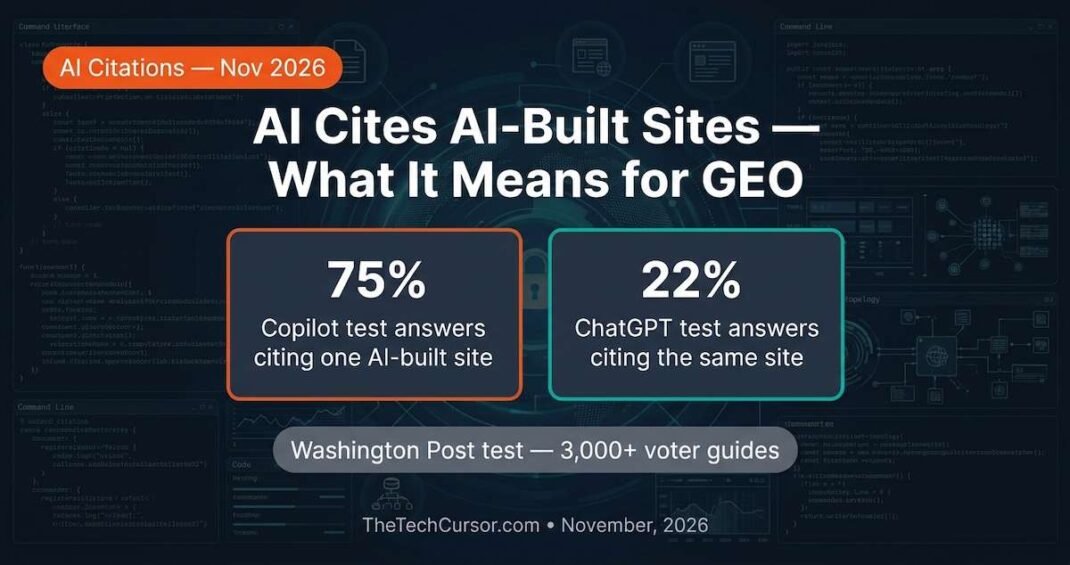
A Washington Post investigation found that AI chatbots leaned on a few obscure, AI-built websites when asked for US midterm election information. Microsoft Copilot cited one of those sites, the Ballot Brief, in 75% of the test answers. ChatGPT cited it in 22%.
The midterm elections take place on November 3, 2026. However, the story matters beyond politics. It shows how a thin, new site can win citations from major AI systems, and why being cited does not equal being trustworthy.
1. What the Test Found
The Post tested chatbots by asking them to build voter guides. Three small sites kept appearing as sources: the Ballot Brief, DecodeTheVote, and Smarter.Vote.
The Ballot Brief stood out. Furthermore, Copilot, Perplexity, and ChatGPT each cited it substantially, according to the Post. It was also the most cited source in Copilot’s answers.
Moreover, the Post found factual errors on the site. These included mistakes in how ZIP codes mapped to congressional districts. Copilot repeated at least one error to a user.
2. How the Test Worked
The Post worked with a data firm called Promptwatch. Together, they tested chatbots from OpenAI, Anthropic, Google, Microsoft, Amazon, and Perplexity.
The requests used a random address in every US county and were sent on September 23, 2026. Then the Post analyzed more than 3,000 AI-generated voter guides.
Separately, the chatbots often failed to name the voter’s congressional district at all. That happened in 48% of guides. Among the guides that did name one, 22% named the wrong district.
3. The Story of the Ballot Brief
The Ballot Brief was built by one person, Ben Torres Ezrick. He wanted a single place for voters to look up candidates. Because there were thousands of candidates, he used teams of AI agents to research profiles and fill the site.
By the Post’s testing, the effort succeeded in winning citations. Additionally, Ezrick said his own data showed Microsoft’s AI systems consulted the site more than 680,000 times over 30 days across September and October. That figure is his own claim.
The site did not earn trust through a long reputation. Instead, it earned visibility by being easy to retrieve and well organized for the exact questions voters asked.
4. How the Companies Responded
However, the responses differed.
ChatGPT used the Ballot Brief as its top source in September. After the Post shared its results, that share fell to 4% in a second round of tests.
Microsoft said it was looking into the results. Also, it said it was committed to providing accurate, high-authority election information. One report adds that Microsoft adjusted its tool to favour authoritative sources and official state election sites.
One report says Claude mainly cited established nonprofit voter guides in the first round. However, in the second round it began linking to the Ballot Brief frequently. Anthropic did not explain the change. It said it had tested its models and strengthened safeguards before the midterms.
Anthropic and OpenAI pointed to partnerships with Democracy Works. Amazon said it paused Alexa’s ability to create voter guides.
5. Why This Matters for AI Search and GEO
Overall, the main lesson is simple. In AI search, citation and trust are different things.
AI systems retrieve sources that match the question, are easy to read, and appear fresh. A new site built around those qualities can win citations before it earns authority. That is an analysis, not a finding of the Post.
Therefore, this creates a two-sided issue for brands. First, errors from a weak source can flow into AI answers about your topic or your brand. Second, strong, authoritative sources can lose citations if their information is hard to retrieve.
The GEO pillars framework treats credibility, structure, freshness, and reach as parts of one system. This test shows why structure and freshness matter alongside credibility.
6. What the Test Does Not Prove
Still, a few cautions help avoid overreading the numbers.
The 75% and 22% figures come from this specific test. They do not mean Copilot or ChatGPT cite the site at those rates for all election questions. The test used a narrow type of request.
The Post’s results also changed quickly. For example, ChatGPT’s share dropped after the findings were shared. Therefore, the numbers describe a moment, not a permanent state.
Finally, some secondary figures come from outlets’ own arithmetic. For example, one outlet estimated that roughly four in ten guides named the right district. That is a derived number, not a Post figure.
7. What Brands and Publishers Should Do
Consequently, the practical lessons apply to any topic, not only elections.
- Check what AI says about you. Run regular prompts about your brand and category. The AI visibility dashboard guide shows how to track this.
- Trace errors to their source. When an AI answer is wrong, find which site it cited. The brand AI visibility guide explains how to measure accuracy.
- Make your best information easy to retrieve. Use clear pages, accurate structured data, and current content.
- Publish original, accurate information. Content with real added value is harder to replace. The AI content watermark article explains why original information matters more than who typed the words.
- Avoid copying the mass-AI-site tactic. Google is investing in detecting this kind of activity, as the SAFE spam detection article explains.
Finally, for readers, the advice is simple. For election details, check official state and local election websites.
8. Bottom Line
A Washington Post test found that major chatbots relied on a few AI-built voter sites. Copilot cited one of them in 75% of test answers, and ChatGPT cited it in 22%. The site contained errors that reached some answers. Companies responded, and ChatGPT’s reliance then dropped quickly.
The Takeaway
Being cited by an AI system is not proof of quality. Therefore, brands should monitor what AI says, make their authoritative information easy to retrieve, and correct errors at the source.