
Read time: 5 min
Google has officially confirmed that the November 2026 core update has finished rolling out. The update, which began on November 10, completed on November 24, 2026, after approximately 14 days.
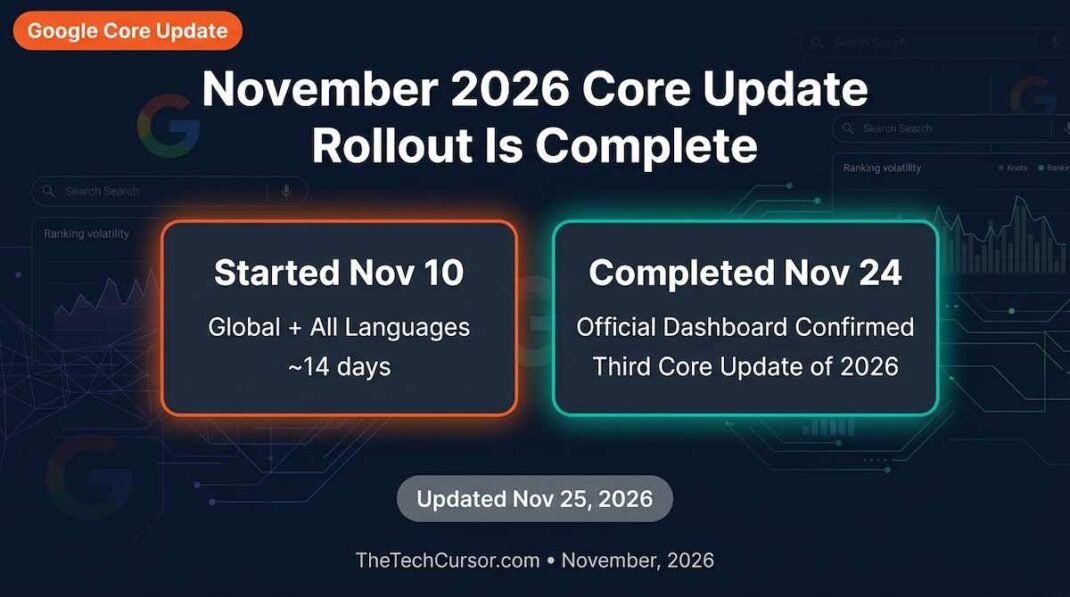
This marks the end of the third broad core update of 2026. Site owners and SEOs can now begin the careful process of evaluating impact — but only after following Google’s recommended waiting period.
Official Confirmation
Google updated its Search Status Dashboard with the following note:
“The rollout was complete as of November 24, 2026.”
The dashboard shows the incident began at 10:06 a.m. Pacific Time on November 10 and ended at 6:03 a.m. Pacific Time on November 24. The total duration was roughly 13 days and 20 hours — within Google’s original “up to two weeks” estimate.
Timeline of the November 2026 Core Update
This was Google’s third core update of the year, following the March 2026 and May 2026 core updates. Several spam updates also occurred earlier in 2026.
What Google Said About the Update
When the update launched, Google described it as:
“A regular update designed to better surface relevant, satisfying content for searchers from all types of sites.”
Like other core updates, it is not a penalty targeting specific sites or page types. Instead, it re-evaluates content quality and relevance signals across the entire web. Rankings can rise or fall depending on how well pages meet Google’s evolving standards for helpful, reliable, and people-first content.
For earlier coverage of this update while it was still rolling out, see our previous article: Google November 2026 Core Update: What We Know So Far.
What This Means for Site Owners
Now that the rollout is complete, ranking fluctuations should begin to stabilize. However, Google strongly advises against making immediate judgments based on data from the rollout period itself.
Key points to remember:
- Core updates are broad systems improvements, not manual actions or spam penalties.
- Traffic changes during the 14-day window do not automatically mean a site was “hit” or “rewarded.”
- Some sites may see delayed effects as the systems continue to settle.
- Holiday traffic (Thanksgiving, Black Friday, Cyber Monday) will overlap with the first full week after completion in many markets, which can complicate analysis.
How to Analyze Your Data Correctly
Google’s official guidance remains consistent:
- Confirm the update has finished on the Search Status Dashboard.
- Wait at least one full week after the completion date before analyzing performance.
- Compare a full week of post-update data with a comparable week from before the update started.
For this update, a practical comparison would be:
- Pre-update week: November 3–9, 2026
- Post-update week: November 25 – December 1, 2026 (or later once holiday noise settles)
When reviewing Search Console:
- Look at queries, pages, and countries separately.
- Check whether losses or gains are concentrated on specific content types.
- Avoid making major content changes based on incomplete or holiday-skewed data.
Looking Ahead: December 2026 Core Update
Shortly after confirming the November update was complete, Google also pre-announced a December 2026 core update on the Search Status Dashboard. No exact start date has been given yet — only that it is scheduled for release in December 2026.
This means SEOs should expect another period of ranking volatility before the year ends.
Bottom Line
The Google November 2026 core update is now fully rolled out. It lasted just under two weeks and followed the same “regular core update” framing Google has used throughout 2026.
The most important next step for most sites is patience. Wait the recommended full week, then carefully compare clean data windows. Focus on whether your content continues to demonstrate helpfulness, expertise, and user satisfaction rather than reacting to short-term ranking swings.
As always, the sites that consistently produce useful, original, and well-structured content tend to recover or improve after core updates — even if they experience temporary volatility during the rollout.