
Read time: 6 min
Google began rolling out its November 2026 core update on Tuesday, November 10. It applies globally and to all languages. Google says the rollout may take up to two weeks.
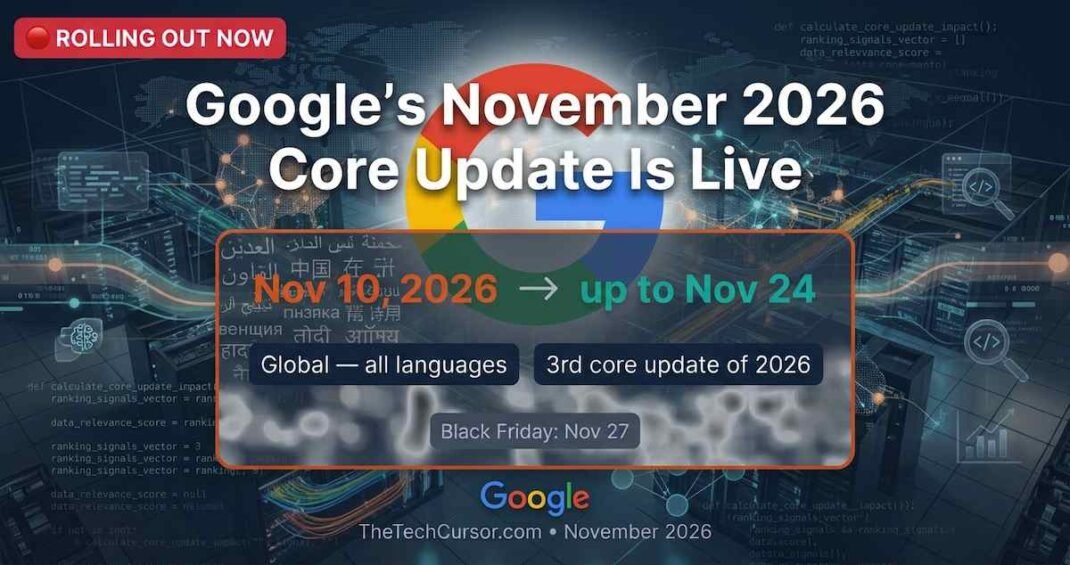
This is the third core update of 2026. SEOs had expected one for weeks, so the confirmation ends a period of speculation. However, Google has shared very little about its goals.
1. What Google Announced
Google logged the update on its Search Status Dashboard at 10:06 a.m. Pacific time on November 10. The entry says it released the November 2026 core update, which applies globally and to all languages.
Google described it as a regular update. Specifically, its stated aim is to better surface relevant, satisfying content from all types of sites. The company’s Search Central account also announced it.
Core updates are broad changes to Google’s ranking systems. Google announces them because they can shift results widely. Moreover, they can affect features beyond blue links, including Discover and featured snippets.
2. The 2026 Update Timeline
The table shows how this update fits among recent ones. Dates come from reports of Google’s dashboard.
| Update | Dates | Length |
|---|---|---|
| December 2025 core update | Late 2025 | About 18 days |
| March 2026 core update | From March 27 | About 12 days |
| May 2026 core update | May 21 to June 2 | 12 days |
| September 2026 spam update | Completed October 8 | About 13.5 days |
| November 2026 core update | From November 10 | Up to two weeks |
One report counted 23 earlier core updates. Their median rollout was about two weeks. Therefore, a finish between November 22 and 24 is plausible, though Google gives no exact date.
3. What Google Has Not Said
First, Google named no specific objectives for this update. The dashboard entry and the social post gave none. Also, no Search Central blog post accompanied the announcement.
Second, Google shared no new guidance specific to this update. However, existing advice on core updates still applies.
Consequently, any claim about what the update “targets” is speculation. That includes the forecast in our earlier core update and AEO/GEO analysis, which predicted a focus on scaled AI content. Google has not confirmed that.
4. Why the Timing Matters
The rollout may run until November 24. That is three days before Black Friday on November 27.
Therefore, ecommerce and seasonal sites should pay attention. Ranking shifts during a core update can affect traffic in the highest-value shopping period of the year.
Some SEOs also saw movement around November 9, before the announcement. Ranking volatility often appears before Google confirms an update. Even so, only the dashboard confirms a named update.
5. What to Do During the Rollout
Resist the urge to react. Because core updates roll out gradually, early movement may not reflect the final outcome.
- Do not make big changes. Large edits mid-rollout make results hard to interpret.
- Record a baseline. Save your Search Console data for the weeks before November 10.
- Check that the movement is organic. Review the performance report first. Rule out tracking errors, seasonality, and technical issues.
- Watch the dashboard. Google posts the completion notice there.
Meanwhile, do not assume a drop is permanent. Many sites see swings that settle.
6. What to Do After It Finishes
Google’s guidance recommends waiting at least a full week after the update completes. Then compare Search Console data from that week with the week before the rollout began.
Next, segment the data. Look at which pages, queries, and countries changed. A drop on a few pages tells a different story from a sitewide decline.
Then review the results themselves. Look at what types of pages now rank. Also check whether your page still meets the intent as directly as it does. The Google 14-point content quality checklist offers a structured way to assess content quality. If pages fell, the site recovery guide explains why improvement takes time.
7. What Not to Assume
Still, a few points help avoid common mistakes.
A core update does not set one universal rule that every site can optimize for. It is not a penalty either. Instead, rankings change because the relative assessment of pages changes.
Do not link every drop to AI content. For example, some sites with human-written content may fall, and some with AI assistance may rise. Google has not said which way the update leans.
Also, keep earlier events separate. The September 2026 spam update and the SAFE detection system targeted manipulation. A core update is a different kind of change.
8. Bottom Line
Google’s November 2026 core update began on November 10 and may run until about November 24. It is global, covers all languages, and comes with no stated objectives. Therefore, wait for completion, then compare a full week of data before drawing conclusions.
The Takeaway
Stay calm and measure. Therefore, record your baseline, avoid reactive changes, and judge the update only after it finishes. Track AI visibility too, using the AI visibility dashboard guide.
9. Sources Reviewed
This article draws on the reports below, reviewed on November 11, 2026. Update details may change as the rollout continues. Check Google’s Search Status Dashboard for the official status and completion notice.
- Google November 2026 core update rolling out now
- Search Engine Roundtable — Google November 2026 Core Update Is Rolling Out
- PPC Land — Google’s core update may run until three days before Black Friday
- PPC Land — Google’s core update shifts rankings for up to 2 weeks before Black Friday
- Relevant Audience — Google November 2026 Core Update: Dates and What to Check
- DEV Community — Google’s November 2026 Core Update Is Rolling Out Globally: What to Monitor
- Justia Onward — Google’s November 2026 Core Algorithm Update Is Now Rolling Out
- Keywords Everywhere — Is Google Updating Right Now?
Pingback: Gemini 4 Hydrogen Is Now AI Mode’s Default: AI Visibility - TheTechCursor
Pingback: Google November 2026 Core Update: Day 10 Status - TheTechCursor
Pingback: Google's Content Advice: Replace Generic Listicles With Expertise - TheTechCursor
Pingback: Google November 2026 Core Update Rollout Is Now Complete - TheTechCursor
Pingback: Google Preannounces December 2026 Core Update: Not Live Yet - TheTechCursor