
Read time: 8 min
Amazon’s Ring announced a flying indoor security camera on November 10, and the usual reaction is some mix of “cool” and “wait, what?” Both are fair. The idea is useful. It also puts a moving, recording device inside your home, and that deserves a closer look than a launch-day headline gives it.
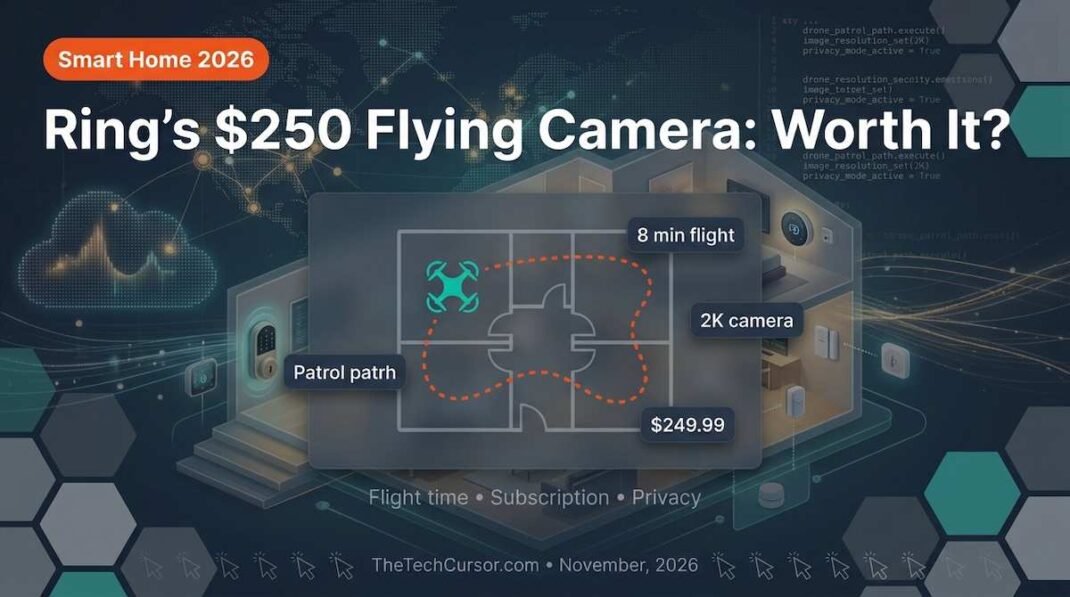
1. What Ring Actually Announced
Ring unveiled two devices under a new “Ring Robotics” label. The Ring Drone Cam is a $249.99 indoor flying camera for homes. The Ring Rover Cam is a $999.99 patrol robot for businesses, built from Amazon’s Astro robot.
The drone isn’t a new idea. Ring first showed it in 2020 as the Always Home Cam, and earlier versions never reached customers. Founder Jamie Siminoff has said earlier designs packed in too many sensors, which added weight and power demands. The new version offloads much of the thinking to the cloud.
Timing: The Drone Cam is due to ship in the US on January 27, 2027, but it hasn’t yet received the FCC authorization needed to be sold. Ring says it’s in the process of obtaining it. The Rover Cam is open for preorder and ships from December 16.
2. How the Drone Cam Works
During setup, you carry the drone through your home so it can build a map. Ring’s AI system, called AI Pilot, identifies rooms and suggests patrol points such as doors and windows. You can edit routes, schedule flights, or launch it manually from the Ring app.
It can also react to other Ring devices. If a sensor, alarm, or camera is triggered, the drone flies to a preset spot to investigate. It also works with Amazon’s Alexa Home Map.
Between flights, it sits in its dock with the camera off.
3. Specs at a Glance
| Feature | Detail |
|---|---|
| Price | $249.99 |
| Camera | 2K, 148° field of view, rotates 360° |
| Night use | Two built-in LED lights |
| Weight | About 165 grams |
| Flight time | Up to 8 minutes per flight (Ring’s spec page) |
| Charging | Roughly 8 minutes of charging per minute of flight, according to launch reports |
| Coverage | Indoor only; one report cites homes up to 3,500 sq ft |
| Ship date | January 27, 2027, pending FCC authorization |
| Subscription | Ring Protect needed for scheduled patrols and video features; 30-day trial included |
4. The Case For It
A fixed camera sees what’s in front of it and nothing else. If your question is whether a back window is open or whether someone moved through the upstairs hallway, a roaming camera answers what a stationary one can’t.
One device can also cover several rooms, which beats buying a camera for each. And because it’s off while docked, it isn’t recording your living room around the clock, which may suit people who dislike always-on cameras.
5. The Limits Nobody Should Skip
This is where reading past the headline pays off.
Short flights. Eight minutes at best, and about 40 minutes of charging after a five-minute flight. It’s built for quick checks, not continuous watching. If something happens while it’s recharging, it may be unavailable.
It needs the cloud. Navigation runs through Ring’s cloud AI. Reviewers report that if the connection drops, the drone is designed to land immediately. Make sure its route doesn’t pass over anything fragile.
It’s loud on purpose. Siminoff has said the buzzing is intentional, as a deterrent. That’s great for scaring off a burglar and less great at 2 a.m. if your family is asleep or you have a nervous pet.
A subscription is part of the deal. Scheduled patrols and video review need a Ring Protect plan. Ring hasn’t given the price in the announcement, so the true cost of ownership is still unknown.
It may not ship on time. Without FCC authorization, Ring can’t sell it. Siminoff has said the drone complies and is assembled in the US, but the date is not guaranteed.
6. The Privacy Questions
Ring says the camera is physically shuttered while docked, there are LED indicators when it records, and footage is protected by its TAKE encryption. One report says TAKE rotates keys every five minutes and purges Ring’s copies after a day, though that comes from a single source, so treat it cautiously.
The history matters here. Ring settled with the FTC in 2023 over employees accessing customer videos, and critics have long raised concerns about police access to doorbell footage. That’s not proof of a problem with this device, but it’s fair context when you’re inviting a camera to roam through your bedroom hallway.
Questions to ask before buying:
- Can you block certain rooms from the drone’s routes?
- Can video be stored locally, or only in the cloud? It’s unclear.
- How long is footage kept, and who can access it?
- What happens to the map of your home that the drone builds?
A point most people overlook: the floor plan is arguably more sensitive than any single video clip.
7. Drone Cam vs Fixed Cameras
| Factor | Ring Drone Cam | Fixed indoor cameras |
|---|---|---|
| Coverage | Moves through multiple rooms | One angle per camera |
| Always watching? | No, off while docked or charging | Often yes |
| Reliability | Brand-new category | Mature, well tested |
| Ongoing cost | Ring Protect plan needed for key features | Varies by brand |
| Noise | Loud by design | Silent |
For most households, the realistic setup is both: fixed cameras on entry points, with the drone as an extra layer for checking rooms.
8. The Rover Cam in Brief
The Rover Cam is a business product, so most homeowners can skip it. It streams up to 4K video, raises a periscope camera to see over counters and shelving, and includes a siren, a light tower, and two-way audio. A Sleep Mode retracts the periscope and turns off the microphone.
It’s also a second attempt. Amazon launched Astro for Business at about $2,350 in 2023, then discontinued it. Ring says feedback from Astro customers inspired the Rover.
9. Who Should Wait
Wait if you live in a small apartment, since a few fixed cameras will cost less. Wait if you have pets that may react to a flying, buzzing object. And wait if home surveillance already makes you uneasy.
It may suit larger homes, frequent travellers, and people already inside the Ring ecosystem.
10. Bottom Line
The Ring Drone Cam solves a real problem, covering many rooms with one device. But it’s a first-generation product with 8-minute flights, a cloud dependency, a subscription, an unconfirmed ship date, and a company with a mixed privacy record.
Three takeaways. First, don’t pre-order on hype, because FCC approval isn’t done. Second, budget for the Ring Protect plan, not just $249.99. Third, if you buy, use it alongside fixed cameras rather than instead of them.
Sources:
- Ring announces Ring Robotics, Amazon
- Drone Cam tech specs, Ring
- Amazon unveils flying security camera and autonomous robot, Notebookcheck
- Ring’s Flying Indoor Security Drone Is Finally Coming for $249.99, Android Headlines
- The Ring Drone Cam is finally shipping, Tom’s Guide
- Hands-on with Ring’s new AI drone camera, Jingletree
- Ring Drone Cam finally ships in January 2027, GlobeTV
- Ring unveils home security drone and business patrol robot, Mezha
- Amazon’s Ring tries again, GeekWire
Pingback: Ring Drone Camera 2026: Features & Everything You Need to Know - The Tech Cursor