Backlinks vs. Brand Mentions in AI Search: What Big Brands Need
Read time: 7 min
For years, big brands could rely on a simple advantage. First, they earned many high-authority links, so their pages ranked well. However, that advantage does not carry over to AI search the way many teams expect.
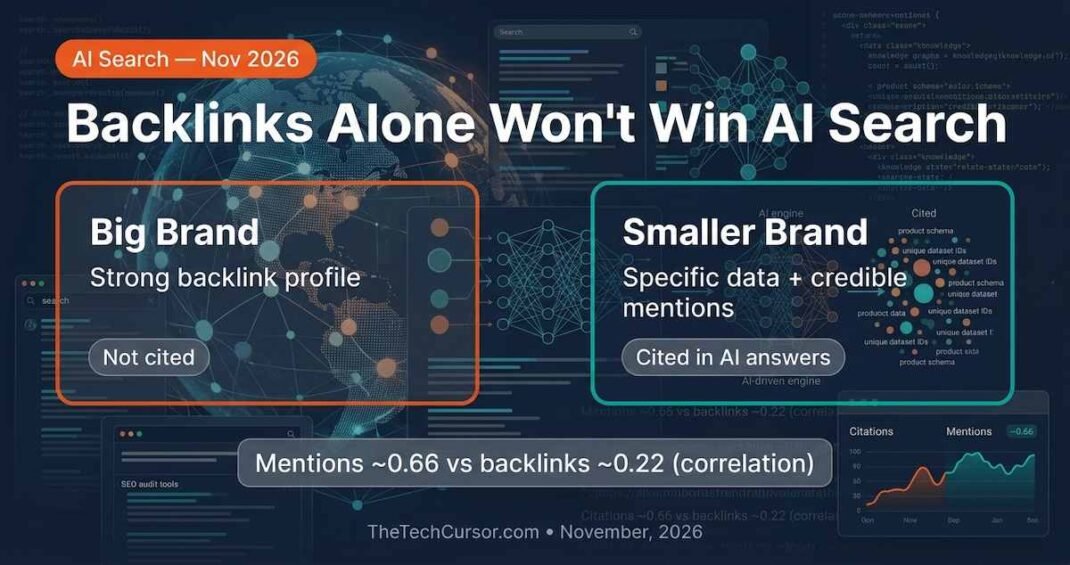
A recent industry analysis made the point clear. Specifically, smaller competitors are winning citations in Google AI Overviews, Perplexity, and ChatGPT, even when established brands have stronger backlink profiles.
I could only access the headings and key lines of that analysis, plus other practitioners’ summaries. Therefore, this article is my own interpretation, so check the details against the original.
1. The Core Problem: Smaller Brands Winning Citations
Traditional SEO taught a clear lesson. Build authority through links, and rankings follow. Large brands have the budgets and relationships to do this well.
AI search draws on different signals. Instead, it looks for pages that answer a question in a clear, extractable way. It also checks whether other sources agree about who the brand is and what it does.
Consequently, a smaller site with specific data or a clear comparison table can beat a famous brand that offers only broad marketing copy. The link profile helps the larger brand rank. However, it does not guarantee a citation.
2. What the Data Says About Links and Mentions
First, the strongest evidence comes from a study by an SEO software company. It examined about 75,000 brands and measured how various signals correlated with brand visibility in AI Overviews.
Brand web mentions showed the strongest correlation, at about 0.664. In contrast, backlinks showed a much weaker correlation, at about 0.218. Mentions do not need to include a link to count.
Still, treat these figures carefully. They are correlations, not proof of cause. They also come from a vendor with its own tools to sell. Still, the direction matches what many practitioners report.
3. The Visibility Cliff
Meanwhile, the same analysis points to a steep drop in visibility.
About 26% of the brands studied had no AI Overview mentions at all. Every brand in that dataset had a Domain Rating above 40. In other words, a solid link profile did not protect them.
Overall, this is a useful reality check for teams that equate authority metrics with AI visibility. A strong score on a link-based metric does not mean an AI system will name the brand.
4. Two Sides of AI Visibility
The analysis describes visibility as having two sides. Both sides matter.
On-site citable content. Your own pages need specific facts, data, quotations, and clear structure. AI systems favour content they can extract and attribute.
Off-site mentions and consensus. Third-party coverage works as a credibility check. It tells a model who you are, what you do, and whether others agree.
Therefore, neither side works alone. Great content with no outside validation may be ignored. Likewise, strong coverage with thin on-site content gives the model little to cite.
The GEO pillars framework describes the same split. Credibility and reach come from outside your site, while structure and relevance come from inside it.
5. The Query Fan-Out Factor
AI systems often expand one question into many sub-queries. This is called query fan-out. The R4T-Diffusion article explains how Google is speeding up that process.
Fan-out favours specific pages. For example, a sub-query about a product feature, a price comparison, or a technical detail is best answered by a page that states those facts clearly. Broad brand pages rarely do.
Additionally, the analysis cites research showing that adding references to sources, quotations, and statistics improved visibility by up to 40%. Treat that figure as an upper bound from a specific study, not a guaranteed gain.
6. Do Not Make a Simple Swap
When leaders see that mentions correlate more strongly than links, a simple conclusion tempts them. Drop link building and chase mentions instead. That would be a mistake.
Links still matter for traditional rankings. Moreover, Google’s AI features draw on pages that rank well, so links influence AI visibility indirectly. Some practitioners go further and argue that sustained AI visibility usually needs a link foundation. That claim comes from vendors, so weigh it accordingly.
However, practitioners also disagree about how much weight mentions deserve. The honest position is that both signals contribute. The traditional link building article explains why volume-based link building is no longer enough, without saying links are worthless.
7. What Big Brands Can Do
Fortunately, big brands still have the resources to do both.
- Publish citable pages. Include specific data, comparison tables, clear definitions, and verified claims. Cite your own sources too.
- Earn third-party coverage. Pursue industry press, reviews, podcasts, and expert commentary. The Invisible PR guide explains how mentions without links still build visibility.
- Keep entity facts consistent. Names, descriptions, and key claims should match across your site and outside sources.
- Measure mentions and citations. Do not report on links alone. The AI visibility dashboard guide shows how to track both.
- Review on-site content. Replace generic copy on key pages with specific, checkable information.
8. What It Means for Smaller Brands
The shift is also an opportunity. Smaller sites cannot outspend large brands on links. However, they can publish sharp, specific content and earn credible mentions in their niche.
A small brand can own a narrow topic and back its claims. Then, if respected niche sources cite it, it can appear in AI answers beside much larger names. That is a more level field than traditional link-based rankings offer.
9. Bottom Line
Backlinks alone will not secure AI visibility. Instead, smaller competitors can win citations over established brands. Brand mentions correlate more strongly with AI Overview visibility than links do, though that is a correlation from a vendor study.
The Takeaway
Treat links as one signal, not the whole strategy. Therefore, build citable content on your own site, earn credible mentions elsewhere, and measure both.
10. Sources Reviewed
I could not open the full original analysis. I reviewed its headings and key lines from a search listing, along with practitioner summaries. Several sources are agency or vendor sites. Verify figures against the original study before relying on them.
- Original analysis — Why backlinks alone won’t save big brands in AI search
- Ahrefs: Top Brand Visibility Factors in ChatGPT, AI Mode, and AI Overviews (75k Brands Studied)
- Sumrush: Why 62% of AI citations don’t lead to brand mentions [Study]
- SEOteric — Why Backlinks Alone Won’t Save Big Brands in AI Search (and What To Do About It)
- SEOteric — Why Backlinks Alone Won’t Save Big Brands in AI Search: What SEOs Should Do Next
- Topify — AI Brand Citation vs. Backlinks: Why Visibility Rules Changed
- Search Atlas — Brand Mentions vs Backlinks: Key Differences, SEO, and AI Visibility Impact
- Wellows — Brand Mentions vs. Citations: What Drives AI Search Visibility?
- LeadWalnut — How Backlinks Drive Brand Mentions in AI Search Results
- Contently — Does Backlinking Help With LLM Visibility?
Pingback: Used or Cited: The Two Ways Your Brand Appears in AI Search — And Why Both Matter - TheTechCursor