Read time: 8 min
Table of Contents
- The Model That Worked for a Decade — And Why It Is Breaking
- What a $500 Backlink Actually Buys You
- How AI Search Changed the Authority Game
- AI Mention Building Is Just Link Building 2.0
- What to Do Instead — 4 Real Authority Strategies
- Strategy 1: Drive Customer Reviews to Influential Third-Party Sources
- Strategy 2: Publish Owned BOFU Listicles for Narrative Control
- Strategy 3: Build Proprietary Content Assets
- Strategy 4: Founder-Led PR and Real Relationships
- Bottom Line
Traditional link building agencies had an incredible run. The pitch was simple and easy to sell: build links from high-DR sites with commercial anchor text, rankings improve, and a spreadsheet arrives every month tallying up the backlink count.
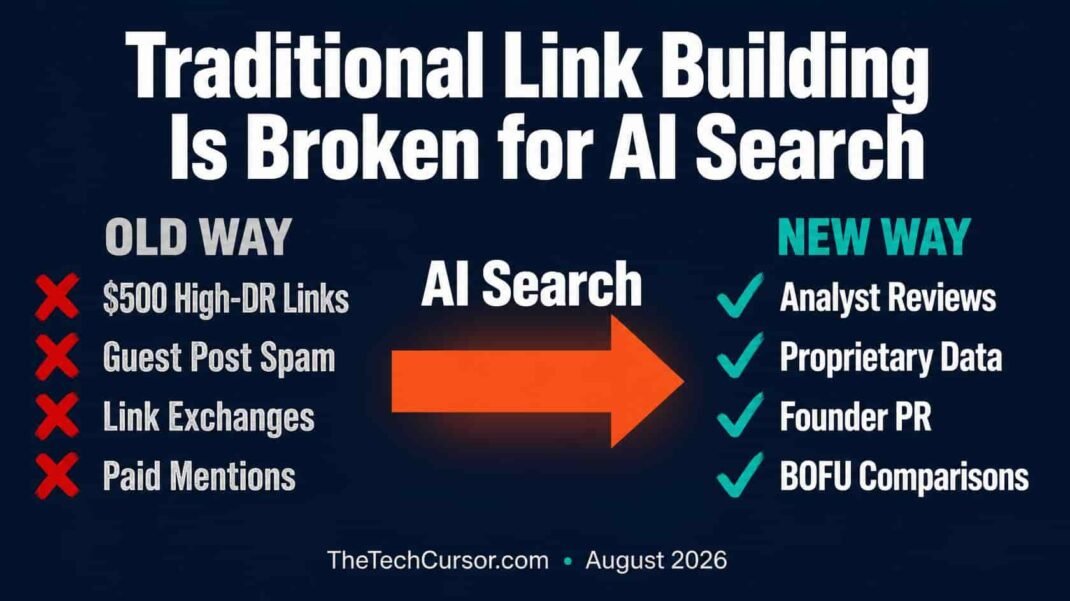
SEO teams reported to leadership: “We built X number of backlinks this month” — broken down by domain authority. The pricing model was equally simple: the higher the domain authority, the more expensive the backlink.
That supply chain link-building model worked well for more than a decade. However, the market has evolved beyond the service model — and AI search has exposed its fundamental weakness.
1. The Model That Worked for a Decade — And Why It Is Breaking
The traditional link building model had one job: push a target URL higher in the rankings list. SEO teams achieved this through volume — ground-and-pound link building to specific target URLs. Domain authority was the proxy for quality. Backlink count was the proxy for success.
Two things have changed simultaneously that are making this model increasingly ineffective.
First, Google’s AI systems evaluate intent differently. Traditional link building could push a URL higher by accumulating authority signals — even when those signals were manufactured. AI search forces a completely different question: has this brand accumulated enough credible context for an AI system to understand, trust, and recommend it?
As SEO professional Wil Reynolds put it: “In the old days you could just muscle your way to the top of Google with zero receipts that you are ‘top 3’ at XYZ thing. If you had enough domain authority, you could rank. AI is 100x more likely to force you to have receipts to back up your claims.”
Second, AI models look for consensus, not random backlinks. AI answer engines analyze patterns of corroboration across the entire web. They do not just crawl backlinks — they synthesize the consensus around an entity. If a brand is mentioned across credible, topically relevant sources, the model encodes it as trustworthy. A random link insert does not add to that consensus. It gets filtered out as noise.
2. What a $500 Backlink Actually Buys You
Most traditional link building vendors sell a unit. That unit is a link insert or a guest article, priced primarily by domain authority. Flat rates of $400 to $500 per backlink — or rigid monthly retainers — are standard.
However, when you inspect the actual link placements those budgets produce, a consistent pattern emerges:
- The link is inserted into completely irrelevant content with no contextual connection to the target page
- Page traffic is generated entirely from countries outside the client’s target market
- The page is already filled with spammy, out-of-context external links
- The editorial suggestion ignores the core topic of the client’s target URL entirely
The core problem is incentive misalignment. The agency is paid to produce a spreadsheet row — not to build real authority. The client receives proof of activity, not proof of impact.
Furthermore, link-building vendors use domain authority as a crutch because it provides buyers an easy filter and sellers an easy pricing model. A high Domain Authority number is often an illusion of authority. It does not guarantee that the website is legitimate, that the referring page drives organic traffic, or — most critically — that AI systems will consider that backlink credible when deciding whether to recommend your brand.
3. How AI Search Changed the Authority Game
For traditional SEO, a link was a form of digital vouching. One page linking to another said: this content is worth referencing.
In AI search, the signal is different. Co-occurrence is the new authority signal — the appearance of your brand name alongside relevant industry terms, competitors, and specific use cases across the web. AI systems map your brand’s entity footprint. They identify what you do, who you serve, and who you compete with. A link inserted into an irrelevant guest article provides zero entity context. It is essentially invisible to the AI’s understanding of your brand.
Context has replaced link count as the primary authority signal.
A brand that appears consistently in credible, topically relevant contexts — editorial coverage, analyst reports, user reviews on trusted platforms, community discussions — builds AI authority. A brand that has accumulated 500 high-DR links from irrelevant guest articles has built traditional SEO authority that AI systems largely cannot use.
This does not mean links are irrelevant. As Gaetano DiNardi notes in his Search Engine Land analysis: “Links still matter because, without a certain baseline level of authority, competitive SEO thresholds become hard to clear.” The outdated package of 500-word guest articles, link inserts, and high-volume link exchanges is becoming less effective — not all link building.
4. AI Mention Building Is Just Link Building 2.0
As the industry shifts toward AI search, link builders are adapting. However, many are simply rebranding rather than genuinely evolving.
Agencies that previously sold backlinks are now pitching “AI mention building” and “LLM visibility campaigns” — promising to engineer your brand into ChatGPT, Perplexity, and AI Overviews. Look under the hood, and it is the same playbook in new packaging.
As covered in the earlier article on GEO vendor scams, the tactics involved are familiar: selling brand mentions on the same low-quality websites, paying for sponsored listicles on external sites to rank clients at the top, and pitching “Reddit strategies” that are blatant astroturfing.
The tell is simple: if a “GEO agency” pitch explicitly states “we’re not asking for a backlink, just a mention” and then offers to link back to you from a “partner site” in return — that is a link exchange scheme with AEO/GEO branding applied.
Buying fake brand mentions is not a modern AI search strategy. Third-party validation only matters when it comes from credible, topically relevant sources. If a brand mention does not come from a domain that buyers and AI engines already trust, it will not influence a recommendation regardless of how many mentions are purchased.
5. What to Do Instead — 4 Real Authority Strategies
GEO is a relevance engineering problem, not a tactical link-building problem. AI systems are trying to determine exactly what you do, who you serve, and where you sit in the competitive landscape. If you do not intentionally shape that narrative through genuine authority building, AI excludes your brand from the recommendation pool.
Here are four approaches that actually work.
6. Strategy 1: Drive Customer Reviews to Influential Third-Party Sources
For many B2B categories, the most visible third-party sources AI systems cite are analyst platforms — Gartner, Forrester, G2, Capterra, and their industry equivalents.
When AI systems respond to queries like “best [category] solutions,” they draw heavily from these established review and analyst platforms because those sources have built genuine credibility with AI training systems over years of consistent, reliable information.
If your brand profile is not aligned to the correct category on these platforms — or if you are not actively driving credible, authentic customer reviews to them — your brand may be excluded from the AI-generated vendor shortlist regardless of your SEO rankings.
The action: Identify the two or three most authoritative review and analyst platforms in your specific category. Build a systematic customer review program that drives genuine, authentic reviews to those platforms consistently. Do not incentivize reviews without proper disclosure — as covered in a recent article on Google’s review snippet guidelines update.
7. Strategy 2: Publish Owned BOFU Listicles for Narrative Control
Self-promotional listicles that rank your brand first have been rightly criticized — both by Google and by AI search researchers. As covered in earlier analysis of AI Overviews and self-promotional content, these pages are frequently cited as sources by AI systems while competitors receive the actual recommendation.
However, there is a legitimate version of this strategy that works differently.
If your brand genuinely belongs in a category, publishing objective, accurate comparison content — Your Brand vs. Competitor, Competitor Alternatives — increases your probability of entering the AI citation pool. The goal is not to manipulate your ranking in AI responses. It is to ensure that AI systems have accurate, detailed information about your product features, use cases, and market position relative to competitors.
When AI systems understand precisely where your product fits in the competitive landscape — and that understanding comes from your own clearly reasoned comparison content — they can more accurately determine when to recommend you.
The critical distinction: Objective comparisons that genuinely help buyers understand trade-offs earn citations. Rankings that transparently promote your brand while dismissing competitors do not.
8. Strategy 3: Build Proprietary Content Assets
Research from Cyrus Shepard found that 92% of sites experiencing significant organic growth produce their own proprietary assets. This finding is even more relevant for AI search, where original data and unique research are among the content types AI systems most actively seek out as citable sources.
Proprietary content assets are content that no competitor can replicate — because they are based on your own original data, research, or tools. They include:
- Original data studies and industry benchmarks — proprietary surveys, internal data analysis, or research that produces statistics other publishers need to reference
- Free interactive tools and calculators — tools that generate sustained organic traffic and earn links naturally as other sites recommend them
- Multimodal assets — infographics, comparison charts, and visual content that AI systems can parse and reference
As covered in the content repurposing guide, original data and statistics generate 30-40% higher AI citation rates than generic content. Furthermore, digital PR campaigns built around proprietary data earn legitimate editorial coverage — the kind of credible, topically relevant placement that genuinely influences AI search authority.
The action: Identify one original data study or interactive tool your brand could produce in the next quarter. Prioritize research that addresses a question your target audience asks frequently but that no credible source has yet answered with reliable data.
9. Strategy 4: Founder-Led PR and Real Relationships
Generic cold email templates for link exchanges do not build trust. Most never reach a human being, and those that do are rarely compelling enough to earn editorial consideration from publications with genuine standards.
Real authority building requires real relationships — and the most credible relationships are those between recognized experts and the communities and publications that cover their space.
This looks like:
- Podcast appearances — as covered in an Invisible PR article, podcast content generates transcripts and show notes that are indexed and cited by AI systems while building genuine audience relationships
- Co-marketing with non-competing brands — partnerships with companies that share your audience create genuine cross-brand visibility without the link-exchange dynamic
- Appearances in private communities, newsletters, and dark social channels — mentions in these channels build brand consensus even when they are not directly indexed
Irina Maltseva of Hunter.io summarizes the underlying principle clearly: you build true entity association by getting your founders and subject matter experts out into the market — not by sending link requests to a database of publishing sites.
The best links are the natural result of a good marketing strategy. They are not manufactured through a vendor relationship — they are earned through genuine expertise, genuine relationships, and content that other people genuinely want to reference.
10. Bottom Line
Traditional link building agencies are struggling because the market no longer rewards raw link volume as a measure of authority — and AI search has made that shift visible in ways that traditional search never fully could.
The fundamental problem is not link building itself. Links still matter as a baseline authority signal. The problem is the supply chain model that optimizes for producing spreadsheet rows rather than building genuine credibility.
If your brand is absent from the conversations that shape your category — the reviews on trusted platforms, the analyst reports, the community discussions, the editorial coverage from credible sources — no number of forced backlinks will compensate for that absence in AI search.
The brands winning in AI search are those that have built genuine authority: authentic reviews on credible platforms, original research that others cite, and real relationships that produce real coverage. That is not a new insight — it is what good marketing has always required. AI search simply makes the stakes higher for doing it right.
Pingback: Google Releases August 2026 Spam Update — What's Changing and What to Check - The Tech Cursor
Pingback: Content Marketing Hits 12-Year Low — AI Isn't Why - The Tech Cursor
Pingback: SEO for AI: How to Get Found When Search Gives the Answer - The Tech Cursor