
Category: GEO | Off-Page SEO | AI Search | Digital Marketing
Read time: 7 min
As AI search has grown in importance, a new category of vendor has emerged: GEO agencies promising to boost your brand’s visibility in ChatGPT, Google AI Overviews, and Perplexity through aggressive off-site brand mention campaigns.
Some of these vendors are legitimate. Many are not.
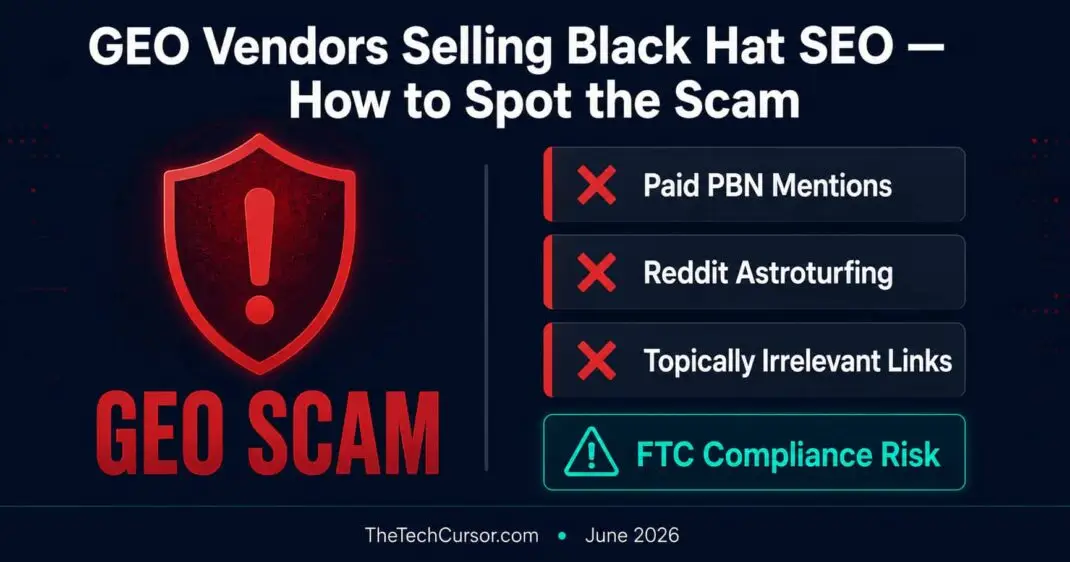
A growing number of marketing leaders are discovering — often after paying significant retainers — that the “GEO outreach” they purchased was nothing more than black hat link building with a new name. Paid mentions on Private Blog Networks. Reddit astroturfing with aged accounts. Low-quality placements on topically irrelevant sites. Premium prices for tactics that Google’s systems have been penalizing for years — and that AI platforms are beginning to recognize and discount.
Here is what is actually happening, how to spot it, and what to do instead.
Table of Contents
- The GEO Opportunity — and the Problem It Created
- What Shady GEO Vendors Are Actually Selling
- The 5 Deceptive Tactics to Watch Out For
- Why These Tactics Appear to Work Right Now
- The Real Risks — Legal, Financial, and Reputational
- How to Evaluate Any GEO Vendor
- What Actually Works for Off-Site AI Visibility
- Bottom Line
1. The GEO Opportunity — and the Problem It Created
There is genuine, legitimate insight behind the GEO movement. Research consistently shows that AI search systems rely heavily on off-site signals — third-party mentions, citations from credible sources, brand presence in trusted publications and communities — when deciding which entities to recommend and cite.
This is well-documented, and TheTechCursor has covered it in depth: topic-specific authority from third-party sources, entity understanding built from multiple data points across the web, and citation patterns from high-authority domains all influence AI search visibility meaningfully.
The problem is that this legitimate insight has created an opening for opportunists. “Off-site mentions matter for AI visibility” has been repackaged by a wave of GEO vendors into justification for the same tactics that poisoned traditional SEO — just with new terminology and higher price tags.
2. What Shady GEO Vendors Are Actually Selling
Independent audits of top-rated GEO vendors have revealed a consistent pattern. Behind the sales pitch about “partnership building” and “AI-era brand discovery,” many of these agencies are offering:
- Paid placements on low-quality publisher sites — essentially link buying with the anchor text replaced by a brand mention
- PBN brand mentions — placements on Private Blog Networks at 10-15 times the cost of a typical SEO backlink
- Reddit astroturfing using aged accounts to mass-post brand mentions across subreddits, with many posts removed within 30 days for violating community guidelines
- Topically irrelevant placements on domains that have one page about your category and dozens of listicles about completely unrelated topics
The workflow these vendors use is revealing. Placement opportunities are generated and sent to the client — often through Slack — listing a prompt topic, domain authority score, citation rate estimate, and a publisher placement fee (commonly $150-$250 per mention). The client approves the placement. The vendor pays the publisher, then invoices the client to recoup the fee, on top of the agency retainer.
The internal marketer reviewing these placements is often a junior team member without the experience to evaluate whether a referring domain is legitimate or a paid-link scheme with new branding.
3. The 5 Deceptive Tactics to Watch Out For
Tactic 1: Manipulated research claims GEO vendors frequently cite statistics like “X% of AI visibility comes from third-party sources” to justify their approach. However, the correlation between third-party source influence and citation rates does not support the conclusion that buying low-quality mentions from irrelevant sites will improve your brand’s AI search visibility.
Tactic 2: “Partnership building” framing. During the sales process, paid placement programs are presented as opportunities to build genuine partnerships with other brands. In practice, the “partners” are publishers selling space on their sites to anyone willing to pay — the same model as paid link schemes.
Tactic 3: PBN brand mentions. Private Blog Networks built for SEO link manipulation are being repurposed to sell brand mentions to GEO clients. The underlying site quality and topical relevance are equally poor — and the risk of eventual penalization is equally real.
Tactic 4: Topically irrelevant placements. A domain with one page about LMS software and dozens of pages about cryptocurrency, travel, and home improvement is a red flag in traditional SEO — and it should be an equally clear red flag in GEO. AI systems, like Google, evaluate topical relevance and source quality when determining which mentions contribute to entity authority.
Tactic 5: Reddit astroturfing. Using aged Reddit accounts to post brand mentions in irrelevant subreddits is a tactic that violates Reddit’s community guidelines and produces placements that are frequently removed within 30 days. The short-term appearance in tracking reports does not reflect lasting AI visibility.
4. Why These Tactics Appear to Work Right Now
Here is an uncomfortable truth: some of these tactics may produce short-term results. The reason is that most LLM citation systems are still significantly less sophisticated than Google’s spam detection, which has been refined over two decades.
It is possible that AI platforms currently reward mention volume from low-quality sources that Google would immediately discount or penalize. This creates what amounts to a temporary window of effectiveness — estimated at one to two years before AI platform companies develop more refined authority and spam detection systems.
Lily Ray, VP of SEO Strategy at Amsive, puts it clearly:
“With each new product release, we see more signs that some of the new GEO/AEO companies lack the experience and context to anticipate how their approaches will be treated once Google and the AI platforms build countermeasures to strip spammy signals from their training data, indexes, and results. Our industry has gone through these cycles many times before. It’s naive and irresponsible to assume the search and AI platforms won’t eventually catch on, too.”
The Penguin update in 2012 systematically suppressed inorganic links after years of link buying. A similar correction for manufactured brand mentions in AI training data and citation systems is a matter of when, not if.
5. The Real Risks — Legal, Financial, and Reputational
Beyond wasted budget, brands participating in paid brand mention schemes face three categories of genuine risk:
Legal risk — FTC compliance. The FTC requires clear disclosure when content placement is paid or sponsored. Many websites accepting payment for brand mentions are not updating their pages to disclose the commercial relationship. This creates potential FTC compliance exposure for brands that approve these placements — not just for the publishers that accept them.
Reputational risk: Being mentioned on pages loaded with paid links to competitors, PBN content, and low-quality listicles is not brand-building. It is the opposite. AI systems that evaluate entity quality alongside mention frequency will increasingly distinguish genuine third-party validation from manufactured presence.
Entity confusion risk. As covered in TheTechCursor’s breakdown of Google’s entity understanding patent, AI systems build holistic profiles of entities from multiple sources. Inconsistent, topically irrelevant mentions from low-quality sources may confuse those entity profiles rather than strengthen them — potentially associating your brand with categories, topics, or contexts you do not want associated with it.
6. How to Evaluate Any GEO Vendor
When a GEO vendor makes specific claims about off-site brand mentions, apply direct scrutiny to each:
Claim: “The majority of AI brand discovery comes from third-party sources” This is directionally true, but it does not mean buying low-quality mentions causes a brand to appear more frequently in AI answers. Correlation between off-site signals and AI visibility does not establish that manufactured low-quality mentions produce the same effect as genuine editorial citations.
Claim: “Listicles and third-party pages are the lever” This does not support the conclusion that brands should pay to appear on thin, irrelevant, AI-generated listicles. The research showing that third-party citations matter refers to credible, topically relevant third-party sources — not paid placements on PBNs.
Claim: “AI search is different, so traditional SEO quality judgment does not apply” Google explicitly says the opposite. SEO best practices remain fully relevant for AI search features. There are no special optimizations required for AI Overviews or AI Mode that override standard Search quality policies.
Questions to ask any GEO vendor directly:
- Can you show me the specific domains where placements will appear before I approve them?
- Are these placements editorially earned or paid?
- How do you disclose paid placements to comply with FTC requirements?
- What is your process for ensuring topical relevance between my brand and the placement domain?
- What happens to my placements if the publisher removes them?
7. What Actually Works for Off-Site AI Visibility
The alternative to manufactured brand mention campaigns is not doing nothing. Off-site signals genuinely matter for AI search visibility — the issue is the quality and authenticity of those signals, not their existence.
Pursue genuine editorial coverage in publications your target audience actually reads and trusts. A single mention in a credible industry publication carries more weight than fifty placements on PBN sites.
Build real relationships with journalists and researchers covering your topic area. As covered in TheTechCursor’s article on link intent, the most effective outreach introduces genuinely useful content to people who have reason to cite it — not requests for paid placements.
Earn Reddit and community presence authentically by contributing genuine expertise to relevant discussions. Real community engagement that earns organic mentions is significantly more valuable than astroturfed posts that get removed in 30 days.
Invest in original research and data that other publishers naturally want to cite. A proprietary study or benchmark report earns mentions from credible sources across an extended time period — without any payment required.
Focus on topical relevance above all else in any outreach or placement strategy. A mention from a source with genuine authority in your specific topic area is worth far more than dozens of placements from unrelated domains with high domain authority scores.
8. Bottom Line
GEO as a discipline is real, important, and growing. The insight that off-site signals matter for AI search visibility is well-founded and worth acting on.
However, a significant portion of what is currently being sold under the GEO label is a repackaging of black hat SEO tactics that the industry has seen before — paid link schemes, PBNs, and astroturfing — with new terminology, premium pricing, and a sales narrative built on selectively interpreted research.
The brands that will build durable AI search visibility are those investing in genuine editorial coverage, authentic community presence, and original content that earns citations from credible sources. The brands paying for manufactured mention volume may see short-term tracking improvements — and face the same correction that every previous wave of inauthentic SEO manipulation has eventually faced.
Do not mistake the temporary effectiveness of spammy tactics for a sustainable strategy.
Pingback: 5 GEO Pillars for AI Search Visibility in 2026 - The Tech Cursor