
Published: June 23, 2026
Read time: 9 min
For over two decades, SEO has been fundamentally about pages. Optimize a page for a keyword. Build links to that page. Structure the content so search engines can understand what the page is about. The page is the unit of optimization.
A 2023 Google patent — now gaining significant attention in the SEO community — suggests that it is about to change.
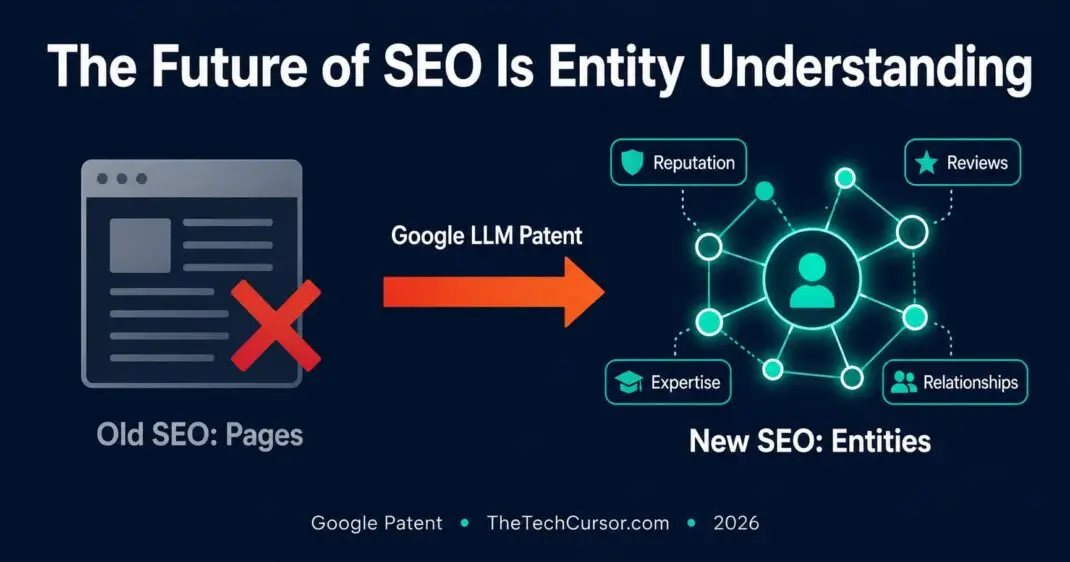
The patent, titled “Data extraction using LLMs,” describes how Google’s AI systems could build a “deep, holistic characterization” of an entity — a business, brand, product, or organization — by collecting and interpreting information from websites, reviews, maps data, job listings, and other public sources.
If systems like this become more central to how Google powers AI Overviews, AI Mode, and recommendation-driven search experiences, the next evolution of SEO may not be about helping Google understand your pages. It may be about helping Google understand who you are.
From Documents to Entities — The Fundamental Shift
Google has spent over two decades helping users find information published on webpages. Whether through traditional blue links, featured snippets, or AI-generated answers, the process has generally started with understanding individual documents.
However, as Google’s search becomes more conversational and recommendation-driven, understanding individual documents is no longer sufficient.
Before an AI system can recommend a business, compare products, explain a brand, or suggest a service provider, it must first understand the entity behind the content. A query like “best accountant for small businesses in my area” cannot be answered by ranking documents — it requires understanding entities, their attributes, their reputation, and their fit for a specific user need.
That is what makes this patent significant.
According to the filing, the techniques described enable AI to generate and enhance a “deep, holistic characterization of a particular entity” — defined broadly to include people, companies, businesses, places, objects, and concepts.
How Google’s Patent Builds Entity Understanding — Step by Step
The patent describes a four-step process for constructing an entity profile:
Step 1: Identify the entity. The system identifies a domain and its associated entity, then gathers information from webpages associated with that domain, processed through a large language model.
Step 2: Interpret — not just extract. Rather than simply pulling facts from pages, the system generates what the patent calls a characterization of the entity. Critically, this characterization is described as “an interpretation of the extracted content rather than a verbatim duplication” of it. The AI forms conclusions about the entity — it does not just copy text.
Step 3: Extract attributes and relationships. The AI system analyzes content to extract signals including an entity’s presence, age, principles, services, reputation, social media sentiment, and relationships between different elements associated with the organization. These signals move understanding beyond individual pages toward understanding the entity itself.
Step 4: Supplement with third-party data. Importantly, the system is not limited to information on a company’s own website. Google explicitly notes that the system may use online maps data, job listing data, business information, and other third-party data as additional inputs. The website becomes one of several sources — not the only source of truth.
What Entity Profiles Actually Look Like
The patent provides concrete examples of what these entity characterizations look like. They are not page summaries. They read like descriptions of a company’s identity, positioning, values, and characteristics.
One example from the patent describes a hypothetical company’s brand identity — noting associations with simplicity, accessibility, trust, innovation, and social responsibility. Another version of the same entity presents those same concepts as a structured set of key attributes: trustworthiness, innovation, accessibility, and social responsibility — each with supporting detail.
Furthermore, the patent describes organizing this understanding into hierarchical graph structures — connecting entity attributes to related concepts, audiences, services, reputation signals, and competitive differentiators. Rather than knowing a business offers a service, the system connects that service to specific audiences, locations, reputation signals, and differentiators.
The result is an entity model that can answer questions traditional extraction systems were never designed to address: not just “what does this page say?” but “what do we understand about this business?”
What This Means for SEO — The Practical Shift
Through an SEO lens, this patent suggests webpages may increasingly serve a second purpose beyond ranking for keywords. They become evidence used to construct an understanding of the entity behind them.
Consider what this means for specific content types:
- A service page does more than target a keyword — it helps establish what services a business offers
- A case study does more than attract traffic — it demonstrates experience and expertise
- A team page helps identify the people and credentials behind the organization
- Customer reviews contribute reputation signals to the entity profile
- Press coverage and industry citations reinforce or challenge the system’s developing understanding
This also explains why the patent’s emphasis on multiple data sources is so significant. The filing does not describe building an understanding from a single webpage. It describes combining website content, maps data, reviews, business listings, and job postings into a more complete picture.
Consequently, visibility in AI search may increasingly depend on how effectively Google understands your entity — not just how well your pages rank for individual keywords. In environments where AI systems are summarizing options, making recommendations, or narrowing choices on behalf of users, the quality of Google’s entity understanding becomes a critical factor in whether your business is surfaced and how it is described.
How Brands Can Shape Their Entity Understanding
The patent does not provide optimization checklists. However, it clearly points to several areas that directly influence how AI systems construct entity understanding.
1. Maintain Consistency Across Sources
Because the system generates a characterization by interpreting information across multiple sources, consistency becomes critically important. Review how your business is described across:
- Your website
- Google Business Profile and other business listings
- Social media accounts
- Press coverage and media mentions
- Industry directories and review platforms
- Job listings and recruiting materials
The goal is not identical wording everywhere. The goal is to ensure AI systems encounter a consistent understanding of who you are, what you do, and who you serve — regardless of which source they analyze.
2. Define and Communicate Your Brand Attributes Clearly
The patent’s example entity summaries focus on characteristics like trustworthiness, innovation, accessibility, and social responsibility. Ask yourself: what attributes should be associated with your brand? What differentiates you from competitors?
For enterprise software: security, compliance, scalability. For e-commerce: quality, value, sustainability. For local services: expertise, responsiveness, community reputation.
The clearer these differentiators are communicated — across your website, content, and public presence — the easier they become for AI systems to identify and associate with your entity.
3. Support Claims With Evidence
The patent describes building entity understanding from multiple sources. This means unsupported claims carry less weight than claims reinforced by evidence across the web. Evidence includes:
- Customer reviews and testimonials
- Case studies with measurable outcomes
- Press coverage and earned media
- Industry awards and certifications
- Author profiles with verifiable credentials
- Third-party citations and mentions
Publishing more content is not the goal. The goal is to provide evidence that supports the attributes you want associated with your entity.
4. Strengthen Entity Relationships
The patent’s use of hierarchical graphs to organize entity relationships is practically significant. Make it easy for AI systems to understand the connections between:
- Your products or services and specific audiences
- Your brand and the industries or categories you serve
- Your team members and their areas of expertise
- Your business and its geographic markets or service areas
Clear, well-structured relationships across your website and public presence help AI systems understand not just what your entity is, but where it fits — and when it should be recommended.
5. Audit Your Entity Footprint
A useful exercise: ask yourself what an AI system would say about your company if it analyzed your website, reviews, business profiles, press coverage, and third-party mentions collectively. Would the picture be clear, consistent, and compelling? Or fragmented, inconsistent, or incomplete?
This entity-level audit — looking at your full digital presence rather than individual pages in isolation — may become just as important as traditional technical SEO audits.
What This Means by Business Type
Enterprise and B2B organizations Enterprise organizations often face a consistency challenge. Different departments describe the business differently. Product pages, investor materials, press releases, and recruiting content frequently present different versions of the company as AI systems synthesize understanding from all of these sources; maintaining a coherent entity identity across channels becomes a strategic priority — not just a branding consideration.
E-commerce and product businesses: The patent’s product-related examples suggest entity understanding may extend to individual products — not just organizations. Users asking which product is best for a specific use case are asking AI systems to evaluate entities and recommend based on fit. Clear product attributes, category relationships, use case content, and review signals all contribute to how products are understood and surfaced in AI-driven shopping experiences.
Local businesses: Many signals referenced in the patent align with signals already central to local search — services, reputation, social sentiment, and business information. For local businesses, the question is whether your website, Google Business Profile, review platforms, and third-party presence collectively tell the same coherent story about your expertise and reputation. Inconsistency across these sources becomes more costly as AI systems synthesise them into a single, unified understanding.
The Bigger Picture: Entity SEO Is the Next Frontier
This patent connects directly to a broader pattern across Google’s AI-powered search experiences. AI Overviews, AI Mode, Ask Maps, and Gemini-powered recommendations all depend on understanding the entities they reference — evaluating, comparing, and recommending businesses, products, and services. They cannot do this from document retrieval alone.
Furthermore, this connects to every other element of the AI search visibility picture covered in TheTechCursor’s content series: topic-specific authority, third-party citation signals, content that demonstrates genuine expertise, and the E-E-A-T framework Google has consistently expanded — all of these are, at their core, entity signals.
The SEO challenge is evolving. Helping Google understand your pages remains important. However, helping Google understand the entity behind those pages — your expertise, your reputation, your relationships, your positioning — is becoming equally important, and possibly more so in AI-powered search experiences.
Bottom Line
Google’s “Data extraction using LLMs” patent describes a system that goes far beyond traditional content extraction. It builds a holistic understanding of entities — businesses, brands, products, and people — from websites, reviews, listings, and other public sources, interpreted by AI rather than merely indexed.
For SEOs and marketers, the practical implication is clear: the unit of optimization is expanding. Pages remain important as evidence. However, the entity those pages represent — how clearly it is defined, how consistently it is communicated, how well it is supported by evidence across the web — is becoming a central factor in AI search visibility.
The brands that understand this shift early and build their digital presence accordingly will be better positioned as AI-powered search becomes the default experience for more users every day.
Pingback: GEO Vendors Are Selling Black Hat SEO — Here's How to Spot and Avoid Paid Brand Mention Scams - The Tech Cursor
Pingback: SEO for AI: How to Get Found When Search Gives the Answer - The Tech Cursor