Published: June 23, 2026
Read time: 7 min
A job posting from Anthropic has gone viral in the SEO community — and for good reason. The role, essentially an AI Search Lead, carries a salary of $255,000 to $320,000 and a job description so comprehensive that one industry veteran joked it should have been titled “Search Gawd.”
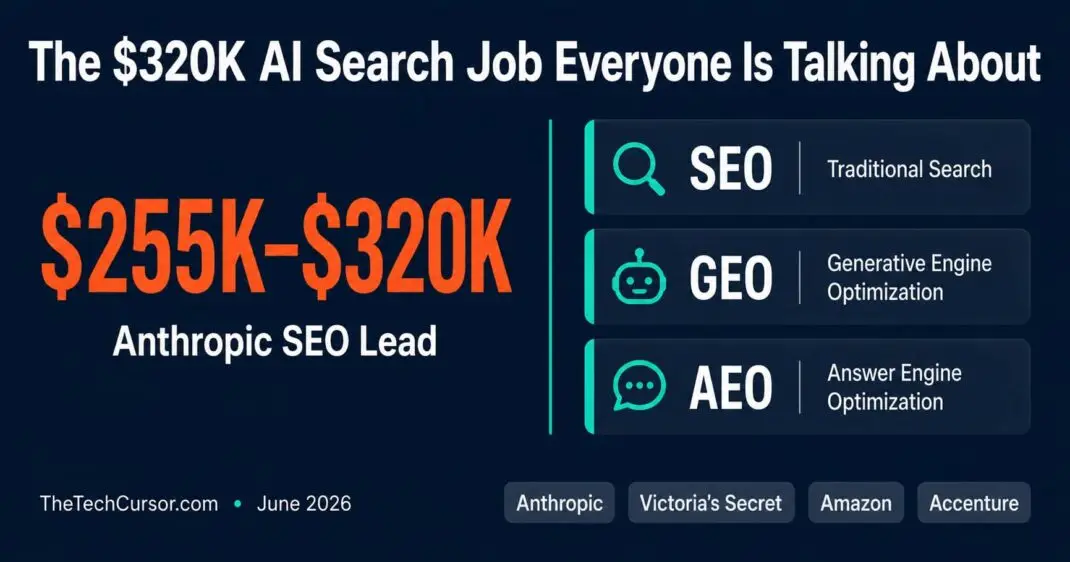
But here is the thing: Anthropic is not alone. Victoria’s Secret, Amazon, Accenture, AirOps, Experian, and dozens of other companies are all posting nearly identical roles right now — under different titles, at different salary levels, but with fundamentally the same brief.
What exactly is this role? Why is everyone suddenly hiring for it? And what does it tell us about where search and digital marketing are heading in 2026?
The Roles Everyone Is Hiring For Right Now
A quick scan of current job boards reveals a striking pattern. Companies across industries are all searching for the same person — just calling them different things:
| Company | Title | Salary |
|---|---|---|
| Anthropic | SEO Lead | $255K–$320K |
| Victoria’s Secret | Director, AI & Organic Search (AEO, GEO, SEO) | $152K–$216K |
| Accenture | Agentic Commerce GEO Consultant | N/A |
| AirOps | Senior SEO Manager (SGE, Perplexity, ChatGPT, Gemini) | N/A |
| SailPoint | AEO/GEO Manager | N/A |
| Amazon News | SEO + AEO + GEO combined role | N/A |
| Danaher | SEO + AEO combined role | N/A |
Different industries. Different price points. Same fundamental challenge: finding someone who understands how AI search works and can build visibility across both traditional and AI-powered discovery channels simultaneously.
What These Roles Actually Require
The job descriptions for these roles are genuinely broad — and that breadth reflects reality rather than wishful thinking. A typical AI Search Lead role in 2026 requires understanding across:
Technical SEO — site architecture, crawlability, indexability, Core Web Vitals, structured data. The foundation remains the same as always.
Content strategy — understanding how to create content that serves both traditional keyword intent and AI query fan-out simultaneously. Knowing when a comprehensive pillar page serves better than multiple thin pages.
AI search optimization (GEO/AEO) — understanding how Google AI Overviews, ChatGPT, Perplexity, and Microsoft Copilot evaluate and cite content. Knowing what makes content AI-readable versus invisible to AI systems.
Performance and paid search — understanding how paid and organic signals now feed the same underlying AI systems. Knowing when paid data informs organic strategy and vice versa.
Analytics and measurement — building measurement frameworks that capture both traditional organic traffic and AI referral traffic separately. Understanding citation share, entity visibility, and AI-specific metrics.
Product and engineering partnership — working with technical teams to implement structured data, improve page experience, and build the infrastructure that enables AI visibility at scale.
Brand and PR strategy — understanding that third-party mentions, earned media, and entity authority now directly influence AI search visibility — not just traditional backlink metrics.
Leadership and communication — translating complex AI search concepts to executives who are used to thinking in terms of traditional keyword rankings and organic traffic reports.
Why This Role Is So Hard to Fill
The challenge is not that the work does not exist. The challenge is that no single career path has traditionally produced someone with all of these skills simultaneously.
Traditional SEO specialists have deep technical and content expertise — but often limited experience with paid search, brand strategy, or executive communication. Paid search specialists know performance media deeply — but may lack the content and technical SEO foundation needed for AI visibility work. Brand and PR professionals understand earned media and entity building — but rarely have the technical SEO or analytics depth required.
The person companies are looking for has moved across multiple of these disciplines — through agencies, publishing, product roles, consulting, or operating positions. Their career may look less linear than a specialist’s. Ironically, that breadth is precisely what makes them capable of doing the job.
Furthermore, the role itself barely existed three years ago under this name. AI Overviews, AI Mode, GEO, AEO — these concepts have only become mainstream in the past 18 to 24 months. No one has five years of experience with a job that did not exist five years ago.
The New Acronym Landscape — SEO, GEO, AEO Explained
If these job descriptions feel confusing, part of the reason is a genuinely new set of acronyms that have entered the field rapidly:
SEO (Search Engine Optimization) — the established discipline of optimizing for traditional search engine rankings. Still fully relevant — the foundation everything else is built on.
GEO (Generative Engine Optimization) — optimizing specifically for visibility in AI-generated search responses. This includes ensuring content is AI-readable, structuring content to match query fan-out patterns, and building entity authority that AI systems recognize.
AEO (Answer Engine Optimization) — optimizing for direct answer placements in search — featured snippets, AI Overviews, voice search responses. Overlaps significantly with GEO but predates the generative AI era.
As Google noted in its official AI search guidance covered in TheTechCursor’s earlier article on AI search myths, GEO and AEO are ultimately still SEO from Google’s perspective — the same foundational practices drive visibility across all three. However, the skills required to execute at the intersection of all three are genuinely broader than traditional SEO required.
What Skills Matter Most Right Now
For anyone currently building or expanding their search marketing skillset, the pattern in these job descriptions points clearly to several areas worth prioritizing:
AI search mechanics. Understanding how Google AI Overviews, ChatGPT, and Perplexity actually work — including query fan-out, entity understanding, citation patterns, and AI readability — is now table stakes for senior search roles. TheTechCursor has covered each of these in depth across recent articles.
Entity SEO. Understanding how Google builds entity profiles from websites, reviews, and third-party sources — and how to optimize an organization’s full digital footprint accordingly — is one of the most undervalued skills in the current market.
Cross-channel measurement. Building measurement frameworks that track AI referral traffic, citation share, and entity visibility alongside traditional organic metrics is a skill very few practitioners have developed yet — which creates significant opportunity for those who do.
Content strategy for AI. Understanding which content formats, structures, and depth levels perform best in AI search environments — and building content repurposing systems that maximize visibility across multiple formats simultaneously.
Technical foundation. Structured data, page experience, crawl efficiency, and AI content readability remain fundamental — and companies are willing to pay significantly for people who can execute technically while also thinking strategically.
The Career Opportunity in This Moment
Here is the honest reality: the convergence of SEO, GEO, and AEO has created a genuine skills gap in the market. Companies are struggling to find people who can operate at the intersection of all these disciplines — which means practitioners who develop this cross-disciplinary understanding early have significant leverage.
The salary data confirms this. Roles that previously commanded $80,000 to $120,000 for traditional SEO expertise are now posting at $150,000 to $320,000 when they require genuine AI search fluency alongside traditional skills.
For professionals currently working in SEO, content marketing, paid search, or digital PR, this is an unusually clear signal about where to invest in skill development. The demand is demonstrably real, the supply is limited, and the window for building differentiated expertise before the market catches up is narrower than it might appear.
What Companies Should Actually Do
For businesses currently trying to hire for these roles, the job description problem is real. When the taxonomy says SEO, the responsibilities describe GEO and AEO, the recruiter screens for keyword ranking experience, and the ATS filters out anyone whose career looks non-linear — the hiring process is almost designed to eliminate the right candidates.
A more effective approach starts with a clearer internal decision: are you hiring a specialist who will execute specific tasks, a leader who will build a team, or an executive who can connect search, content, product, brand, and performance into a coherent strategy? These are genuinely different roles with different ideal candidates — treating them as one role and expecting a unicorn is not a strategy.
Bottom Line
The viral Anthropic job posting and the dozens of similar roles appearing across major companies are not a symptom of unrealistic expectations. They are a direct reflection of what AI-powered search now requires from anyone responsible for digital visibility.
The companies that figure out how to identify, hire, and empower people with genuine cross-disciplinary AI search expertise will build durable visibility advantages over the next several years. The practitioners who build that expertise now — before the market fully prices it in — will be the ones fielding the most interesting opportunities.
The job that did not exist five years ago is now the most important search marketing hire a company can make.