
Category: SEO | AI Search | Technical SEO | Research Tools
Read time: 7 min
Google search operators have existed for over two decades. Most SEO guides treat them as static reference tools — a list of commands you memorize and occasionally use during audits. In 2026, they are something more.
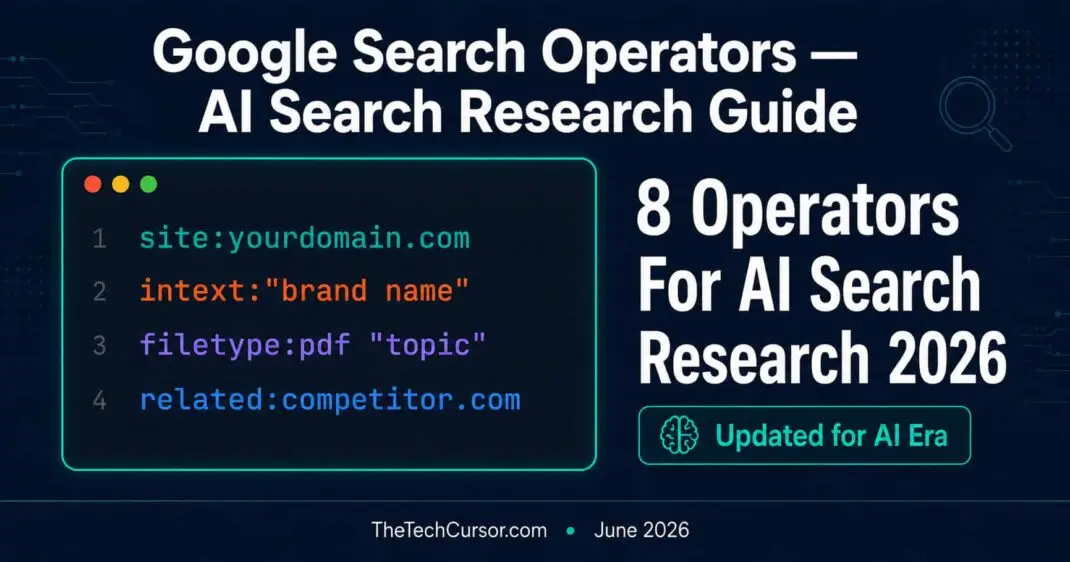
As AI search has transformed how content is discovered, cited, and recommended, search operators have gained a second life as research tools for the AI era. They help you understand what content AI systems can access, who is being cited in your niche, and where your brand’s entity signals are strong or missing.
This guide covers the operators that matter most in 2026 — with updated use cases specifically for AI search research, entity auditing, and competitive intelligence.
Table of Contents
- Why Search Operators Still Matter in the AI Era
- The 8 Most Valuable Operators for AI Search Research
- Operator 1: site: — Your AI Visibility Audit Tool
- Operator 2: intext: — Find Brand Mentions and Citations
- Operator 3: intitle: — Gauge AI Content Competition
- Operator 4: filetype: — Uncover Hidden Research Sources
- Operator 5: related: — Map Your AI Search Competitors
- Operator 6: inurl: — Diagnose Technical AI Visibility Issues
- Operator 7: before: / after: — Track AI Content Timelines
- Operator 8: Combining Operators — Advanced AI Research Use Cases
- Deprecated Operators You Can Stop Using
- Bottom Line
1. Why Search Operators Still Matter in the AI Era
A reasonable question: if AI search systems like Google AI Overviews, ChatGPT, and Perplexity are changing how people find information, do operators built for traditional search still have value?
The answer is yes — and in some ways, more than before.
AI search systems draw from Google’s index. Content that is not indexed cannot be surfaced in AI responses. Content that is poorly structured, duplicated, or buried may be indexed but not cited. Understanding what Google can see on your site — and how it interprets it — remains fundamental to AI visibility, even as the format of search results evolves.
Furthermore, operators are increasingly useful for entity research — understanding how Google categorizes your brand, who else is in your entity neighbourhood, and where your content sits relative to the sources AI systems already trust in your topic area.
2. The 8 Most Valuable Operators for AI Search Research
Not all 19+ Google search operators deserve equal attention in 2026. Here are the eight that provide the most value for AI-era SEO research:
| Operator | Primary AI Search Use Case |
|---|---|
site: |
Index audit and AI visibility foundation check |
intext: |
Brand mention and citation discovery |
intitle: |
Competitive content gap analysis |
filetype: |
Uncovering citable research sources |
related: |
Mapping the AI search competitive landscape |
inurl: |
Technical AI visibility diagnostics |
before: / after: |
AI content timeline research |
| Combined operators | Advanced entity and citation research |
3. Operator 1: site: — Your AI Visibility Audit Tool
Basic syntax: site:yourdomain.com
What it shows: Every page Google has indexed from your domain.
AI search use case: Before any content can appear in AI Overviews or be cited by AI systems, it must be indexed. The site: Operator is your first check — confirming that the pages you want AI systems to use are actually accessible in Google’s index.
Advanced uses for AI research:
site:yourdomain.com intext:"AI Overviews"→ Find which of your pages already mention AI topics that might generate AI Overview citations
site:yourdomain.com -site:yourdomain.com/tag→ Check for indexed tag pages or other thin content that might dilute your topical authority signals
site:competitordomain.com→ Understand the scale and structure of competitor content before analyzing their AI visibility
4. Operator 2: intext: — Find Brand Mentions and Citations
Basic syntax: intext:"your brand name"
What it shows: Pages anywhere on the web that mention your brand in their content.
AI search use case: As covered in TheTechCursor’s breakdown of Google’s entity understanding patent, AI systems build entity profiles partly from third-party mentions across the web. The intext: operator lets you audit where your brand is mentioned — and evaluate the quality and relevance of those mentions.
Advanced uses for AI research:
intext:"your brand" -site:yourdomain.com→ Find all third-party mentions of your brand, excluding your own site
intext:"your brand" site:reddit.com→ Check Reddit presence — a platform AI systems cite frequently for “best of” queries
intext:"your brand" intext:"competitor brand"→ Find pages that mention both you and a competitor — potential sources already in your topic’s AI citation network
5. Operator 3: intitle: — Gauge AI Content Competition
Basic syntax: intitle:"your topic"
What it shows: Pages that include your target topic in their title tag.
AI search use case: Understanding how much content exists for a topic helps evaluate how competitive the AI citation landscape is. Topics with thousands of results from authoritative domains require a different content strategy than topics with sparse coverage.
Advanced uses for AI research:
intitle:"best [your category] software" -site:yourdomain.com→ Find the exact listicle competition for your product category — the pages that AI Overviews currently cite for comparison queries
intitle:"what is [your topic]"→ Identify which sites own the definitional content for your core topic — often the most heavily cited pages in AI responses
6. Operator 4: filetype: — Uncover Hidden Research Sources
Basic syntax: filetype:pdf "your topic"
What it shows: PDF, DOC, PPT, and other file types containing your search terms.
AI search use case: Original research reports, academic papers, and government data in PDF format are among the most credible sources AI systems cite for factual claims. Finding and referencing these sources in your content — or creating similar original research yourself — directly improves citation probability.
Advanced uses for AI research:
filetype:pdf "your industry" statistics 2026→ Find credible data sources to reference in content — improving your information gain score and citation worthiness
filetype:pdf site:gov "your topic"→ Government data and reports — among the highest-authority sources AI systems use for factual grounding
filetype:pdf site:edu "your topic"→ Academic research in your topic area — often cited by AI systems for authoritative claims
7. Operator 5: related: — Map Your AI Search Competitors
Basic syntax: related:yourdomain.com
What it shows: Sites Google considers topically similar to yours.
AI search use case: The sites Google considers related to yours are likely competing in the same AI citation space. Understanding who is in your entity neighbourhood helps identify which publishers and domains are most likely to cite you — and which competitor content is drawing AI citations away from your brand.
Advanced use: Run related: on your top competitors to build a map of the authoritative domain landscape in your topic area. These are the sites whose links and mentions carry the most weight in your specific niche’s AI trust network.
8. Operator 6: inurl: — Diagnose Technical AI Visibility Issues
Basic syntax: inurl:keyword site:yourdomain.com
What it shows: Pages on your site with specific terms in the URL.
AI search use case: Technical issues that prevent AI systems from accessing your content start with indexability problems. The inurl: operator helps diagnose several common issues quickly.
Advanced uses for AI research:
site:yourdomain.com inurl:tag→ Check for indexed tag pages creating thin content that dilutes topical authority
site:yourdomain.com inurl:?→ Find parameterized URLs that may be creating duplicate content in Google’s index
inurl:guest-post "your topic"→ Find guest posting opportunities on sites already in your topic’s content ecosystem — potential citation sources
9. Operator 7: before: / after: — Track AI Content Timelines
Basic syntax: "your topic" after:2025-01-01 or "your topic" before:2024-01-01
What it shows: Content published before or after a specific date.
AI search use case: AI systems show a strong preference for fresh content — research shows content from the past year receives the majority of LLM crawler attention. The after: Operator helps you understand what content has been created recently in your topic area and whether your content strategy is keeping pace with the current publishing landscape.
Advanced use:
"your topic" after:2026-01-01 -site:yourdomain.com→ Find all recent content from competitors in your topic area — identify freshness gaps in your own coverage
"AI Overviews" "your topic" after:2025-06-01→ Research how coverage of AI visibility in your specific topic has evolved recently
10. Operator 8: Combining Operators — Advanced AI Research Use Cases
The most powerful research in 2026 comes from combining multiple operators. Here are specific use cases for AI search visibility research:
Find third-party pages citing competitors but not you:
intext:"competitor brand" -intext:"your brand" "your category"Find link-building opportunities in your AI citation network:
"your topic" inurl:"write-for-us" OR inurl:"guest-post" OR intext:"sponsored post"Audit your own brand’s entity footprint:
"your brand name" -site:yourdomain.com -site:linkedin.com -site:twitter.comFind topically irrelevant mentions to disavow or monitor:
intext:"your brand" site:gambling.com OR site:crypto.com OR site:adult-site.comDiscover what content Google surfaces for AI-style conversational queries:
intitle:"how to" OR intitle:"what is" OR intitle:"best" "your topic" after:2025-01-0111. Deprecated Operators You Can Stop Using
Several operators that SEOs relied on previously no longer function as intended:
| Operator | What It Did | Status |
|---|---|---|
~ |
Expanded results to include synonyms | Deprecated — no longer works |
+ |
Forced exact pairing of terms | Deprecated — use quotes instead |
link: |
Found pages linking to a target URL | Deprecated — use GSC or Ahrefs |
info: |
Retrieved Google’s information about a URL | Deprecated — no longer returns useful data |
Stop including these in your research workflows — they will not produce the results you expect and will waste your time.
12. Bottom Line
Google search operators are not a relic of traditional SEO. In 2026, they are research tools for the AI era — helping you audit your index foundation, map your entity’s citation landscape, find third-party mention opportunities, and diagnose technical issues that affect AI visibility.
The key shift is in how you use them. Rather than asking “how do I rank for this keyword?” the AI-era question is “what content can AI systems access about my brand, my topic, and my competitors — and where are the gaps?”
Search operators help you answer that question efficiently. Master them, combine them creatively, and you will have research capabilities that most competitors are not using.