
Category: GEO | AI Search | Content Strategy | Brand Authority
Read time: 9 min
Table of Contents
- Why GEO Needs a Framework, Not Just Tactics
- The 5 GEO Pillars at a Glance
- Pillar 1: Credibility — Can AI Systems Trust Your Brand?
- Pillar 2: Relevance — Does Your Content Match AI Query Intent?
- Pillar 3: Structure — Can AI Systems Actually Read Your Content?
- Pillar 4: Freshness — Is Your Information Current Enough to Cite?
- Pillar 5: Reach — Where Does Your Brand Appear Beyond Your Site?
- How the Five Pillars Work Together
- Diagnosing Your GEO Gaps
- Building Your GEO Pillar Action Plan
- Bottom Line
Most GEO advice is tactical. Publish original research. Earn backlinks from authoritative sources. Add structured data. Use clear headings. Each of these is useful — but tactics without a framework produce scattered, uncoordinated effort that rarely moves the needle at the brand level.
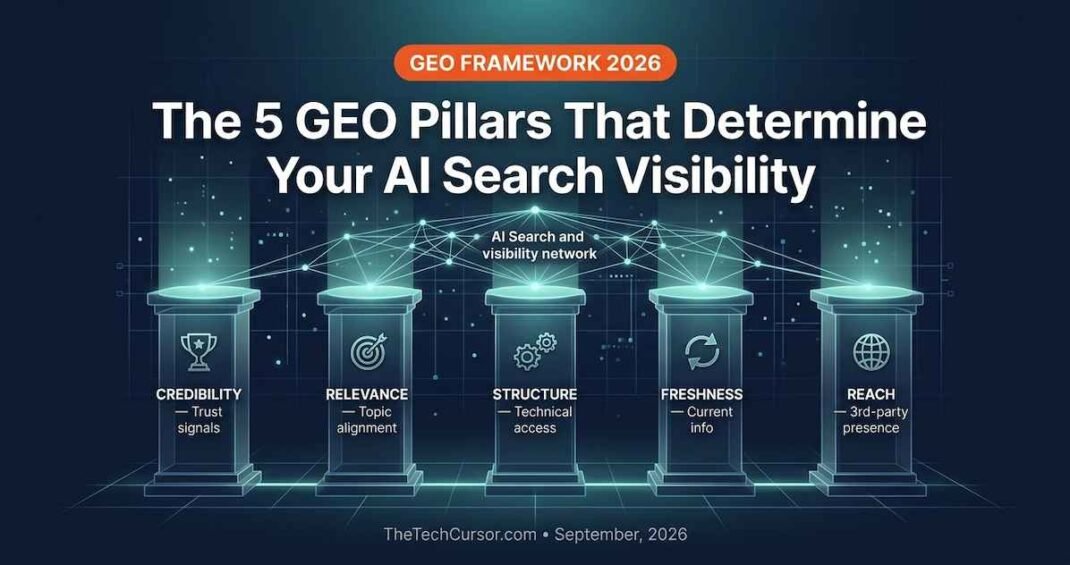
The brands consistently appearing in AI search responses are not executing random GEO tactics. They are building across five interconnected pillars that collectively determine how AI systems understand, trust, and cite them.
Understanding these five pillars — and which ones your brand is weakest on — is the difference between GEO as a series of one-off projects and GEO as a sustainable competitive advantage.
1. Why GEO Needs a Framework, Not Just Tactics
Generative Engine Optimization differs from traditional SEO in one fundamental way: the evaluation is holistic, not query-by-query.
Traditional SEO asks: does this page rank for this keyword? The answer is specific, measurable, and actionable at the page level.
GEO asks: does this brand deserve to be recommended? That question is answered by AI systems drawing on everything they know about the brand — its content, its citations, its third-party mentions, its entity associations, and the consensus of sources that discuss it.
A single well-optimized page cannot make an AI system recommend your brand. A coherent, well-built brand presence across multiple signals can. That is what the five pillars framework addresses — the dimensions of brand presence that collectively determine AI recommendation probability.
2. The 5 GEO Pillars at a Glance
| Pillar | Core Question | Primary Signals |
|---|---|---|
| Credibility | Can AI systems trust your brand? | E-E-A-T, third-party validation, author credentials |
| Relevance | Does your content match AI query intent? | Topic coverage, query alignment, specificity |
| Structure | Can AI systems read your content? | Technical accessibility, schema, heading hierarchy |
| Freshness | Is your information current? | Content recency, update frequency, news coverage |
| Reach | Where does your brand appear? | Third-party mentions, citations, community presence |
Each pillar is independent enough to diagnose separately. However, weakness in any one pillar creates a ceiling on what the others can achieve. A brand with perfect structure but low credibility will not be cited. A brand with high credibility but poor relevance will not appear for the right queries.
3. Pillar 1: Credibility — Can AI Systems Trust Your Brand?
Credibility is the foundation of GEO. AI systems are designed to recommend sources that users can trust. Before any other pillar matters, the brand must clear a credibility threshold.
What credibility means for AI systems:
AI systems evaluate credibility through multiple overlapping signals. Named authors with verifiable expertise signal that real humans with accountable identities stand behind the content. Third-party mentions from authoritative sources signal that the brand has been evaluated by others and found credible. Consistent entity information across the web signals that the brand is a stable, real entity rather than a transient or manufactured presence.
Key credibility signals to build:
Named author profiles are the most immediately actionable credibility signal. Every piece of content published under a name should connect to a verifiable author identity — LinkedIn profile, published bio, industry recognition, or expert credentials. Generic “editorial team” bylines contribute nothing to credibility signals.
Third-party validation from sources AI systems already trust carries significant weight. Coverage in industry publications, analyst reports, academic citations, and established media outlets all contribute to the credibility signal that AI systems draw on. As detailed in the Invisible PR guide, this validation does not require links — unlinked mentions in credible contexts contribute to credibility signals that AI systems incorporate.
Review platform presence on sites like G2, Capterra, Trustpilot, or Gartner adds credibility for product and service brands. These platforms are consistently cited by AI systems for vendor evaluation queries. A brand absent from relevant review platforms is absent from a primary credibility signal for its category.
Credibility red flags:
Anonymous content, inconsistent brand information across platforms, absence from industry publications, and no presence on category-relevant review platforms all weaken credibility signals. These issues do not just affect AI visibility — they affect every touchpoint in the customer journey.
4. Pillar 2: Relevance — Does Your Content Match AI Query Intent?
Credibility determines whether AI systems trust your brand. Relevance determines whether they associate your brand with the right topics and queries.
What relevance means for AI systems:
AI systems build topic associations for every brand they encounter. When enough signals consistently connect your brand to a specific topic area, the AI system develops confidence that your brand is relevant for queries in that area. Weak or inconsistent topic signals produce uncertain associations — and uncertain associations produce inconsistent AI recommendations.
Building strong relevance signals:
Topic depth beats topic breadth for AI relevance. A brand that covers five topics comprehensively is more reliably cited for those five topics than a brand that covers fifty topics superficially. AI systems reward depth of coverage within a defined topic area — not the breadth of topics touched.
Query alignment is the practical application of topic depth. Before producing content, map the actual queries your target audience submits to AI systems. As covered in the query templates and topical authority guide, organizing content around query patterns rather than individual keywords produces better alignment with how AI systems process information.
Specificity improves relevance signals significantly. Generic content about broad topics is less likely to be cited than specific content addressing precise questions. “How to choose project management software” is a generic topic. “How to choose project management software for remote engineering teams with Jira already in the stack” is specific — and far more likely to be cited for the precise query it addresses.
Relevance red flags:
Publishing content across too many unrelated topics, producing generic overviews of broad subjects, and failing to cover the specific questions your audience actually asks AI systems are all relevance weaknesses. Each produces weaker topic associations that reduce AI recommendation probability.
5. Pillar 3: Structure — Can AI Systems Actually Read Your Content?
Structure is the most technical of the five pillars — and the one most likely to be creating invisible GEO problems that content and credibility improvements cannot fix.
What structure means for AI systems:
AI systems retrieve and process your content through crawlers and indexing systems before it ever appears in a generated response. Content that is technically inaccessible — blocked by robots.txt, rendered in JavaScript that crawlers cannot process, buried behind authentication, or poorly organized for extraction — cannot be cited regardless of its quality.
Key structural requirements:
Crawler accessibility is the baseline. Your most important content must be accessible to AI crawlers. Review robots.txt, meta robots tags, and JavaScript rendering to confirm that key pages are actually being crawled and indexed. As highlighted in the Freshpet GEO playbook, high-value content like reviews and Q&A sections is frequently locked behind JavaScript that crawlers cannot access — creating invisible GEO gaps.
Heading hierarchy helps AI systems identify what each section of a page addresses. Descriptive headings that clearly communicate section content make it easier for AI systems to extract the specific information relevant to a query. Vague or keyword-stuffed headings create parsing challenges that reduce extraction accuracy.
Schema markup helps AI systems classify content type, identify author information, understand entity relationships, and extract structured data. At minimum, implement Article, Organization, and Person schema for content pages. Additionally, implement Product, Review, FAQ, and HowTo schema where applicable. Schema markup directly improves AI citation probability by reducing ambiguity in how AI systems classify and represent your content.
Page speed affects crawl priority. Slow pages receive less frequent crawling — meaning content updates take longer to register in AI systems that rely on fresh indexed content.
Structure red flags:
JavaScript-rendered content, inconsistent heading hierarchies, missing schema markup, blocked crawlers, and slow page speeds all create structural barriers that prevent otherwise good content from being cited.
6. Pillar 4: Freshness — Is Your Information Current Enough to Cite?
Freshness is the pillar most frequently underestimated in GEO programs. AI systems — particularly those using retrieval-augmented generation — weight recent information more heavily than outdated information for time-sensitive topics.
What freshness means for AI systems:
For fast-moving topics — AI tools, platform features, regulatory changes, market data — AI systems specifically seek recent sources. A page published two years ago may contain accurate background information but be deprioritized in favour of more recent sources for queries where recency matters.
Furthermore, AI systems encounter stale information and sometimes cite it confidently. When your brand’s content contains outdated statistics, superseded product information, or historical claims presented without date context, AI systems can cite that stale information — creating brand accuracy problems that are difficult to detect and correct.
Building freshness signals:
Regular content audits identify pages where key claims, statistics, or product information have gone stale. Updating these pages — with a visible updated date — signals freshness to both crawlers and AI systems. As covered in the Google content quality checklist, accurate and current information is a core quality signal.
Publishing cadence contributes to freshness signals at the site level. Sites that publish regularly demonstrate ongoing investment in current information — a signal that AI systems incorporate when evaluating source reliability for time-sensitive queries.
News coverage and PR mentions create external freshness signals. When your brand appears in recent news articles, industry publications, and timely coverage, AI retrieval systems encounter your brand in fresh, indexed contexts — supplementing your owned content with third-party freshness signals.
Freshness red flags:
Pages with statistics from several years ago presented without date context, product pages describing features that have since changed, and blog archives with no recent publication activity all create freshness problems. These issues are invisible in standard SEO reporting but directly affect AI citation quality and accuracy.
7. Pillar 5: Reach — Where Does Your Brand Appear Beyond Your Site?
Reach is the pillar that extends GEO beyond your own website — into the third-party web that AI systems draw on alongside owned content.
What reach means for AI systems:
AI systems do not evaluate brands based only on their own websites. They synthesize information from across the web — editorial coverage, review platforms, community discussions, social content, podcast transcripts, and countless other sources. A brand that exists only on its own website has a narrow reach that limits how much information AI systems have available to form confident associations and recommendations.
Building reach signals:
Editorial coverage in industry publications is the highest-value reach signal for most brands. Being mentioned, quoted, or featured in publications that AI systems already consider authoritative creates strong entity associations that owned content cannot replicate. Pitching expert commentary, contributing guest analysis, and participating in industry roundups all build editorial reach.
Community presence on platforms like Reddit, LinkedIn, and niche forums creates conversational reach signals. As established in AI citation research, Reddit accounts for a significant percentage of the sources AI systems draw on for decision-stage queries. Authentic participation in relevant communities — answering questions, sharing insights, contributing expertise — builds the kind of conversational presence that AI systems encounter during retrieval.
Podcast and video appearances create reach signals through transcripts and show notes. These are indexed, crawlable, and frequently cited by AI systems for expertise-related queries. A regular cadence of appearances on relevant podcasts builds both reach and credibility simultaneously.
Partner and ecosystem mentions extend reach through association. When complementary brands, industry partners, and ecosystem tools mention your brand in their content, those mentions create entity associations that expand the network of signals AI systems draw on.
Reach red flags:
No presence in industry publications, absence from relevant review platforms, no community participation, and an ecosystem of third-party mentions that is thin or dominated by low-authority sources all indicate weak reach. These weaknesses cannot be compensated by owned content quality alone.
8. How the Five Pillars Work Together
The five pillars are not independent — they interact and amplify each other when built in combination.
Credibility amplifies reach. A brand with strong credibility signals gets more value from each third-party mention — because AI systems weight mentions from credible brands more heavily than mentions from unknown ones. Building credibility first makes every subsequent reach investment more effective.
Relevance focuses structure. Knowing precisely which topics and queries you are targeting makes structural decisions more effective. When you know which content needs to be cited for which queries, you can prioritize structural improvements on the specific pages that matter most for those queries.
Freshness supports credibility. A brand that consistently publishes accurate, current information builds a track record of reliability that AI systems incorporate into credibility evaluation. Freshness is not just a signal in isolation — it contributes to the overall trustworthiness assessment.
Reach validates relevance. Third-party sources that discuss your brand in the context of specific topics validate your relevance for those topics independently of your own content claims. When industry publications, review platforms, and community discussions consistently associate your brand with a specific topic area, that external consensus reinforces the relevance signals from your owned content.
The compounding effect of all five pillars working in alignment is why the most successful GEO programs treat AI visibility as a coordinated brand investment — not a collection of isolated SEO tactics.
9. Diagnosing Your GEO Gaps
Before building an action plan, diagnose which pillars represent your brand’s greatest gaps.
Credibility audit: Search for your brand name across major AI systems. Does the information they return accurately reflect your brand? Are your authors identifiable and credible? Do you appear on relevant review platforms? Is there consistent, positive third-party coverage?
Relevance audit: Run 20-30 prompts relevant to your category across ChatGPT, Gemini, Claude, and Perplexity. Does your brand appear? For which topics? Are the associations accurate? Where are you consistently absent?
Structure audit: Crawl your site with Screaming Frog. Check robots.txt and meta robots for unintended blocks. Review JavaScript rendering for content locked behind client-side rendering. Audit schema markup coverage. Check page speed for key pages.
Freshness audit: Identify your ten most-cited pages and check every statistic, product claim, and date reference. Flag anything more than 18 months old without a visible update date. Review your publishing cadence for the last six months.
Reach audit: Search for your brand name in Google News, on Reddit, and across major industry publications. Count the number of credible third-party mentions in the last 90 days. Compare your mention volume to two or three key competitors.
The pillar with the lowest score relative to your competitors is typically where GEO investment produces the fastest improvement in AI visibility.
10. Building Your GEO Pillar Action Plan
Once gaps are identified, prioritize actions by pillar — starting with the foundation and working outward.
Month 1-2: Credibility and Structure. These are the prerequisite pillars. Without credibility, AI systems will not cite you regardless of how relevant your content is. Without structural accessibility, your content cannot be retrieved regardless of its quality. Fix crawlability issues, implement schema markup, establish named author profiles, and identify the highest-priority review platforms for your category.
Month 3-4: Relevance. With credibility and structure in place, focus on topic alignment. Audit your content against the queries your audience submits to AI systems. Identify the gaps between what you publish and what AI systems are retrieving for your category. Commission content that addresses those gaps — prioritizing specificity and depth over breadth.
Month 5-6: Freshness. Conduct a systematic freshness audit of your highest-priority content. Update stale statistics, product information, and historical claims. Establish a content maintenance calendar that triggers reviews for key pages on a regular cadence.
Ongoing: Reach is built continuously rather than in a discrete phase. Establish a regular cadence of editorial outreach, podcast appearances, community participation, and partner co-marketing. Track brand mention volume and source quality monthly against competitor benchmarks.
Measurement: Track progress against each pillar using the AI visibility dashboard framework — prompt tracking for relevance and reach, Search Console AI reports for structural accessibility, brand monitoring tools for credibility and reach signals, and content audit logs for freshness.
11. Bottom Line
GEO is not a single tactic or a one-time optimization. It is a five-pillar brand investment that determines how AI systems understand, trust, and cite your brand across every surface where AI search is active.
The five pillars — Credibility, Relevance, Structure, Freshness, and Reach — each address a distinct dimension of AI visibility. Weakness in any one creates a ceiling on what the others can achieve. Strength across all five creates the compounding advantage that makes AI recommendation a reliable, scalable channel rather than an unpredictable outcome.
Diagnose your gaps. Prioritize by pillar. Build systematically. The brands that build all five pillars in coordination will consistently outperform those executing isolated GEO tactics — and that competitive advantage will compound as AI search continues to expand.
Pingback: State of Search 2027: What to Stop, Measure & Fund - The Tech Cursor
Pingback: Schema for AI Search: Turn Entity Gaps Into Growth - The Tech Cursor
Pingback: 9 Ecommerce Search Trends for 2027: Real Store Data - The Tech Cursor
Pingback: How to Build an AI Visibility Dashboard (2026 Guide) - The Tech Cursor
Pingback: New Study: Google AI Mode Sends Fewer Clicks, Worse UX - The Tech Cursor
Pingback: AI Mode Follow-Up Questions Reveal Your Content Gaps - The Tech Cursor
Pingback: Global vs Local E-E-A-T: Build Trust Without Confusing AI Search - The Tech Cursor