
Read time: 8 min
Table of Contents
- What Entity Gaps Actually Are
- The Three-Bucket Entity Audit Framework
- How to Build Your Entity Gap Audit
- Case Study: Partner A — Schema Fixes Drive 20% Lead Quality Lift
- Case Study: Partner B — Content Strategy Reverses Traffic Decline
- The Schema Fixes That Made the Difference
- What to Do When You Cannot Fill an Entity Gap
- Connecting Entity Work to AI Visibility
- Entity Reconciliation as Ongoing Infrastructure
- Bottom Line
Schema markup and entity SEO have been part of technical SEO for years. However, most implementations stop at adding structured data and hoping for the best. The brands seeing real gains in 2026 are doing something different. They are auditing their entity gaps systematically. They find where AI systems misunderstand or cannot verify their brand. Then they fix those gaps with specific schema and content changes.
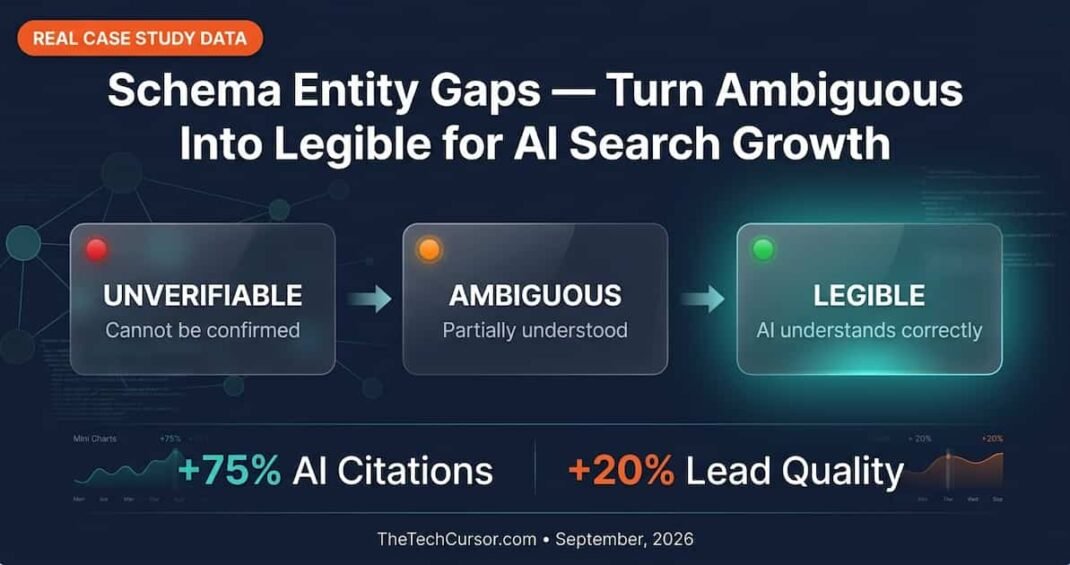
Ray Martinez, VP of SEO at Archer Education, recently shared case study data from two university programs. The results are among the most concrete entity SEO outcomes publicly documented. Partner A saw a 75% increase in AI citations over six months. Their lead-to-payment rate improved by 20%. Furthermore, Partner B reversed a year-over-year traffic decline. Their organic lead volume rose 18%.
Moreover, the process behind those results is directly applicable to any brand with entity gaps — not just higher education.
1. What Entity Gaps Actually Are
An entity gap is a mismatch between what your brand actually is and what AI systems and search engines can verify about it.
AI systems build understanding of brands from multiple sources. They read your schema markup. They also read your page content. Then they cross-reference that against third-party sources. When your schema says one thing but your content implies another, the AI system faces a reconciliation problem.
That reconciliation problem produces three outcomes. Sometimes the AI system gets your brand right. Sometimes it gets it partially right with important details missing. In other cases, it cannot verify your claims at all. Consequently, it either omits your brand or misrepresents it.
These three outcomes map directly to the three-bucket audit framework.
2. The Three-Bucket Entity Audit Framework
Every entity associated with your brand falls into one of three categories. The categories are universal. They apply to products, services, programs, people, and locations equally.
Legible entities are understood correctly by AI systems. Your schema accurately describes them. Additionally, your content reinforces them and third-party sources corroborate them.
Ambiguous entities are partially understood but inconsistently represented. Your schema may use vague language. Furthermore, your content may describe the entity differently from your schema. AI systems encounter conflicting signals and produce uncertain or inconsistent representations. These entities need clarification.
Unverifiable entities are claimed on your site but not supported by enough external evidence or precise enough schema for AI systems to confirm. These entities either get omitted from AI responses or are cited with low confidence. They need either stronger evidence or honest acknowledgment that they cannot currently be verified.
Therefore, the goal of entity gap work is to move entities from ambiguous and unverifiable into legible. This requires both schema improvements and content changes — often simultaneously.
3. How to Build Your Entity Gap Audit
The audit process Ray Martinez describes uses vector embeddings to compare your current site against an ideal entity model. This is a sophisticated technical approach. However, the underlying logic is accessible to any SEO team.
Step 1: Define your ideal entity model
First, start by listing every entity that matters for your brand. For a product company, this includes product names, features, specifications, pricing structures, and use cases. For a service business, this includes service types, delivery methods, credentials, outcomes, and geographic coverage. For each entity, define what accurate, specific, verifiable information looks like.
Step 2: Audit your current schema against the ideal model
Next, compare your existing schema.org markup against your ideal entity model. For each entity, ask three questions. First, is this entity present in your schema? Second, is the schema specific enough to be unambiguous? Third, is the format machine-readable rather than human-readable text?
Step 3: Audit your content for entity reinforcement
Schema alone is not sufficient. AI systems cross-reference schema claims against page content. If your schema declares a specific attribute but your content is vague, the schema claim becomes ambiguous. Therefore, check that your content reinforces every schema entity with specific, consistent language.
Step 4: Categorize each entity
Then, using your audit findings, categorize every entity as legible, ambiguous, or unverifiable. Prioritize the ambiguous and unverifiable entities that appear on your highest-value pages — product pages, service pages, or whatever drives the most commercial activity on your site.
Step 5: Prioritize by commercial impact
Finally, fix the entities on your most commercially important pages first. As Martinez notes, “In higher education, the program page is the money asset.” Every business has an equivalent — the pages where entity clarity most directly affects conversion. Start there.
4. Case Study: Partner A — Schema Fixes Drive 20% Lead Quality Lift
Partner A is a private, multi-campus international university. They had underdeveloped AI visibility and organic presence despite a distinctive international learning model. Their AI share of voice sat at 1% against competitors, with the category leader holding 22%.
The entity audit revealed a specific problem. Their schema and content used imprecise, human-readable language. However, prospective students and AI systems both needed to verify those attributes precisely.
For example, their program pages listed “good academic record” as an admissions requirement. That phrase is unmeasurable. AI systems cannot verify whether a prospective student meets it. Furthermore, prospective students cannot self-qualify against it. The fix was simple but significant: replace “good academic record” with a specific numeric GPA threshold.
Similarly, program duration was expressed as “15 months” in plain text. This is technically correct but not machine-readable in a format AI systems and search engines recognize for structured comparisons. The fix converted it to ISO 8601 format — P15M — which is precisely parseable.
These fixes were repeated across more than a dozen entities. In each case, the change was simple. Vague human-readable text was replaced with specific machine-readable values.
The results were measurable and concrete:
AI Citation and Lead Quality Results
AI citations grew from approximately 1,600 per month in January 2026 to 42,000 per month by mid-2026. That is a 75% increase over six months. Organic lead volume declined 23% year-over-year — however, this decline was more than offset by quality improvement. Their lead-to-payment rate improved from 7.8% to 9.4%, a 20% improvement. Their application-to-payment rate rose from 34.7% to 42.9%.
However, the interpretation is important. Fewer leads, but significantly more of them converted to paying students. Notably, the entity work did not just improve AI visibility. It improved the quality of the audience the program attracted — because better entity clarity meant more students arrived with accurate expectations and genuine fit.
5. Case Study: Partner B — Content Strategy Reverses Traffic Decline
Partner B is an online nursing program for a regional college. The program had dominated organic traffic for years. However, it was experiencing declining organic clicks and increasing competition from similar programs with comparable offerings.
Their entity audit told a different story from Partner A. Partner A’s primary issue was schema precision. However, Partner B’s primary issue was content coverage. They had identified entities — career outcomes, admissions information, curriculum details — that mattered to prospective nursing students but were inadequately covered on their program pages and supporting content.
Furthermore, their blog content was disconnected from their program page. It covered nursing career topics. However, it did not reinforce the specific entities prospective students needed to make enrollment decisions.
Consequently, the fix involved three changes. They updated the program page content around degree naming conventions, admissions information, and program outcomes. They refreshed existing blog articles to align with the program page entities. They built internal links from blog articles to the program page to reinforce entity associations.
They also added a more robust schema implementation to both the program page and refreshed blog articles.
The results reversed the declining trend:
Organic lead volume increased 18% year-over-year. Application volume rose 22%. AI citations grew approximately 11% year-over-year and approximately 77% above the prior six months. AI share of voice moved from approximately 1.8% to 2.5% — still well below the category leader’s 27%, but demonstrably gaining ground.
6. The Schema Fixes That Made the Difference
The specific schema changes Partner A made illustrate the principle that applies across any business category. The pattern is consistent: replace vague human-readable text with specific machine-readable values.
| Entity | Before | After | Why It Matters |
|---|---|---|---|
| Program duration | “15 months” (text) | ISO 8601 P15M | Machine-parseable for structured comparisons |
| Start dates | Ambiguous text | ISO 8601 YYYY-MM-DD | Precise date matching for AI retrieval |
| Credit hours | “45 credits” text | QuantitativeValue + unitText | Structured numeric data |
| Language | “English” | ISO 639-1 “en” | Standard code for language matching |
| GPA requirement | “good academic record” | Numeric 3.0/4.0 | Verifiable, specific threshold |
| Delivery mode | Implied | Explicit “on-campus” | Removes ambiguity |
| Tuition | Buried in other fees | Stated per-credit rate | Findable, comparable |
The underlying principle applies universally. Anywhere your schema or content uses vague language for an attribute users need to verify precisely, there is an entity gap. Specifically, look for approximate, implied, or unspecific descriptions.
For example, for an ecommerce brand, this means precise product specifications rather than marketing descriptions. For a service business, this means specific outcome data rather than general benefit claims. Similarly, for a SaaS company, this means specific feature descriptions and integration lists rather than capability summaries.
7. What to Do When You Cannot Fill an Entity Gap
One of the most practically valuable insights from the Archer Education case studies is the honest acknowledgment that not every entity gap can or should be filled.
Partner A did not address application deadlines in their schema. Their rolling starts across multiple campuses made a single deadline declaration inaccurate. Moreover, adding an inaccurate deadline would have created a worse user experience than leaving the entity ambiguous.
Partner B did not heavily emphasize faculty entities. Faculty availability created complications. Claiming specific faculty credentials that could not be consistently maintained would undermine trust rather than build it.
This is an important principle. Inaccurate entity claims are worse than missing entity claims. AI systems that discover contradictions between your schema claims and verifiable reality may reduce their confidence in your other claims as well.
When you identify an unverifiable entity gap, you have three options. First, address the underlying reality that makes the entity unverifiable, then add it. Second, leave the gap acknowledged in your audit as an institutional constraint. Third, add the entity only at a level of specificity that can be consistently verified.
The option to avoid is claiming an entity that cannot be consistently verified. That approach creates more problems than it solves.
8. Connecting Entity Work to AI Visibility
Specifically, the connection between entity gap work and AI visibility is direct. AI systems retrieve and cite brands based on how confidently they can characterize what the brand is, what it offers, and how it compares to alternatives.
When your entities are ambiguous, AI systems face a choice. They either avoid citing you in favour of competitors with clearer entity signals. Alternatively, they cite you with low confidence. Both outcomes reduce your AI share of voice.
When your entities are legible, AI systems can cite you with higher confidence. Specifically, they can cite you accurately for the attributes prospective customers care about. Legible means specific, machine-readable, and corroborated by content.
This connects directly to the 5 GEO pillars framework. Specifically, the Credibility and Structure pillars are directly served by entity gap work. Credibility improves when your claims are specific and verifiable. Moreover, Structure improves when your schema is precise and machine-readable.
The schema and AI citations guide covers the specific schema types most valued by AI retrieval systems. Entity gap work is the strategic layer on top of that technical foundation. You need both: the right schema types implemented precisely, and the right entity coverage filling the gaps AI systems encounter when they try to characterize your brand.
9. Entity Reconciliation as Ongoing Infrastructure
The Archer Education case studies demonstrate one more important principle. Specifically, entity reconciliation is not a one-time project. It is ongoing infrastructure.
Content and facts drift over time. Program requirements change. Product features evolve. Pricing structures shift. Consequently, every time your real-world entity changes without a schema update, a new entity gap opens.
Furthermore, AI systems continue to improve their ability to detect contradictions between claimed and verifiable entities. What was sufficient in 2024 may now produce ambiguous signals. The standard is rising.
Furthermore, three practices make entity reconciliation sustainable rather than episodic.
Regular entity audits — quarterly or semi-annually — catch drift before it becomes significant. An audit does not need to be as comprehensive as the initial baseline audit. A focused review of high-priority entities on your most commercially important pages is sufficient for ongoing maintenance.
Content update protocols — ensuring that whenever a real-world entity changes, the corresponding schema and content updates happen simultaneously. This prevents the common pattern where marketing updates the product page copy but the schema remains outdated.
Monitoring AI output for entity accuracy — as part of your AI visibility dashboard, regularly testing whether AI systems represent your brand entities accurately. When AI outputs contradict your claimed entities, that signals a new gap requiring investigation.
10. Bottom Line
Entity gap work is one of the highest-ROI technical SEO investments available in 2026. The Archer Education case studies show what is possible: 75% growth in AI citations, 20% improvement in lead quality, and reversal of a year-over-year traffic decline — all from audit-driven schema fixes and content alignment.
The three-bucket framework — legible, ambiguous, unverifiable — is simple enough to apply to any business. The fixes are primarily about precision. Replace vague language with specific values. Convert human-readable descriptions to machine-readable formats. Additionally, ensure content reinforces schema claims consistently.
Furthermore, the principle that not every gap should be filled is equally important. Accurate entity claims at lower specificity are better than inaccurate claims at higher specificity. Honest gaps are better than manufactured ones.
Start Your Entity Audit This Week
Start by identifying your three most commercially important pages. Then list every entity they contain. Next, categorize each as legible, ambiguous, or unverifiable. Fix the ambiguous entities with specific values and consistent content reinforcement. Leave the unverifiable entities honest about what they are. Repeat the process quarterly.
Entity work is infrastructure. Build it systematically. Maintain it consistently. The AI visibility gains will follow.