
Read time: 8 min
Table of Contents
- Why Strong SEO Was Not Enough for AI Visibility
- The Starting Point — Observation Before Assumption
- The Four-Pillar GEO Framework
- Pillar 1: Relevance — Write for People, Be Parseable by Machines
- Pillar 2: Authority — Contextual Credibility Over Big-Name Links
- Pillar 3: Structure — Make the Important Stuff Findable
- Pillar 4: Engagement — Community as a Content Research Tool
- The 475-Prompt Tracking System
- How to Build Your Own Prompt Audit
- Measuring AI Visibility Without Pretending Attribution Is Simple
- Bottom Line
Freshpet had established SEO rankings, years of content, significant third-party coverage, and strong brand recognition in the pet food category. When AI Overviews and large language models began reshaping how buyers discover products, the team assumed that foundation would carry over.
It did not.
The brand was frequently absent from AI-generated recommendations about fresh pet food — despite being a category leader in traditional search. That gap became the starting point for a deliberate generative engine optimization (GEO) program developed with Intero Digital. Consequently, the Freshpet case study is one of the most detailed real-brand GEO implementations publicly documented. Here is the complete playbook — and how to apply it to your own brand.
1. Why Strong SEO Was Not Enough for AI Visibility
The assumption that good SEO automatically translates to AI visibility is one of the most common and most costly misconceptions in digital marketing right now. However, it is simply not true.
As Cosima Compton of Intero Digital explained in the webinar, LLMs try to understand industries, concepts, and relationships between entities — not simply reproduce a conventional search results page. A recognized brand may therefore be absent from AI recommendations when its available content does not clearly establish how it relates to a user’s specific question.
This is the core distinction between traditional SEO and GEO. Traditional SEO is about ranking for queries. GEO is about being understood by AI systems — becoming the clear, credible answer to a specific question, not just a page that contains relevant keywords.
Freshpet’s experience demonstrates that these are genuinely different problems requiring genuinely different solutions. A brand can have excellent traditional SEO and poor AI visibility simultaneously — and fixing AI visibility requires work that traditional SEO alone does not cover.
2. The Starting Point — Observation Before Assumption
The first and most important step in Freshpet’s GEO program was systematic observation — recording what AI systems actually said about the brand before assuming what needed to be fixed.
As Compton recommended: ask the questions your customers are likely to ask, record what the systems return, and identify where your brand is missing, misrepresented, or supported by outdated information.
This observation-first approach matters because AI visibility problems are not uniform. For example, a brand might appear correctly in response to “best fresh dog food” but be absent from “fresh pet food for dogs with sensitive stomachs.” Each type of gap requires a different fix.
Furthermore, this observation reveals which AI systems have different gaps. ChatGPT, Gemini, Claude, and Perplexity often return meaningfully different responses to the same query — because they draw on different training data and retrieval systems. A brand may appear confidently in one system and be absent from another.
Without systematic observation, remediation efforts are guesswork. However, with it, they become targeted and prioritized.
3. The Four-Pillar GEO Framework
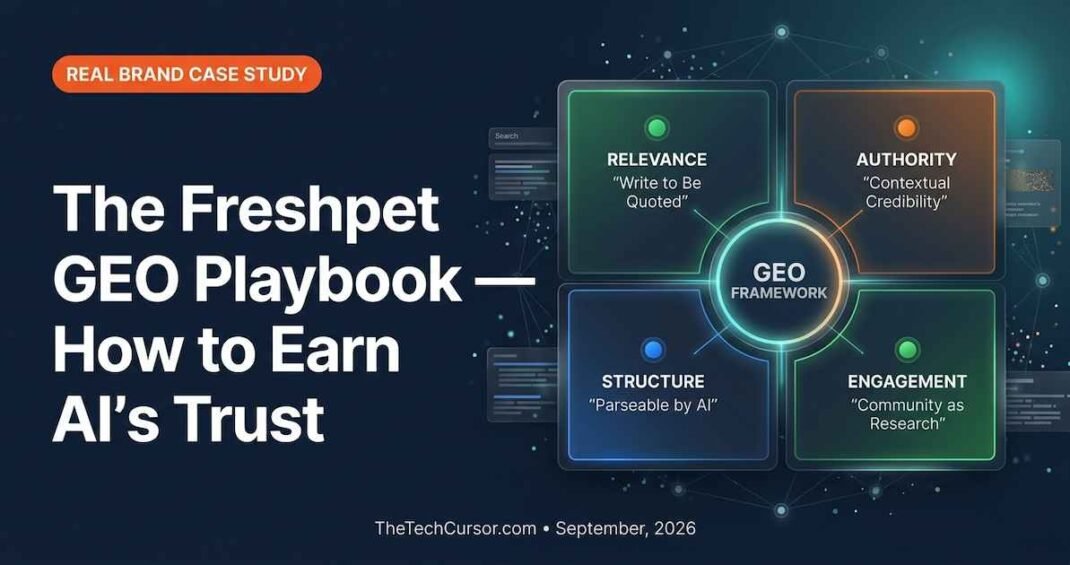
Intero Digital’s GEO framework is organized around four pillars that collectively address the factors influencing AI visibility. The pillars work best when they reinforce each other — not as isolated channels but as a coordinated system.
Relevance: Content directly answers current audience questions and matches the intent behind them.
Authority: Claims have enough context, sourcing, and third-party validation to be trusted by AI systems evaluating credibility.
Structure: Important information is accessible to both crawlers and readers — parseable, scannable, and extractable.
Engagement: Community conversations and third-party discussions are monitored as research inputs and addressed with authoritative content.
Each pillar is discussed in detail in the sections below. The key integration insight from the Freshpet case study is that onsite content, SEO, earned media, and social strategy should reinforce the same priority topics — not operate as disconnected channels that happen to mention the same brand name.
4. Pillar 1: Relevance — Write for People, Be Parseable by Machines
One of Steven Elwell’s clearest observations from the Freshpet experience was that much of the brand’s legacy content had been written like a magazine article — designed to draw a reader through a narrative from beginning to end.
That approach may serve human readers. However, the key facts are harder for an LLM to extract when they are buried in long passages. The AI systems that process Freshpet’s content need to identify specific, quotable claims — not read a story to the end to find the point.
The solution is not to strip away brand voice or write awkward copy for robots. Rather, it is to organize complex ideas into focused sections that can stand on their own. A page can still sound natural while using:
- Descriptive headings that communicate what each section contains
- Direct answers placed at the beginning of relevant sections
- Short, substantive paragraphs rather than extended narratives
- Meaningful lists and tables where they serve the content
Elwell described the shift as writing content that can be quoted, not merely read. For Freshpet, that meant revisiting page templates, formatting rules, and the underlying approach to information architecture — not just rewriting individual sentences.
Compton also recommended reviewing pages regularly, especially when they contain changing statistics or time-sensitive details. AI systems can cite outdated information from pages that have not been updated — and stale citations create both accuracy problems and brand perception problems simultaneously.
5. Pillar 2: Authority — Contextual Credibility Over Big-Name Links
The Freshpet team drew an important distinction between having backlinks and building contextual authority — one that has direct implications for how to think about link building in the GEO era.
A mention in a major national publication can still be valuable. However, an industry-specific source may do more to establish a brand’s relationship to a specialized topic. Elwell noted that a credible pet industry publication can reinforce Freshpet’s expertise in ways a broad national outlet may not — because AI systems evaluating Freshpet’s authority in pet nutrition are looking for signals from sources that are themselves authoritative about pet nutrition.
This connects directly to why traditional link building no longer works for AI search: context is the new authority signal. A link or mention that clearly establishes your brand’s expertise in a specific area is more valuable for AI visibility than a mention that simply includes your brand name on a high-authority domain.
Furthermore, Ratliff highlighted that the surrounding coverage matters significantly. If every mention uses the brand name as anchor text and points to the homepage, AI systems receive less context about the specific subjects the brand should be associated with. Earned media works harder for GEO when the article itself accurately explains the brand’s expertise and connects to a relevant onsite resource.
What authority building looks like in practice:
- Author credentials clearly displayed for all subject-matter expert content
- Citations to reputable sources within onsite content — not just claims
- Industry directory listings in category-relevant directories
- Editorial coverage in publications specific to your category
- Third-party mentions that explain what the brand is known for, not just that it exists
6. Pillar 3: Structure — Make the Important Stuff Findable
Technical structure has a direct impact on GEO performance — and Freshpet’s experience surfaced a specific technical issue that is easy to miss and surprisingly common.
Consequently, the team discovered that valuable content existed on Freshpet’s pages but was delivered through JavaScript in ways that made it difficult for AI crawlers to access. Product reviews and Q&A content — exactly the kind of authentic, credible information AI systems value highly — were not readily visible to LLMs because of how they were rendered.
The takeaway is to audit the rendered experience, not just the editorial inventory. The checklist:
- Crawler access: Are robots.txt and meta robots directives allowing AI crawlers to access important content?
- JavaScript rendering: Is high-value content — reviews, Q&A, specifications — available in parseable HTML, or locked behind JavaScript rendering that crawlers cannot process?
- Page speed: Slow pages may be deprioritized by crawlers with limited budgets
- Clean HTML: Messy markup creates parsing challenges that reduce extraction accuracy
- Schema markup: Relevant structured data helps AI systems understand content type, author, date, and relationships between entities
Compton also recommended using descriptive headings throughout — not just for SEO, but because headings serve as navigation signals that help AI systems identify which section of a page addresses which question.
7. Pillar 4: Engagement — Community as a Content Research Tool
Reddit and community platforms matter for GEO because customers use them to exchange candid opinions — and because AI systems can draw from those conversations when generating responses.
However, the Freshpet approach to community engagement is notably measured. Elwell explained that pet nutrition can be as emotionally charged as conversations about baby food. Arguing with individual users would not serve the brand — and could easily backfire in a community context where authenticity is highly valued.
Instead, Freshpet takes a listening-first approach. The team monitors community discussions to identify recurring questions or misconceptions — and then creates authoritative content elsewhere that addresses those questions with clear, evidence-backed answers.
This distinction is important and directly relevant to the GEO vendor scam patterns circulating in the industry: community monitoring as a research input is legitimate and valuable. Manufactured community mentions — paying for fake Reddit posts or astroturfed discussions — are both unethical and increasingly detectable by AI systems.
The legitimate version of community engagement for GEO is: listen to what real users are saying, identify the genuine questions and concerns, and create authoritative onsite content that answers them. AI systems then have access to the credible answer when they synthesize information about your category.
8. The 475-Prompt Tracking System
The most impressive operational detail from the Freshpet case study is the scale of their prompt tracking program.
Additionally, Elwell revealed that Freshpet tracks 475 prompts across the major LLMs — ChatGPT, Gemini, Claude, and Perplexity — organized into topic categories. That structure allows the team to:
- Spot clusters of weak answers across related topics
- Identify which AI systems have different gaps for the same query
- Create content that addresses multiple related questions simultaneously
- Involve subject matter experts in areas where their credentials can strengthen AI confidence in the brand’s authority
- Track visibility trends over time rather than just point-in-time snapshots
475 prompts is a significant operational investment. However, the logic behind it is directly applicable at any scale. The goal is not a specific prompt count — it is having a set broad enough to represent the full customer journey and organized well enough that findings lead to specific, prioritized work.
9. How to Build Your Own Prompt Audit
For brands and marketers who do not yet have a dedicated AI visibility platform, Compton outlined a practical manual starting point that requires no specialized tools.
Step 1: Build your prompt set. Develop at least 20-30 prompts covering the core questions in your market — across awareness, consideration, and decision stages. Include:
- Category-level questions (“what is the best [product type]?”)
- Brand comparison queries (“how does [brand] compare to [competitor]?”)
- Use-case specific questions (“what [product type] is best for [specific situation]?”)
- Problem/solution queries (“what should I use if [specific problem]?”)
Step 2: Run prompts across multiple LLMs Test each prompt in ChatGPT, Gemini, Claude, and Perplexity. Record the responses — specifically: does your brand appear? In what context? With what level of accuracy? Which sources are cited?
Step 3: Document gaps systematically. For each prompt, note whether the brand is: present and accurate, present but inaccurate, absent, or mentioned in a context that does not serve the brand’s positioning. This documentation becomes the foundation for prioritizing remediation.
Step 4: Map gaps to the four pillars. For each documented gap, identify which pillar it falls under. A gap caused by missing content is a relevance problem. A gap caused by insufficient third-party validation is an authority problem. A gap caused by crawlability issues is a structure problem.
Step 5: Prioritize by proximity to conversion. Fix gaps closest to revenue first. Comparison queries and purchase-stage questions directly affect whether a buyer chooses your brand. Awareness-stage gaps are important but lower-urgency relative to gaps that are costing active purchase decisions.
10. Measuring AI Visibility Without Pretending Attribution Is Simple
Elwell’s candid framing of GEO measurement is one of the most practically useful parts of the Freshpet case study — because it resists the temptation to overclaim attribution that the data cannot support.
AI visibility does not map neatly to the traditional model of ranking, click, and conversion. Freshpet’s primary site often sends customers to retailers — making direct revenue attribution from AI visibility particularly difficult. The measurement approach combines referral traffic from LLM citations, downstream actions, and modelled relationships. Google Search Console’s AI Performance Reports and GA4 configurations provide the most reliable available signals for tracking these patterns.
Elwell’s caution is worth repeating: do not get too far ahead of observable data with projected attribution. Combine directional indicators, visibility trends, and business events — but be explicit about what the data can and cannot prove.
This connects directly to TheTechCursor’s article on measuring brand AI visibility — which covers the specific Search Console reports, GA4 configurations, and third-party monitoring tools that provide the most reliable available signals for AI search performance.
11. Bottom Line
The Freshpet GEO playbook is one of the most detailed and honest public accounts of what it actually takes to build AI search visibility for an established brand.
Key Lessons From Freshpet’s GEO Program
The key lessons are:
- Strong traditional SEO does not automatically transfer to AI visibility — the two require genuinely different work
- Start with systematic observation across multiple AI systems before assuming what needs to be fixed
- Address all four pillars — relevance, authority, structure, and engagement — as a coordinated system rather than isolated channels. Write content that can be quoted and extracted, not just read from beginning to end — Google’s 14-point content quality checklist covers exactly the quality signals that make content both rankable and citable.
- Build contextual authority through industry-specific sources, not just high-domain-authority links
- Audit rendered content, not just editorial inventory — JavaScript-delivered content may be invisible to AI crawlers
- Use community monitoring as research input for content creation, not as a channel for brand promotion
- Track prompts across multiple LLMs systematically — and prioritize gaps closest to conversion
- Measure what you can observe, model what you cannot, and be honest about the difference
GEO is not a single tactic or a one-time optimization. As Compton summarized: it is a coordinated process — learn how the brand appears, make its expertise easier to verify, remove technical barriers, build contextual authority, and measure outcomes with appropriate caution.
Freshpet started with observation. Start there.
Pingback: Topic Clusters for SEO and AI Search in 2026 - The Tech Cursor