
Topic Clusters for SEO and AI Search in 2026
Read time: 8 min
Table of Contents
- Why Topic Clusters Matter More Than Ever in 2026
- The Classic Topic Cluster Model — And What It Misses for AI Search
- What AI Search Systems Need From Topic Clusters
- Step 1: Choose the Right Pillar Topic
- Step 2: Map Supporting Content Around Real Audience Needs
- Step 3: Build Entity Signals Into Every Piece
- Step 4: Internal Linking With Intent
- Step 5: Freshness and Maintenance
- Measuring Topic Cluster Performance in 2026
- Common Mistakes That Undermine Topic Clusters
- Bottom Line
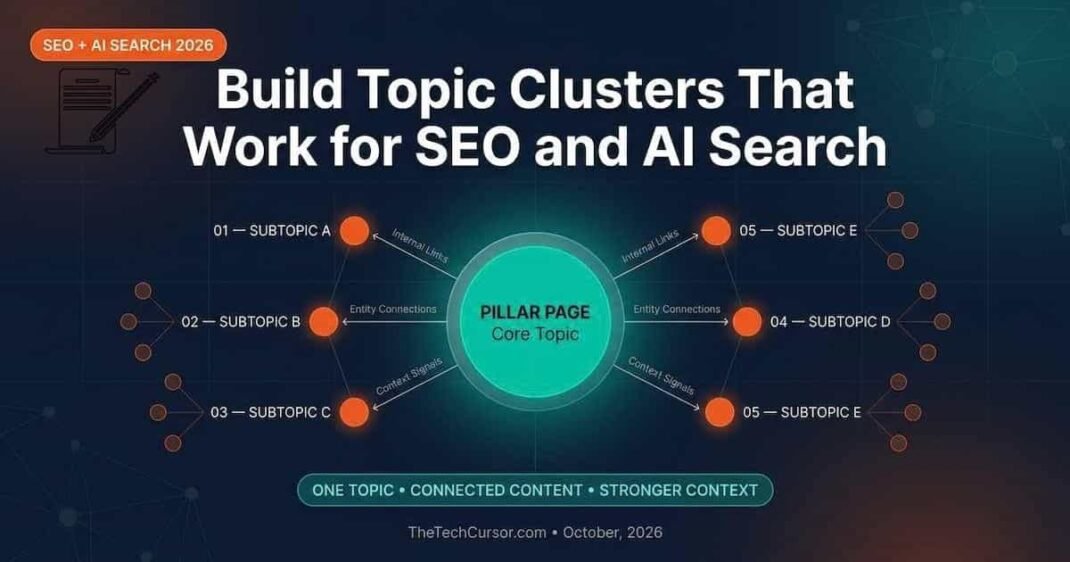
Topic clusters have been a core content strategy framework for nearly a decade. The logic has always been sound: build a central pillar page that covers a broad topic authoritatively, surround it with spoke content that covers subtopics in depth, and link them together to reinforce topical authority.
However, AI search has added a new layer to this framework. A topic cluster that works well for traditional SEO ranking does not automatically work well for AI search visibility. Consequently, building clusters in 2026 means thinking about two overlapping but distinct goals simultaneously.
1. Why Topic Clusters Matter More Than Ever in 2026
The case for topic clusters has strengthened in the AI search era — not weakened.
AI systems build understanding of brands and websites holistically. They look for consistent, deep coverage of a defined topic area across multiple pieces of content. Furthermore, they evaluate whether the content on a site genuinely addresses the questions real users ask — not just whether individual pages rank for specific keywords.
A site with comprehensive topic cluster coverage sends a clear signal: this source covers this topic in depth and from multiple angles. That signal directly increases the probability of AI citation for queries related to the cluster topic. Additionally, it supports traditional search rankings, which remain the primary driver of most sites’ organic traffic.
Topic clusters therefore serve both channels simultaneously. Done well, a single content investment improves traditional SEO performance and AI search visibility at the same time.
2. The Classic Topic Cluster Model — And What It Misses for AI Search
The classic topic cluster model has three components: a pillar page, spoke content, and internal links.
The pillar page covers a broad topic comprehensively — typically at a length and depth that establishes it as the definitive resource on the subject. Spoke content covers specific subtopics in greater depth than the pillar page can address. Internal links connect the spoke content back to the pillar and connect related spokes to each other.
This model works well for traditional SEO. However, it was designed before AI search was a primary consideration. For AI search specifically, it misses three things.
First, it does not account for entity signals. Traditional topic clusters focus on keywords and topics — but AI systems need entity signals to understand what the content is about and who is behind it. Named authors, specific credentials, and consistent entity associations across the cluster all matter for AI citation probability.
Second, it does not account for the question-answer structure that AI systems favour when generating responses. Traditional spoke content is often structured as explanatory text. AI systems prefer content where specific questions have clear, extractable answers.
Third, it does not account for freshness signals at the cluster level. AI retrieval systems weight recent content more heavily for time-sensitive topics. A cluster where spoke content has not been updated in two years loses AI citation probability even if the pillar page is strong.
3. What AI Search Systems Need From Topic Clusters
AI systems evaluate topic clusters differently from traditional search algorithms. Understanding what they look for makes cluster design decisions clearer.
Topical coherence: AI systems are more likely to cite a source consistently when the site demonstrates clear, coherent coverage of a defined topic area. A site whose content spans too many unrelated topics sends weaker entity signals than one with focused, deep coverage of a narrower area.
Entity clarity: Every piece in the cluster should reinforce the same entity associations — the same author credentials, the same brand positioning, the same expertise area. Inconsistent entity signals across a cluster create ambiguity that reduces AI citation confidence.
Answerable content: Spoke content structured around specific questions — with direct, extractable answers — is more useful to AI systems than explanatory content that requires reading from beginning to end to extract the key point. The Freshpet GEO playbook describes this as writing content that can be quoted rather than just read.
Schema reinforcement: Structured data that labels the content type, identifies the author, and marks up key entities helps AI systems classify and cite the content accurately. Furthermore, FAQ schema on spoke content pages with a question-answer structure makes that content directly parseable for AI retrieval.
4. Step 1: Choose the Right Pillar Topic
The pillar topic determines everything that follows. Choosing it well is the most important decision in building a topic cluster.
A good pillar topic has three characteristics.
It is broad enough to support multiple spoke pieces: A pillar topic that only generates three or four natural subtopics is too narrow. The right pillar generates at least eight to twelve clear subtopics — each of which can be covered in a standalone piece of 800 to 1,500 words.
It maps to genuine commercial interest: The pillar topic should connect clearly to what your business does and what your target audience searches for. A topic cluster built around a topic that does not map to your commercial goals produces traffic without business value.
It represents an area where you have genuine expertise: AI citation probability is highest for content that demonstrates genuine expertise — original data, first-hand experience, or credentials that validate the authority claims the content makes. Choose a pillar topic where your team has something genuinely substantive to say. The content quality checklist provides a useful framework for evaluating this.
5. Step 2: Map Supporting Content Around Real Audience Needs
Spoke content should be driven by actual audience questions — not by keyword volume alone.
Keyword tools show which phrases people type into search engines. However, they systematically underrepresent the questions people ask AI systems. Most AI sub-queries have zero search volume in keyword research tools. Consequently, a spoke content map built purely from keyword data will miss significant portions of the audience need landscape.
Three research approaches complement keyword data.
Customer and sales team intelligence: The questions your sales team hears on calls, the objections that delay deals, and the language real customers use to describe their problems are all spoke content opportunities that keyword tools cannot see. One conversation with a sales representative can surface ten spoke content topics that would never appear in a keyword research report.
Community and forum research: Reddit, LinkedIn, Quora, and niche community forums contain the natural-language questions your audience asks when they are not searching on Google. These questions reflect real information needs expressed in authentic vocabulary — exactly the content that AI systems retrieve for conversational queries.
AI system prompting: Ask ChatGPT, Gemini, and Perplexity what questions people typically ask about your pillar topic. The sub-questions these systems generate reflect the kinds of queries they are trained to answer — which directly predicts which spoke content topics will earn AI citations.
6. Step 3: Build Entity Signals Into Every Piece
Entity signals are the component of topic cluster design most consistently overlooked in traditional SEO frameworks. They matter significantly for AI search visibility.
Named author attribution: Every piece in the cluster should carry a named author with a brief biography that states specific credentials relevant to the topic. Generic “editorial team” bylines contribute nothing to entity signals. A named expert who can be verified — through LinkedIn, published work, or industry recognition — provides a strong credibility signal to AI systems evaluating whether to cite the content.
Consistent brand entity signals: The schema markup, about page, and profile information for the brand should consistently describe the same expertise areas that the topic cluster covers. Inconsistency between brand-level entity claims and cluster-level content creates ambiguity. AI systems faced with ambiguous entity signals tend to cite with lower confidence — or not at all.
Cross-referencing supporting evidence: Spoke content that cites primary sources — research studies, official documentation, expert statements — builds credibility signals that AI systems weight positively. Furthermore, original data that no other source has — a survey, a proprietary analysis, a case study — is the highest-value entity signal available. AI systems are significantly more likely to cite content containing original data than content that summarizes what other sources have already said.
7. Step 4: Internal Linking With Intent
Internal linking in a topic cluster serves multiple purposes — and the traditional SEO rationale needs updating for 2026.
Traditional rationale: internal links pass PageRank from spoke content to the pillar page, reinforcing the pillar’s authority for its target keyword.
2026 rationale: internal links also signal topical relationships to AI crawlers. When a spoke page links to the pillar and to related spoke pages, the link pattern communicates the semantic relationships between topics — helping AI systems understand how the pieces of the cluster relate to each other.
Several internal linking principles apply specifically to AI search performance.
Anchor text should be descriptive and specific. Generic “click here” or “read more” anchors provide no semantic signal. Anchor text that describes the target page’s topic precisely — “our guide to keyword research for voice search” rather than “more on this topic” — communicates a clear relationship between the linking and linked pages.
The pillar page should link to every major spoke piece. Spoke pieces should link to the pillar and to closely related spokes. This creates a coherent web of relationships rather than a one-directional hierarchy.
Furthermore, every significant update to spoke content is an opportunity to add or update internal links. A content refresh that adds a new section covering a topic addressed by another spoke page should add a contextual internal link to that spoke page.
8. Step 5: Freshness and Maintenance
A topic cluster is not a build-once-and-leave asset. It requires ongoing maintenance to sustain both traditional SEO performance and AI citation probability.
Set up a content calendar for the cluster: Each spoke piece should have a review date — typically quarterly for fast-moving topics and annually for stable ones. The review process checks for outdated statistics, superseded product information, and changes in industry consensus that might make the existing content inaccurate.
Prioritize freshness on time-sensitive spokes: Some spoke topics change more rapidly than others. Spokes covering AI tool features, platform policies, algorithm updates, and regulatory requirements need more frequent reviews than spokes covering foundational concepts. Allocate review resources accordingly.
Update the pillar page to reflect new spoke content: When new spoke content is added to the cluster, update the pillar page to reference and link to it. The pillar should always represent the current state of the cluster — not the state it was in when the cluster was first built.
Monitor AI citation status quarterly: Prompt tracking for the pillar topic and key spoke topics reveals whether AI systems are citing the cluster’s content and for which queries. Changes in citation status often reflect content freshness issues, entity signal inconsistencies, or competitor content that has entered the cluster’s topic area. The AI visibility dashboard covers how to track these signals systematically.
9. Measuring Topic Cluster Performance in 2026
Topic cluster measurement requires tracking two parallel sets of metrics — traditional SEO performance and AI search performance.
Traditional SEO metrics: Organic impressions and clicks for pillar and spoke pages. Rankings for target keywords across the cluster. Internal link click-through rates from spoke to pillar. Time on page and engagement metrics for spoke content.
AI search metrics: AI citation share for pillar topic queries — tracked through prompt testing across ChatGPT, Gemini, Claude, and Perplexity. AI referral traffic in GA4 — sessions from AI platforms to cluster pages. Brand mention volume in the context of the pillar topic — tracked through brand monitoring tools.
Integrated view: The most useful view combines both sets. A topic cluster that drives strong traditional rankings but low AI citation share may have entity signal gaps. Conversely, a cluster that drives AI citations but low traditional traffic may have technical or keyword targeting issues. Addressing both simultaneously requires seeing both sets of metrics together.
10. Common Mistakes That Undermine Topic Clusters
Several patterns consistently undermine topic cluster performance — in both traditional SEO and AI search.
Building for volume rather than depth: A cluster with twenty thin spoke pages covering superficial subtopics performs worse than a cluster with eight substantial spoke pages covering genuine audience needs in depth. Spoke content that only summarizes what the pillar already says adds no value to either traditional or AI search.
Orphaning spoke content: Spoke content that is not linked from the pillar page — or that does not link back to the pillar — is functionally disconnected from the cluster. It cannot pass topical authority signals or benefit from the cluster’s overall entity associations.
Ignoring entity signals: A cluster built around strong keyword targeting but with generic bylines, no schema markup, and inconsistent brand entity information will underperform on AI citations relative to its traditional SEO strength. Entity signals are not optional in 2026.
Neglecting maintenance: Clusters that are built and left without ongoing freshness management gradually lose AI citation probability as the content ages. Furthermore, competitor content that addresses the same topics with more recent data can displace older cluster content in both rankings and AI citations.
11. Bottom Line
Topic clusters remain the most effective content architecture for building topical authority in both traditional search and AI search. However, building them for 2026 requires a more intentional approach than the classic pillar-and-spoke model described.
The additions that matter most are entity signals on every piece, question-answer structure in spoke content, schema markup that labels content type and author, and ongoing freshness management that keeps the cluster competitive over time.
Topic Cluster Build Checklist
- Pillar topic chosen — broad enough for 8-12 spokes, commercially relevant, expertise-backed
- Spoke topics mapped from keyword data, customer intelligence, and AI system prompting
- Named author attribution on every piece with stated credentials
- FAQ schema on spoke pages with direct question-answer structure
- Internal links — pillar to all major spokes, spokes to pillar and related spokes
- Content review calendar set — quarterly for fast-moving topics, annually for stable ones
- AI citation tracking set up — prompt tracking and GA4 AI referral segment