
Category: Content Strategy | SEO | AI Content | Digital Marketing
Read time: 9 min
Table of Contents
- How SEO Turned Writing Into a Commodity
- The AI Content Boom — Was It Actually Worth It?
- Content Is a Weak Force — And Always Was
- Human Slop vs AI Slop — There Is No Difference
- Why You Still Need Content in an AI Search World
- The Writer’s Real Job Has Always Been Thinking, Not Typing
- The J.K. Rowling Proof — Quality Is Not Objective
- What the Idea Economy Means for Your SEO Strategy
- How to Compete When Words Are Free
- Bottom Line
AI has made the production of words incredibly cheap. That single fact is reshaping the economics of SEO content — and raising a question the industry has been reluctant to confront directly: What is content worth when the words themselves cost almost nothing?
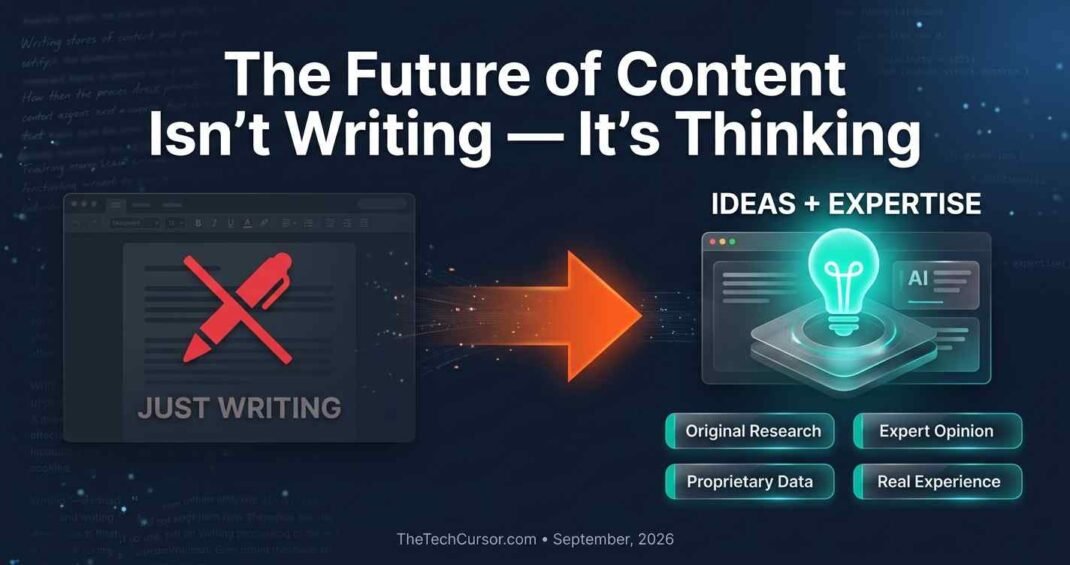
The answer is not what most SEO agencies want to hear. The value was never in the words. It was always in the ideas behind them. The brands and SEO professionals who understand this are entering what Andrew Holland of JBH calls the idea economy — where thinking, expertise, judgment, and original insight are the scarce resources that drive content performance.
The rest are producing cheaper and cheaper versions of the same thing — and getting correspondingly cheaper results.
1. How SEO Turned Writing Into a Commodity
The original logic of SEO content was sound. Identify the searches businesses were paying Google to appear for in paid ads. Earn those positions organically instead. Reduce paid-search dependency. Generate demand without paying for every click.
That model still makes sense. However, over time, the SEO industry drifted from that logic toward a simpler proposition: publish more content, get more rankings, get more traffic, sell more retainers.
Content became perfect for the agency retainer model because it took time to produce. Writers were abundant. Salaries stayed relatively low. Agencies could charge handsomely for production while clients received a stream of deliverables and a traffic graph that trended upward — at least for a while.
The implicit assumption was that volume drove results. More pages, more keywords, more traffic. The connection between content quality and business outcomes was rarely examined rigorously. Traffic was the metric that sold retainers, so traffic was what got optimized.
Then AI made the production of words incredibly cheap. And that exposed a commercial problem that was always present but easy to ignore when words were expensive to produce: the value was never in the volume of words. It was in the quality of the thinking behind them.
2. The AI Content Boom — Was It Actually Worth It?
The SEO industry witnessed an AI content mountain between 2023 and 2025. Publishers using AI writing tools and programmatic content systems posted case studies showing enormous traffic growth from publishing thousands of pages. Then many of those same sites lost that traffic just as spectacularly — hit by core algorithm updates, helpful content system penalties, and the scaled content abuse policies that Google has been enforcing with increasing aggression.
The industry response was predictable: “See. We told you not to do it.” Then came the recovery audits.
However, a question that rarely gets asked is whether the AI content boom was actually worth it for the brands that ran it. If a company generated millions of visits while content production costs collapsed, the answer cannot be decided by looking only at the final downward line on a traffic chart. The honest assessment requires knowing what the content cost, what it generated in revenue and leads while it worked, and whether the economics made sense across the full arc.
That is marketing: inputs, outputs, return. The moral panic about who typed the sentences does not answer those questions. Some of the AI content experiments probably had positive ROI even accounting for the eventual penalty. Many did not. We will never fully know — because the industry moved from cheerleading to condemnation without ever doing the math.
What is clear is that the sites that maintained traffic through the AI content era were not the ones that published the most pages. They were the ones whose content contained genuine ideas, original information, and expert perspective that AI could not simply generate itself. That pattern points directly to where content value now lives.
3. Content Is a Weak Force — And Always Was
Before diagnosing what AI has changed about content, it is worth being honest about what content was never particularly good at — even before AI disrupted it.
Content marketing is, at its core, a form of advertising. Brands create content to expose people to information intended to influence what they know, think, or do. Like advertising, it is usually a weak force. How many people read one blog article and immediately decide to buy software? Not many.
People are busy. They have jobs, families, financial pressures, and dozens of competing claims on their attention. They are not waiting eagerly to consume a 2,000-word “ultimate guide” to something they will evaluate for three minutes and then forget.
Howard Gossage’s observation — that people read what interests them, and sometimes it’s an ad — is the most honest description of how content actually works. Most SEO content failed that test long before AI arrived. It was 2,000 words of deliberate dullness created because a keyword research tool showed a phrase had 1,300 monthly searches — with no consideration of whether the reader would find the result genuinely useful.
AI did not create weak content. It industrialized the production of content that was already weak. The question now is what separates content worth reading from the volume of content that has always been forgettable.
4. Human Slop vs AI Slop — There Is No Difference
One of the strangest assumptions in the AI content debate is that human writing is automatically good. It is not. The $10 article existed long before generative AI. So did the $35, 1,000-word article based on no research, no experience, no original information, and no interesting point of view.
Human slop and AI slop share the same fundamental problem: an absence of ideas. Neither has anything worth saying. The production method is irrelevant when the content itself is empty.
Spend more on content, and you typically buy more time — more research, more thought, more editing, better writing. The expensive writer brought judgment, experience, and original perspective that the cheap writer did not. AI changes the economics of that process: research happens faster, drafting happens faster, rewriting happens faster. However, none of those speed improvements changes the fundamental requirement that something worth saying must exist before the writing begins.
A real-world example illustrates the shift. A head of content at a SaaS company needed content produced for the brand. A writer quoted a substantial day rate. Instead, the team built an AI content process, got “good enough” drafts, and had their internal team enhance and elevate the output at a fraction of the original cost.
That is not a story about AI replacing good writers. It is a story about AI commoditizing production — and shifting the value question from “who typed this?” to “does this content contain an idea worth communicating?”
The only sustainable defence against AI commoditization is bringing something other than words to the table. That means original research and proprietary data, first-hand expertise, genuine opinions, and perspectives derived from real experience. None of those can be generated by a language model operating without human input — because they do not exist until a human creates them.
5. Why You Still Need Content in an AI Search World
Given that AI Overviews are reducing clicks to publisher content — with organic search clicks falling significantly since AI Overviews expanded — the question of why brands should invest in content at all is reasonable.
The answer is that content is your voice. It is how your brand places information into the world.
Content lets you explain what your product does and what it does not do. It lets you demonstrate why you make something a certain way, what expertise you possess, what you have learned from experience, and what you disagree with in your industry.
Humans read it. Search engines index it. AI systems encounter it during training and retrieval. Journalists reference it when writing about your category. Customers share it when they find it genuinely useful.
None of that guarantees distribution. Publishing content without a promotional strategy is a hope, not a plan. However, publishing nothing guarantees invisibility. If you never say anything, you give the market very little to work with — and you give AI systems very little accurate information to use when someone asks about your brand or category.
Furthermore, content that appears in AI citations — cited as a source in AI Overviews, AI Mode, or ChatGPT responses — generates brand awareness and entity authority even when it does not generate a direct click. The traffic may not always arrive immediately, but the brand impression, the entity signal, and the authority association are all valuable outcomes that compound over time.
6. The Writer’s Real Job Has Always Been Thinking, Not Typing
If AI can research and draft increasingly well, what exactly are brands paying a writer to do?
The answer is not typing. It is thinking. Research direction. Experience. Taste. Observation. Argument. Customer understanding. Original information. Editing. Judgment.
Brands are paying someone to decide what deserves to exist — what is worth saying, to whom, and why. That is a fundamentally different value proposition than producing a specified number of words about a specified keyword, which was the implicit job description for much of SEO content writing.
In the old keyword-first content model, the brief dictated the article. Find the keyword. Look at what ranks. Produce something similar, usually longer. Writers served the keyword rather than the reader.
In the idea economy, writers become more valuable upstream — at the strategic level before production begins. The more important questions become:
- What should this brand actually talk about?
- What does it know that competitors do not?
- What does the market misunderstand about this category?
- What perspective can we publish that changes how someone thinks about the problem we solve?
- If we had to spend significant budget promoting this piece after publication, would it be worth promoting?
Those are better questions than “how many words should this article be?” — and AI cannot answer them without significant human direction and expertise.
7. The J.K. Rowling Proof — Quality Is Not Objective
One of the most clarifying examples of what content value actually means comes not from SEO but from publishing.
J.K. Rowling’s Harry Potter and the Philosopher’s Stone began with a tiny print run of 500 copies, roughly 300 of which went to libraries and schools. That book eventually became one of the most commercially successful publishing phenomena in history.
Years later, Rowling submitted a crime novel under the pseudonym Robert Galbraith. Publishers rejected it. One advised “Galbraith” to take a writing course. When the novel was eventually published under the pseudonym, it received respectable reviews but sold approximately 1,500 hardback copies. Then Rowling’s identity was revealed. The book shot to number one.
Same book. Same sentences. Same ideas. Different context, different distribution, different results.
That story does not prove quality is meaningless. It proves that quality is not some objective substance poured into a manuscript by a human author that readers automatically recognize and reward. Distribution matters. Context matters. Fame matters. Ideas matter — but so does everything around them.
For SEO content, the implication is significant. The question of whether AI wrote the first draft is less important than whether the content contains ideas worth reading, is positioned in a context that gives those ideas credibility, and has sufficient distribution to reach the audience it is meant to serve.
AI will expose content with no ideas — because cheap production makes emptiness easier to scale and therefore easier to identify. However, it will also empower people with exceptional expertise and ideas who previously struggled to express them in polished prose. The engineer who writes badly but knows something genuinely valuable. The consultant with decades of experience who never had time to document it. The founder with proprietary market insight who does not naturally reach for a keyboard.
8. What the Idea Economy Means for Your SEO Strategy
The shift from a production economy to an idea economy has direct implications for how to build a content strategy that performs in 2026 and beyond.
Audit what you actually know. The most valuable content your brand can produce comes from what you genuinely know and cannot be easily replicated. Internal data, customer research, proprietary methodologies, hard-won experience from years in your industry — these are the raw materials for idea economy content. Before commissioning more production, audit what your organization actually knows that is worth publishing.
Invest in research before production. The content marketing performance collapse documented in Orbit Media’s 2026 survey correlates strongly with a decline in pre-production research — including keyword research, competitor analysis, and audience understanding. Brands that maintained those research investments are the ones still reporting strong content results. The lesson: research is not overhead to be cut when AI makes production cheaper. It is the input that determines whether production is worth doing.
Make your expertise verifiable. E-E-A-T signals — Experience, Expertise, Authoritativeness, and Trustworthiness — matter more in the idea economy than they ever did in the production economy. Named authors with verifiable credentials, first-hand experience explicitly stated in content, and third-party validation of expertise claims are all signals that both Google and AI systems use to evaluate whether your content deserves to rank and be cited.
Think about distribution before you publish. The Rowling/Galbraith example illustrates that ideas without distribution stay invisible. Before commissioning any piece of content, the question “how will this reach the people it is meant for?” should have a specific answer. If the answer is “we will publish it and hope Google ranks it,” the content probably does not deserve to be commissioned.
9. How to Compete When Words Are Free
The practical question for every content team and SEO professional reading this is how to compete when AI has commoditized the thing they were previously paid to produce.
Double down on original data. Original research and proprietary data cannot be generated by AI without human input — because the data does not exist until someone designs the study, runs the survey, or analyzes the proprietary dataset. A survey of your customers, an analysis of your internal conversion data, or a study of trends in your category creates content that is genuinely unique. AI systems cite original research at significantly higher rates than generic content, making it doubly valuable in an AI search era.
Develop genuine opinions. Generic, balanced coverage of any topic can now be produced by AI in seconds. What AI cannot produce is a genuine, defensible opinion derived from real experience. Taking positions — even controversial ones — distinguishes idea economy content from commodity content. Opinion requires a person with actual beliefs based on experience, which is precisely what AI lacks.
Build topical authority through depth. A brand that covers a narrow topic with genuine depth — more comprehensive, more expert, more current than any competitor — builds the kind of topical authority that AI search systems recognize and cite consistently. Breadth without depth produces the kind of content mountain that algorithm updates have been dismantling. Depth within a focused niche produces the authority that compounds over time.
Invest in the humans who have the ideas. The most important investment shift in the idea economy is redirecting budget from production toward the people who generate ideas worth producing. Subject matter experts, experienced practitioners, researchers, and strategic thinkers are more valuable than ever — not as writers, but as the source of raw material that makes content worth reading regardless of who or what does the writing.
10. Bottom Line
The future of content is not writing. It is thinking. The production of words is now a commodity. The ideas behind them — the expertise, judgment, original research, genuine opinions, and defensible perspectives that no language model can generate without human input — are the scarce resource that determines content value.
This shift does not mean AI is bad or that human writing is automatically better. It means the question that matters has changed. The old question was: “How do we produce more content faster?” The new question is: “Do we have ideas worth communicating — and are we communicating them in ways that reach the people they are meant for?”
Welcome to the idea economy. The brands that answer that second question well will outperform those still answering the first — regardless of which tools they use to produce the words.
Pingback: MIT, Anthropic & OpenAI's Warning: What Marketers Do Now - The Tech Cursor
Pingback: Anthropic's Power Prompts: A Marketer's Guide to Fable 5.1 - The Tech Cursor
Pingback: AI Mode Follow-Up Questions Reveal Your Content Gaps - The Tech Cursor