
There is a version of SEO goal-setting that most teams are still doing — and it is quietly becoming one of the most expensive habits in digital marketing.
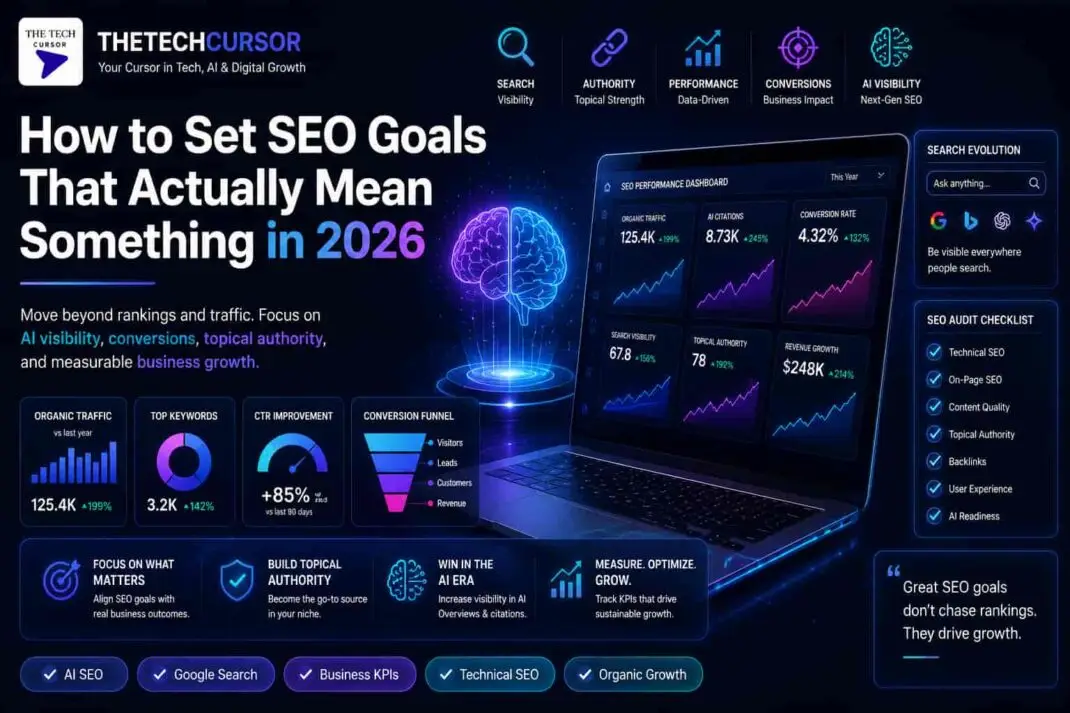
The goal gets set in January: increase organic traffic by 20%. The team spends twelve months publishing content, building links, and running technical audits. Traffic holds flat — or drops. The post-mortem blames the algorithm. Nobody asks the harder question: was traffic the right goal in the first place?
In 2026, organic traffic is an increasingly unreliable proxy for SEO performance. A brand can appear in an AI Overview, get cited by Perplexity, influence a purchase decision on ChatGPT, and drive real revenue — with none of those actions registering as a session in GA4. Meanwhile, a site can hold its traffic numbers while losing meaningful ground to competitors who are showing up in the AI-generated answers that are quietly reshaping how people find everything.
The measurement framework most teams are using was built for a different search landscape. This article is about building one for the current one.
Table of Contents
- Why Traditional SEO Metrics Are Misleading More Teams Than They Used To
- What a Good SEO Goal Looks Like in 2026
- Step 1 — Start With the Business, Not the Channel
- Step 2 — Build Baselines Before You Set Targets
- Step 3 — Map the Full Search Landscape, Including AI
- Step 4 — Set Goals You Can Actually Resource
- Step 5 — Build a Diagnostic Review Cadence, Not Just a Reporting Cadence
- SEO Goal Examples That Work in 2026
- Bottom Line
Why Traditional SEO Metrics Are Misleading More Teams Than They Used To
Organic traffic was never a perfect metric. It was always a proxy — a reasonable approximation of whether SEO was working, grounded in the assumption that more visibility in search results would produce more sessions.
That assumption is eroding.
AI Overviews now answer a growing share of queries directly in the SERP — reducing clicks even when rankings hold. Zero-click searches have been a known dynamic for years, but the scale has accelerated. And on AI-native platforms — ChatGPT, Perplexity, Gemini, Microsoft Copilot — brand citations drive real discovery and real decisions that produce no session data at all.
The result is a measurement gap that is becoming material for a growing number of businesses. SEO can be working — in the sense that it is creating brand awareness, driving discovery, and influencing purchase decisions — while traffic numbers stay flat or decline. And SEO can appear to be working — traffic holding steady — while a brand is steadily losing ground in the AI-generated responses where more and more discovery is happening.
Neither situation shows up clearly in a traffic dashboard. Both require different measurement approaches to detect.
This does not mean traffic is irrelevant. It means it should no longer be the headline KPI — and that teams relying on it as their primary measure of SEO health are operating with an increasingly incomplete picture.
What a Good SEO Goal Looks Like in 2026
The standard framework for goal-setting — SMART: Specific, Measurable, Achievable, Relevant, Time-bound — is still the right structure. What has changed is what those criteria should be applied to.
Specific means starting with a business outcome, not a channel metric. “Increase organic traffic” is a channel metric. “Increase qualified leads from organic search by 25% in six months” is a business outcome. The difference is not semantic — it determines what you measure, what you optimize, and whether your SEO work can demonstrate real value to the business.
Measurable means having a reliable tracking source before you set the target. If you cannot track a metric consistently — if the data is broken, incomplete, or requires manual reconciliation every month — it should not be a goal. Identify your measurement source first. Ideally, that means closing the loop between organic sessions and CRM data: pipeline, revenue, or qualified leads that can be attributed to organic. When that is not available, identify the on-site actions that best represent SEO’s contribution to business outcomes — form fills, demo requests, purchases, content downloads — and track those.
Achievable means grounded in your current baseline, your competitive environment, and your team’s actual capacity. A 50% increase in organic leads is not a stretch goal if your site is already well-optimized and in a growing market. It is an unrealistic target if you are in a competitive space with a small team and limited development support.
Relevant means connected to what the business actually cares about this year. If the business objective is pipeline growth, the SEO goal should connect to the pipeline. If the objective is market expansion, the SEO goal should connect to visibility in the new market. SEO goals that optimize for channel metrics while the business is focused on revenue create a credibility gap that is hard to close.
Time-bound means a specific deadline with a realistic understanding of how long SEO changes take to register. For most sites, meaningful movement on competitive terms takes three to six months minimum. Build timeframes that reflect this reality rather than ones that create pressure for results that the timeline cannot support.
Step 1 — Start With the Business, Not the Channel
Every SEO goal should begin with a business question, not a channel question.
The channel question is: “How do we grow organic traffic?” The business question is: “What does the organization need to achieve this year, and what role can organic search play in achieving it?”
Those two starting points lead to very different goal structures.
A team starting from the business question will identify the specific outcomes the organization is measuring — revenue, pipeline, qualified leads, customer acquisition — and work backwards to the organic metrics that connect to them. A team starting from the channel question will optimize for traffic and hope the business impact follows.
In practice, this means having a conversation with leadership or the broader marketing team before setting SEO goals. What are the business priorities for the next six to twelve months? Which products or services are the focus of growth investment? Are there new markets, new audiences, or new product lines where visibility is needed?
Once you have clear answers to those questions, the SEO goal-setting process becomes significantly more concrete. You are no longer deciding between “rank for more keywords” and “increase domain authority.” You are deciding which specific queries, audiences, and conversion paths SEO should prioritize — and setting goals that reflect that prioritization.
One practical rule: if you cannot draw a direct line from your SEO goal to a specific business outcome, the goal needs to be revised before it is finalized.
Step 2 — Build Baselines Before You Set Targets
The most common goal-setting mistake is setting targets before establishing what the current baseline actually is.
Without a baseline, targets are arbitrary. A 20% increase in organic leads sounds specific and measurable — but 20% of what? From what starting point, measured how, over what period?
Baselines require data. Useful sources include GA4 for conversion tracking, Google Search Console for rankings and impressions, CRM integrations for revenue attribution where available, and third-party tools for competitive benchmarking and keyword landscape analysis.
For teams with limited historical data — a new site, a recent migration, or poor tracking hygiene — the first goal is to build the baseline itself. That is a legitimate goal for the first 90-day period, and it sets up every subsequent goal to be more meaningful.
A few baseline elements worth establishing before setting targets:
Organic conversion rate by landing page. Which pages are generating conversions from organic traffic, and at what rate? This is the most direct signal of organic’s contribution to business outcomes — and it varies significantly across page types, keyword intent clusters, and audience segments.
Keyword visibility for priority terms. Where do you currently rank for the queries that matter most to the business? This is the starting point for any ranking-improvement goal and the reference point for detecting meaningful shifts over time.
AI search presence. Are you showing up in AI-generated responses for the queries that matter most to your audience? This is harder to measure systematically — no platform provides complete coverage data — but directional monitoring through prompt testing across ChatGPT, Perplexity, and Gemini gives you a starting point.
Branded search volume trends. Branded search is often a downstream indicator of brand awareness and SEO performance — including AI-driven discovery that never produces direct session data. Tracking branded search trends alongside organic traffic gives you a more complete picture of whether SEO is building momentum.
Build these baselines before setting targets. Then set 90-day gates: use the first period to establish reliable baselines, and use those baselines to set the longer-term goals that follow.
Step 3 — Map the Full Search Landscape, Including AI
Goal-setting without landscape analysis produces targets that are either too conservative — because you did not see an opportunity that existed — or too ambitious — because you did not see a competitive dynamic that made the target unrealistic.
The landscape analysis for 2026 needs to account for more than keyword competition. It needs to account for how the SERP has changed and how AI-native platforms are reshaping discovery in your category.
Keyword opportunity and intent mapping. What is the search volume for your priority terms? What is the competitive density? What does the intent breakdown look like — informational, commercial, transactional? Intent mapping matters more than ever because it determines what a realistic conversion goal looks like for organic traffic. High-intent transactional terms convert differently from informational terms, and goals should reflect that difference.
SERP feature analysis. What features are showing up for your priority queries — AI Overviews, featured snippets, People Also Ask boxes, video carousels, local packs? Each feature affects how clicks are distributed across results. A query that shows an AI Overview at the top will produce fewer clicks to organic results even if your ranking holds — which means traffic goals for those queries need to be adjusted accordingly.
AI search visibility. For your most important queries, are you appearing in AI-generated responses? Set up a monitoring protocol — a set of priority prompts across the platforms your audience uses — and track your presence directionally over time. This is not precise enough for hard KPIs yet, but it is meaningful enough to inform goal-setting and strategy.
Competitive movement. Who is gaining ground in your space, and where? Are competitors capturing AI citations you are not? Are they ranking for intent clusters where you have weak coverage? Understanding where you are losing ground is as important as understanding where you have opportunity.
This analysis does not need to be exhaustive before goals are set — it needs to be honest. The goal is to set targets that are ambitious relative to what is actually achievable in the environment you are competing in.
Step 4 — Set Goals You Can Actually Resource
Ambitious goals are valuable. Unachievable goals are demoralizing — and they produce bad decisions, because teams under pressure to hit impossible targets make short-term choices that undermine long-term performance.
Before finalizing any SEO goal, pressure-test it against your team’s actual capacity.
How much time can your team realistically dedicate to SEO execution each week — not in an ideal scenario, but given your current workload, approval timelines, and competing priorities?
What development support is available for technical SEO work? How long does it typically take for a technical change to move from recommendation to implementation?
What content production capacity does your team have? What is the realistic output per month, accounting for research, writing, review, and publication?
Are there other planned initiatives — a site migration, a platform change, a brand refresh — that will consume SEO capacity or create disruption during the goal period?
These are not excuses to set conservative goals. They are inputs to setting honest ones. A goal that requires ten pieces of content per month when your team produces four is not a stretch — it is a plan to fail.
One practical step: before setting the final target, identify the specific activities required to achieve it and confirm that the resources to execute those activities exist. If they do not, either adjust the target or make the resource gap explicit as a prerequisite.
Step 5 — Build a Diagnostic Review Cadence, Not Just a Reporting Cadence
Most teams review SEO performance monthly and ask the same question: Are we on track?
That is a useful question. But it is not sufficient — especially in an environment where the factors affecting SEO performance are changing faster than annual goal cycles can absorb.
The more useful cadence treats benchmarks as diagnostic tools rather than scorecards. When performance diverges from the target — in either direction — the benchmark surfaces a question that requires investigation.
If organic leads are below target, is this a rankings issue, a conversion rate issue, a traffic volume issue, or a tracking issue? Is a competitor gaining ground on priority queries? Has AI Overview coverage expanded for key terms and shifted click distribution? Has there been a change to the site that affected page experience or crawlability?
If organic leads are above target, what drove the outperformance? Is it sustainable? Does it suggest the target was too conservative — and should future goals be recalibrated?
The answers to these questions require investigation beyond the dashboard. They require search console data, ranking movement analysis, SERP feature monitoring, and qualitative assessment of what has changed in the environment.
Build this diagnostic cadence into your monthly review. Not just “are we on track” — but “if we are not on track, we will investigate these specific signals to understand why.” That distinction is what separates teams that adapt to a changing landscape from teams that wait for the landscape to stop changing before they update their strategy.
SEO Goal Examples That Work in 2026
The right goals will vary by business type, stage, and objective. These examples follow the SMART structure and reflect the current search landscape:
Revenue and pipeline goals
- Increase revenue attributable to organic search by 25% in 12 months
- Grow the qualified pipeline from organic by 30% over the next two quarters
- Increase organic-attributed demo requests by 20% in six months
Conversion and efficiency goals
- Improve conversion rate on the top 10 organic landing pages by 15% in 90 days
- Reduce bounce rate on high-intent organic landing pages from 70% to 55% in six months
- Increase form submission rate from organic traffic by 10% in Q3
Visibility and ranking goals
- Achieve first-page rankings for 15 priority commercial-intent keywords within six months
- Close the keyword gap with the top two competitors on 20 target queries within 12 months
- Increase impressions for priority product terms by 40% in six months
AI search visibility goals
- Establish a baseline for AI search presence across ChatGPT, Perplexity, and Gemini for 30 priority queries within 90 days
- Increase the share of monitored AI prompts where the brand appears by 20% in six months
- Appear in AI-generated responses for the top five consideration-stage queries in the category within 12 months
Note on AI search goals: measurement for AI citation presence is still directional rather than precise. Set AI visibility goals as tracking and trend goals for now — monitor movement, not absolute numbers — and build harder KPIs as measurement capabilities improve.
Bottom Line
SEO goal-setting in 2026 requires one fundamental shift: moving the headline KPI from a channel metric to a business outcome.
Traffic still matters. Rankings still matter. But neither is sufficient as a primary measure of whether SEO is working — because both can mislead in an environment where AI-generated responses drive real business impact that produces no session data, and where SERP features redistribute clicks independent of ranking position.
The teams getting this right are starting from business objectives, building goals backwards from outcomes, establishing honest baselines, and reviewing performance diagnostically rather than just tracking whether a number is up or down.
The search landscape will keep evolving. The measurement frameworks that serve you in 2026 will need to evolve with it. The goal-setting process described here is designed to do exactly that — not as a fixed target, but as a framework that improves as your baselines develop and your understanding of the landscape deepens.
Set goals that connect to what the business actually cares about. Track them honestly. Adjust when the data tells you to.
That is what working looks like now.