
Category: E-Commerce | AI Shopping | Google Ads | Digital Marketing
Published: July 1, 2026
Read time: 9 min
Site: TheTechCursor
Your Google Merchant Center account is healthy. Your bids are competitive. Your catalogue is live. And you are still not appearing in ChatGPT shopping results or Google AI Overviews.
The problem is not your budget. It is not your page authority. It is not even your product. The problem is your feed — specifically, what it does not say.
AI shopping surfaces do not reward compliance. They reward completeness, clarity, and confidence. A product feed that meets minimum Merchant Center requirements is the e-commerce equivalent of a resume that lists your name and phone number: technically valid, practically invisible.
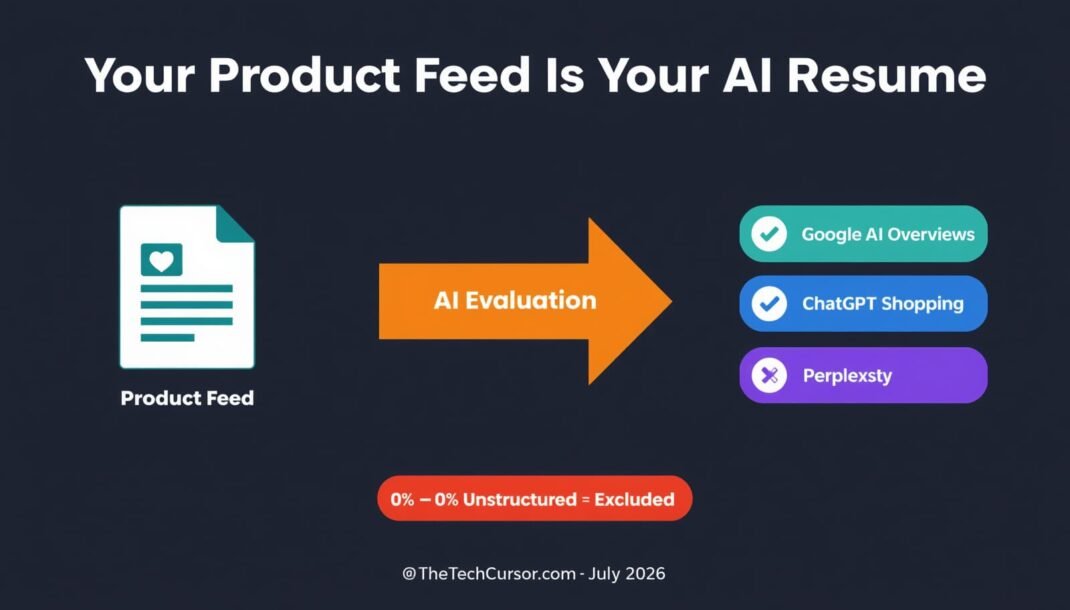
AI agents are not browsing your catalog. They are evaluating it. The depth of your product data determines whether your products get recommended — or get silently skipped.
Table of Contents
- The New Reality: AI Agents Are the Shoppers Now
- Your Product Feed Is Not Just Data — It Is a Credentialing Document
- Google AI vs ChatGPT Shopping — Two Different Systems
- Silent Failure: The Problem Nobody Sees Coming
- The Four Attribute Tiers — From Invisible to Recommended
- What Makes a Product Feed AI-Ready
- Title Construction: The First Thing AI Reads
- The Mismatch Penalty — When Feed and Schema Disagree
- Availability and Trust Signals AI Checks Before Recommending
- How to Audit Your Feed Right Now
- Bottom Line
1. The New Reality: AI Agents Are the Shoppers Now
The prior era of digital commerce was built around traffic. A search engine surfaced options, a consumer clicked the most promising result, and your product page made the conversion case. Everything — SEO, paid search, feed management — was oriented toward that click-driven moment.
That model is being replaced.
AI agents have become the shopper’s first advisor. They research, compare, filter, and recommend on the consumer’s behalf. The shopper may never visit your product page during the decision phase. The AI does it for them, and the recommendation arrives pre-formed.
The numbers reflect this shift clearly. AI referral traffic to US retail sites surged dramatically through 2025 and into 2026. As covered in TheTechCursor’s analysis of Adobe’s AI traffic data, AI-referred retail visitors now convert 54% better than non-AI traffic — making AI recommendation visibility not just a traffic question but a revenue quality question.
ChatGPT alone now serves over 900 million weekly users. The moment of competitive differentiation has moved upstream. Your product is no longer evaluated when a consumer lands on your page. It is evaluated when an AI agent reads your data.
If that data is incomplete, ambiguous, or inconsistent — your product is filtered out before any consumer sees it.
2. Your Product Feed Is Not Just Data — It Is a Credentialing Document
Think of a resume. It is not just proof you exist. It is a credentialing document that tells an evaluator whether you qualify for a specific role. Your product feed works the same way in AI shopping.
The research behind this is striking. A 2026 University of Illinois study tested 3,000 products across GPT-4o, Gemini 2.5, Claude 4, and Grok 3:
| Content Type | Description | AI Top-1 Recommendation Rate |
|---|---|---|
| Unstructured | Basic descriptions without comparative framing | 0% |
| Reasoning-based | Structured comparisons, feature analysis, logical arguments | 80–85% |
| Review/Experience | Authentic use-case narratives and purchase stories | 78–88% |
The 0% figure is not a rounding error. Products that cannot be reasoned about are not recommended at a low rate. They are excluded entirely. This is not a performance gap — it is an eligibility gap.
3. Google AI vs ChatGPT Shopping — Two Different Systems
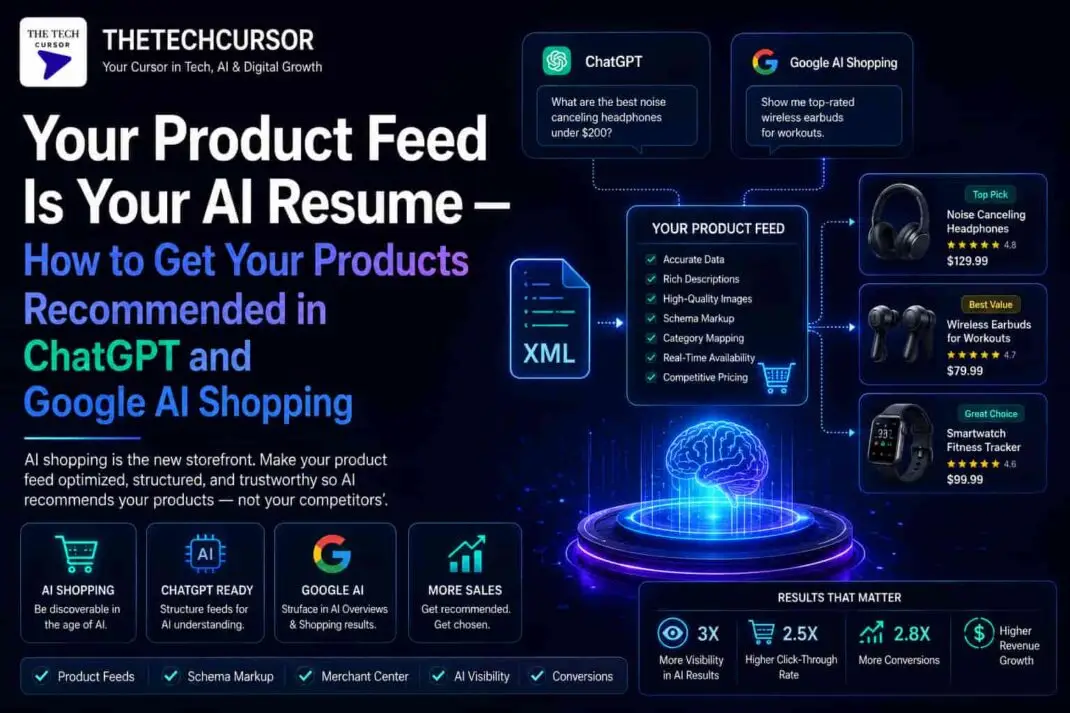
Most retailers treat AI shopping as a single channel. It is not. Google and OpenAI operate on fundamentally different architectures — and a feed strategy built for one does not automatically work for the other.
| Google Gemini AI Shopping | ChatGPT Shopping | |
|---|---|---|
| Data source | Shopping Graph (50B+ listings) | Bing search index |
| Feed requirement | Google Merchant Center | Bing Merchant Center |
| Trust mechanism | Feed completeness + GMC health | Entity Authority (15+ independent sources) |
| Query processing | Query fan-out — prompt broken into micro-intents | Entity reasoning across multiple source triangulation |
Google’s approach: When a user submits a natural language query like “sustainable women’s running shoes for hot weather,” Google breaks it into discrete micro-intents — sustainability certification, gender, product type, temperature performance. If your feed does not carry data addressing each micro-intent, your product is never in consideration regardless of your bids.
ChatGPT’s approach: ChatGPT queries Bing’s index — not Google’s. This means Bing Merchant Center is non-negotiable for ChatGPT shopping visibility. Furthermore, ChatGPT builds confidence by triangulating data across at least 15 independent sources — Reddit discussions, editorial reviews, listicles, and your structured data. A product that exists only in your feed has low entity authority and low recommendation probability.
The practical implication: Your SEO and content strategy directly affect your ChatGPT shopping visibility. Third-party reviews, editorial mentions, and community discussions are not separate from your feed strategy — they are part of it.
4. Silent Failure: The Problem Nobody Sees Coming
This is the concept most critical for any retailer reading this article — and the one most likely to describe a problem you are currently experiencing without knowing it.
Silent failure occurs when a product with missing attributes or a generic description is discarded by an AI reasoning layer — with no warning, no error message, and no diagnostic signal in your reporting.
There is no “disapproved” status in Google Merchant Center for AI recommendation exclusion. There is no alert in your analytics. The product simply does not appear in AI recommendations. The traffic that never arrives never shows up in your reports.
This is categorically different from poor performance. Poor performance means you appear but do not convert. Silent failure means you never appear. Your product was not outcompeted. It was never entered in the competition.
For retailers managing large catalogs, hundreds or thousands of products can be in silent failure simultaneously — with no visibility into which ones or why.
5. The Four Attribute Tiers — From Invisible to Recommended
Attribute completeness is not binary. It exists on a spectrum, and the tier you achieve determines which AI surfaces your products can reach:
| Tier | Name | What Is Included | AI Surface Reached |
|---|---|---|---|
| 1 | Baseline | Title, price, availability, GTIN, brand, condition, product type | GMC eligibility only — no AI recommendation pathway |
| 2 | Discovery | Tier 1 + material, color, size, gender, age group, category | AI candidate set for primary category queries |
| 3 | Match Precision | Tier 2 + use cases, fit notes, compatibility, certifications, audience descriptors | Mid-tail and long-tail conversational queries |
| 4 | Reasoning Fuel | Tier 3 + comparative advantages, use-case bridging language, review integration | Broad, specific, and cross-category queries on all major platforms |
Most product feeds max out at Tier 2. Tiers 1 and 2 get a product considered. Tiers 3 and 4 determine whether it gets recommended. The gap between “in the candidate set” and “recommended” lives between Tier 2 and Tier 3.
For retailers with large catalogs, prioritize enrichment by revenue impact: top revenue drivers first, high-intent category leaders second, unique or differentiated products third.
6. What Makes a Product Feed AI-Ready
Beyond the attribute tiers, three specific techniques separate AI-ready feeds from compliant-but-invisible ones:
GTINs as Entity Fingerprints GTINs, MPNs, and SKUs are how AI systems build a unified identity for a product across platforms. If a product carries different identifiers across your feed, your product page, and third-party references, the AI cannot reconcile them into a single trusted entity. GTIN integrity is foundational.
Use-Case Bridging Language This is the technique of connecting a product to situational consumer needs rather than describing features in isolation:
- ✅ “Ideal for home offices with limited desk space”
- ✅ “Designed for trail runners who overpronate”
- ✅ “Built for frequent travelers who need TSA checkpoint access”
- ❌ “Features a compact design with ergonomic support”
Use-case bridging creates the semantic links that help AI agents match your products to conversational, intent-driven prompts. Without it, a technically complete product description can still fail at the synthesis stage.
Variant-Level Data Completeness AI systems evaluate products at the SKU level — not the parent product level. A blue women’s running shoe in size 8 wide requires its own complete attribute set entirely separate from the size 7 regular. The parent product’s attributes do not carry over to variants in AI evaluation.
This is where most product feeds break down. Parent products are often well-enriched because category managers pay attention to them. Variant-level data degrades because no single person owns it. A shopper asking for “waterproof hiking boots in women’s wide width size 9” will not find your product if the wide-width variant lacks its own waterproof attribute and width specification.
7. Title Construction: The First Thing AI Reads
Product titles are the primary identifier AI systems use to classify a product. The standard formula is straightforward:
Brand + Product Type + Key Differentiator(s)
| Example | |
|---|---|
| Before | “TR-18383 Men’s Tee, Blue/L” |
| After | “Nike Men’s Dri-FIT Training Tee — Moisture-Wicking for High-Intensity Workouts” |
The improved title gives the AI multiple semantic hooks simultaneously: brand, audience, product type, material attribute, and a use-case signal. Lead with the core item type so the AI can classify the product before processing differentiators.
For ChatGPT and Bing specifically, Bing’s index weights page-title clarity heavily during the discovery stage. Titles that mirror how a shopper would actually phrase a search request outperform manufacturer-style or internal SKU-based titles.
8. The Mismatch Penalty — When Feed and Schema Disagree
AI systems cross-reference your product feed against your on-page JSON-LD schema markup. When those two sources conflict, the AI registers the inconsistency as a signal that your data is unreliable — and removes the listing from consideration entirely.
The conflict can be as small as a price discrepancy, a different availability status, or a mismatched product name. This is not a ranking penalty. It is a binary exclusion.
A single price mismatch between your feed and your schema markup is enough for an AI system to drop the listing entirely.
At any scale, feed-schema misalignment is common because feed management and schema markup typically sit with different teams with no real-time synchronization. The standard: price, availability, GTIN, brand, and title must be identical across both your feed and your schema markup. Schema validation should run after every site deployment.
9. Availability and Trust Signals AI Checks Before Recommending
Real-time availability accuracy AI shopping surfaces — particularly ChatGPT via integrations with commerce APIs — prioritize feeds that reflect real-time or near-real-time inventory. When a product is marked “in stock” but is actually unavailable, the broken experience degrades the AI’s trust in your entire feed — not just that product. Over time, AI systems that detect this pattern reduce recommendation frequency across your full catalog.
For high-velocity products, hourly feed refreshes are the minimum standard. Once-daily updates are effectively disqualifying for AI shopping surfaces that weight merchant reliability as a recommendation factor.
Shipping, returns, and the trust signal layer AI systems evaluate whether a merchant can be trusted to fulfill the transaction. Clear, structured shipping timelines and return policies in the feed function as trust signals. Missing or vague shipping and returns data raises the AI’s uncertainty about the merchant — which suppresses recommendation rates even when product attributes are otherwise strong.
Crawlability — who you might be blocking If your robots.txt blocks AI crawlers, your product pages cannot be retrieved during discovery, and feed optimization alone will not produce AI recommendations. Check for and explicitly allow: GPTBot, OAI-SearchBot, PerplexityBot, and Google-Extended. These bots are frequently blocked by default in configurations established before AI shopping existed.
10. How to Audit Your Feed Right Now
Use these 10 diagnostic questions to assess your current AI shopping readiness. Any answer that requires “sort of” is a no.
- Are all active SKUs — including all variants — covered at Tier 2 attribute level or above?
- Do your product titles follow the Brand + Type + Differentiator formula rather than internal codes?
- Are GTINs present and consistent across your feed, product pages, and schema markup?
- Does your feed refresh at a minimum of hourly for high-velocity products?
- Are your JSON-LD schema values synchronized with your feed for price, availability, GTIN, and title?
- Are AI crawlers permitted in your robots.txt?
- Do your product descriptions include use-case bridging language?
- Is your feed live in Bing Merchant Center — not only Google Merchant Center?
- Do your high-velocity product variants have their own complete attribute sets?
- Have you tested your top 20 products in ChatGPT, Perplexity, and Google AI Overviews in the last 30 days?
Scoring:
- 8-10 yes: Strong AI shopping readiness — focus on Tier 3-4 enrichment
- 5-7 yes: Discoverable but inconsistent — close specific gaps
- Under 5: Likely experiencing widespread silent failure — start with crawlability, freshness, and GTIN integrity
11. Bottom Line
AI agents do not infer. They evaluate. They read your feed, check your schema, cross-reference your entity footprint across independent sources, and decide whether your product is worth recommending — before any consumer enters the picture.
Your structured product data is your entire first impression in AI shopping. It is made in milliseconds by a system that has no patience for incomplete information.
The retailers who will own AI recommendation share are not necessarily the largest or best-funded. They are the ones who have made their product data clear, consistent, complete, and machine-readable — and who maintain it systematically rather than treating feed quality as a one-time project.
Your product feed is your AI resume. Make sure it earns the recommendation.