
Clicks without conversions are one of the most demoralizing patterns in digital marketing. The ad is working — CTR is healthy, spend is flowing, impressions are climbing — but the revenue is not following.
Most teams respond by adjusting the ad itself: testing new headlines, swapping creatives, tightening audience targeting. Sometimes that helps. More often, it does not — because the problem was never the ad.
This is the diagnostic gap that wastes the most budget in paid advertising. The ad gets you the click. Everything that happens after the click is what determines whether you get the conversion. And most conversion problems live after the click, not before it.
This article gives you a systematic framework for diagnosing exactly where the breakdown is happening — so you stop guessing and start fixing the right thing.
Table of Contents
- Why Most Ad Optimization Misses the Real Problem
- The Four Stages Where Conversion Breaks Down
- Stage One: Message Match — Does the Landing Page Deliver What the Ad Promised?
- Stage Two: Page Experience — Is Something Getting in the Way?
- Stage Three: Offer Clarity — Do Visitors Actually Understand What You Are Selling?
- Stage Four: Audience Intent — Are You Attracting the Right Clicks in the First Place?
- How to Run the Diagnostic: A Practical Sequence
- The Most Common Diagnosis by Ad Type
- Bottom Line
Why Most Ad Optimization Misses the Real Problem
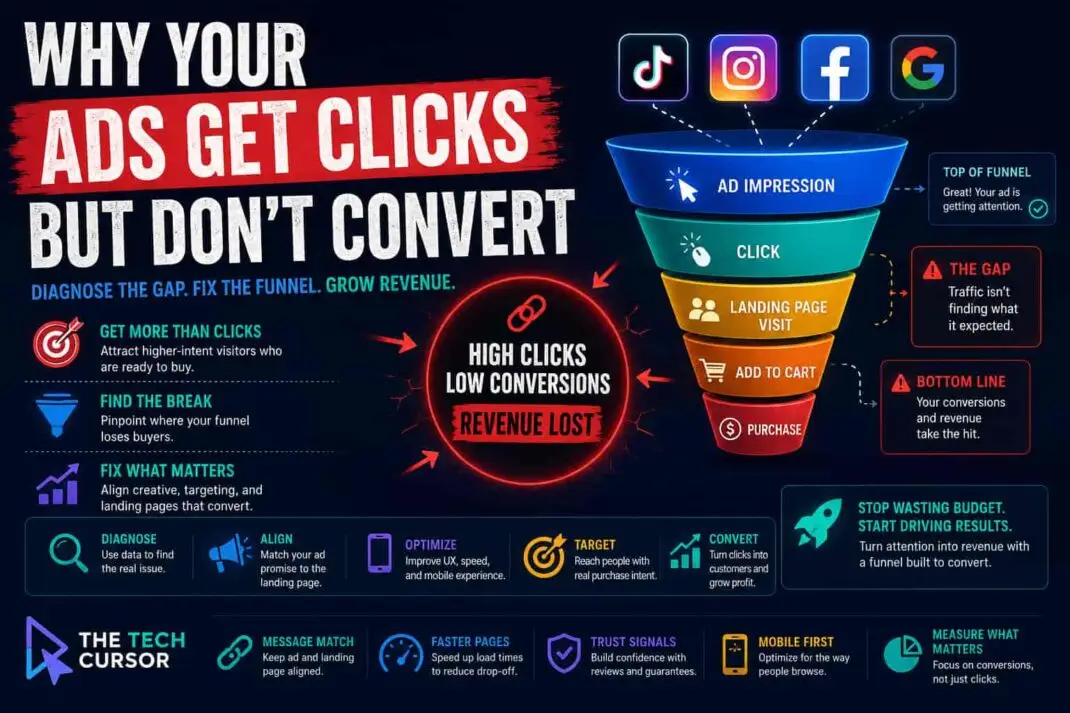
When clicks are not converting, the instinct is to optimize the thing you can see most clearly: the ad. Change the headline. Test a different image. Narrow the audience. Lower the bid.
These are not wrong moves. But they are often the wrong moves at the wrong moment — applied before anyone has identified where the actual breakdown is happening.
The click is the end of the ad’s job. Once a visitor lands on your page, the ad has done everything it can do. If the post-click experience fails to continue what the ad started, no amount of ad optimization will fix the conversion rate.
The gap between click and conversion involves four distinct stages, each capable of killing a campaign independently. A methodical diagnostic — one that checks each stage in sequence before changing anything — is the fastest path to understanding what is actually broken.
The Four Stages Where Conversion Breaks Down
Before running any test or making any change, map the problem to one of these four stages:
Stage 1 — Message Match: Does the landing page immediately deliver what the ad promised?
Stage 2 — Page Experience: Is something on the page creating friction, confusion, or distrust?
Stage 3 — Offer Clarity: Does the visitor understand what they are getting, what it costs, and why they should want it?
Stage 4 — Audience Intent: Are the people clicking actually in the market for what you are selling?
Most campaigns with healthy CTR but poor conversion rates have a problem concentrated in one of these four stages. Identifying which one — before changing anything — is the entire game.
Stage One: Message Match — Does the Landing Page Deliver What the Ad Promised?
Message match is the single most underdiagnosed conversion killer in paid advertising. It is also one of the easiest to fix once identified.
The principle is straightforward: every ad creates a specific expectation in the visitor’s mind. The headline, the offer, the visual, the tone — all of it signals what the visitor will find on the other side of the click. If the landing page does not immediately and clearly match that expectation, visitors leave. Not because the page is bad. Because the experience feels discontinuous.
Message match failures are not always obvious. They do not require a completely different offer on the landing page — even subtle disconnects cause drop-off. Some of the most common patterns:
The headline mismatch. The ad headline and the landing page headline address the same topic but use different language, different framing, or a different level of specificity. A visitor who clicks on “Automate Your SEO Reporting in 10 Minutes” and arrives at a page headlined “The Future of Marketing Intelligence” is already disoriented.
The offer drifts. The ad promotes a specific offer — a free trial, a discount, a specific product — and the landing page leads with a broader brand or category message. The visitor arrived for a specific thing. The page is asking them to go looking for it.
The visual discontinuity. The creative in the ad and the visual treatment on the landing page feel like different brands. This is especially common when ad creative is handled separately from landing page design. The subconscious trust signal snaps.
How to diagnose it: Read your ad copy. Then open your landing page and read the first thing a visitor sees — headline, subheadline, hero image, and the first paragraph. Do they feel like a continuation of the same conversation? If someone covered the URL bar and you showed them the ad and the landing page side by side, would the connection be immediately obvious?
If the answer is no, message match is likely the primary problem. Fix this before changing anything else.
Stage Two: Page Experience — Is Something Getting in the Way?
Assuming message match is solid, the next stage to examine is the page experience itself — everything that could create friction between the visitor’s arrival and their decision to convert.
Page experience problems fall into three categories:
Technical friction. Load speed is the most measurable — and most consistently underestimated — conversion killer in paid advertising. A visitor who clicked an ad has demonstrated intent. Asking them to wait three seconds for a page to load is asking them to reconsider whether they really wanted this. On mobile, the tolerance is even lower.
Beyond speed: broken elements, forms that do not submit correctly on certain browsers, checkout flows that fail on mobile, pop-ups that trigger before the visitor has read a single sentence. These are not UX edge cases. They are conversion killers that show up in heatmaps and session recordings every day and are rarely fixed because no one checked.
Visual and cognitive friction. Too many competing calls to action. A page structure that makes it unclear where to look next. Navigation that invites visitors to explore elsewhere rather than focus on the conversion action. Dense blocks of text that communicate effort before they communicate value.
A good landing page for a paid campaign is not a homepage. It is not a product brochure. It is a single-purpose page designed to continue the conversation the ad started and move the visitor toward one specific action. Every element that does not serve that purpose creates friction.
Trust friction. Visitors arriving from paid ads — especially first-time visitors — arrive with scepticism. They do not know your brand. The ad got their attention; the page has to earn their trust. Missing or weak trust signals — no customer reviews, no recognizable logos, no clear information about what happens after they click the CTA — all increase abandonment at the conversion point even when everything else is working.
How to diagnose it: Review your page speed score (Core Web Vitals, PageSpeed Insights). Watch five session recordings from paid traffic specifically — not all traffic. Run the page on a mobile device you have not used recently, with a slow connection. Check whether a first-time visitor with no context could immediately identify one clear next action.
Stage Three: Offer Clarity — Do Visitors Actually Understand What You Are Selling?
This stage is where teams most often underestimate their own marketing problem. After months of living inside their product or service, they cannot see it the way a stranger sees it for the first time.
Offer clarity is not about having a good offer. It is about communicating that offer in a way that a visitor — who arrived thirty seconds ago, knows nothing about your brand, and is deciding whether to keep reading in the next few seconds — can immediately understand.
The most common offer clarity failures:
The value proposition requires effort to decode. The headline communicates what the product is, but not why it matters or who it is for. “AI-Powered Content Intelligence Platform” describes a category. “See exactly which pages are losing rankings before your competitors notice” communicates a specific, desirable outcome.
The offer mechanics are unclear. What happens when someone clicks “Get Started”? Is it a free trial? A demo request? An immediate purchase? How long does the trial last? Is a credit card required? Uncertainty at the conversion point is one of the most consistent drivers of abandonment — not because visitors have decided no, but because they have not been given enough information to decide yes.
The price signal is missing or wrong. Hiding pricing creates friction for visitors who want to qualify themselves quickly. Showing pricing without context — without anchoring it against the value delivered or alternatives — creates sticker shock. Neither is a pricing problem. Both are communication problems.
The comparison is missing. Why this, instead of the alternatives the visitor is already aware of? If your offer exists in a competitive market — and almost every offer does — visitors are implicitly running a comparison in their heads. A landing page that does not address that comparison is leaving the visitor to fill in the gap themselves, often with assumptions that favour the competitor.
How to diagnose it: Show your landing page to three people who match your target customer profile but are not familiar with your product. Ask them: “What does this company do? Who is it for? What would happen if you clicked this button?” Their answers will show you exactly where clarity breaks down.
Stage Four: Audience Intent — Are You Attracting the Right Clicks in the First Place?
If message match is solid, page experience is clean, and offer clarity is strong — but conversion rates are still low — the problem is often the audience.
Not all clicks are equal. A high CTR on a broad audience segment can generate large volumes of clicks from people who are curious but not in the market. A lower CTR on a tighter, higher-intent audience will often produce significantly better conversion rates and lower cost per acquisition.
The intent diagnostic looks at two things:
Query or signal intent. In search advertising, are the keywords triggering your ads aligned with purchase intent, or are they attracting informational queries from people who are still in research mode? A campaign built around broad match keywords will frequently show ads to users whose actual query is nothing close to the one you targeted. Reviewing the search terms report — not the keyword list, the actual queries — is often revealing.
In social and display advertising, intent is expressed through behavior signals. Broad interest-based targeting captures people who are adjacent to your market but not actively in it. Retargeting, lookalike audiences built from converters rather than visitors, and intent-layered audiences (people who have visited competitor sites, searched relevant terms, or engaged with category content) consistently outperform broad demographic targeting.
Stage of the buying journey. A visitor who has never heard of your product and a visitor who has compared three competitors and is ready to decide are both in your target audience — but they need completely different experiences to convert. Sending top-of-funnel traffic directly to a bottom-of-funnel offer (a free trial, a demo, a purchase) is a stage mismatch that no landing page optimization can fully compensate for.
How to diagnose it: For search, pull the search terms report and sort by clicks. Identify the top-50 queries by click volume and categorize them by intent: informational, navigational, or transactional. Calculate what percentage of your click spend is going to non-transactional queries. For social and display, compare conversion rates across audience segments to identify which signals correlate with intent.
How to Run the Diagnostic: A Practical Sequence
Apply the diagnostic in order. Each stage assumes the previous one is not the problem. If you identify the issue at Stage 1, fix it before evaluating Stage 2.
Step 1 — Message match audit (15 minutes): Read your top five ads. Open the corresponding landing pages. Check headline-to-headline continuity, offer continuity, and visual continuity. If you find a clear mismatch, stop here. Fix it. Retest before moving further.
Step 2 — Page experience audit (30 minutes): Run Core Web Vitals on your landing page. Watch five session recordings from paid traffic specifically. Test the full conversion flow on mobile. Document every friction point. Prioritize by frequency and severity.
Step 3 — Offer clarity test (1–2 days): Show the landing page to 3–5 people matching your target customer profile who are unfamiliar with the product. Record the session. Use their confusion to identify clarity gaps. Do not brief them beforehand — the goal is to see the page as a stranger sees it.
Step 4 — Audience intent analysis (1 hour) For search: pull and categorize search terms by intent. For social and display: compare conversion rates by audience segment. Identify where intent is weakest relative to spend.
Once you have run all four stages, you will almost always find the problem concentrated in one or two areas. Fix those areas first — completely — before testing anything else.
The Most Common Diagnosis by Ad Type
Different ad formats tend to have characteristic failure modes that are worth knowing before you start:
Search ads: The most common failure is keyword intent mismatch — broad or phrase match keywords pulling in informational queries that convert at a fraction of the rate of transactional queries. The second most common is a message match failure between the ad and a landing page that was not built specifically for the campaign.
Social ads (Meta, LinkedIn, TikTok): The most common failure is audience intent — interests-based targeting that generates clicks from people who are curious but not in the market. Second most common is offer clarity — social traffic is cold, and offers that work for search traffic (where intent is pre-established) often lack the context needed to convert a stranger.
Display and programmatic: Page experience and trust are the dominant issues. Display clicks frequently arrive on pages with no trust signals, slow load times, or pop-ups that fire immediately — all of which compound the already-low intent of display traffic.
Retargeting: When retargeting underperforms, the most common cause is stage mismatch — showing the same ad and the same offer to visitors at different stages of the buying journey, without differentiating between someone who bounced after two seconds and someone who spent eight minutes reading the pricing page.
Bottom Line
Clicks without conversions are not an ad problem. They are a diagnostic problem — which means the solution starts not with testing new creative, but with identifying which of the four stages is actually breaking down.
Message match, page experience, offer clarity, and audience intent each account for a meaningful share of conversion failures. They are not equally likely for every campaign type, but they are all worth checking before any optimization work begins.
The teams that consistently improve conversion rates are not the ones that run the most tests. They are the ones who diagnose before they test — and fix the right thing, in the right order, with evidence rather than instinct.
Start with the audit. The fix usually becomes obvious once you know where to look.
Pingback: Why Your Google Ads Leads Are Wasting Your Budget — And How CRM Data Fixes It - The Tech Cursor