
Category: AI | OpenAI | AI Regulation | Tech News
Published: June 29, 2026
Read time: 7 min
Site: TheTechCursor
OpenAI just launched its most powerful model yet — and for the first time in history, the US government asked it to slow down before going public.
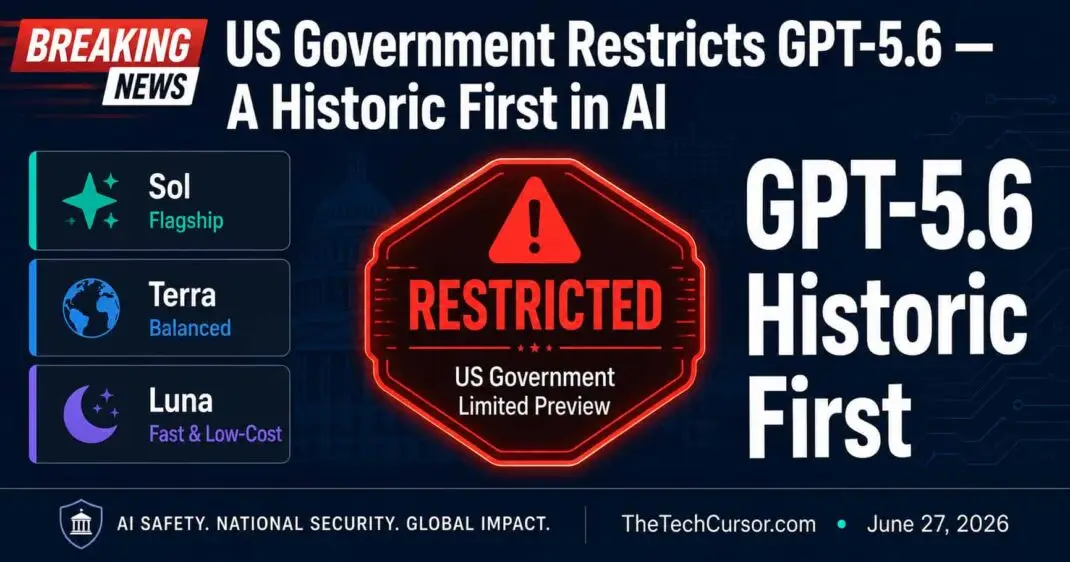
GPT-5.6 launched on June 27, 2026, as a limited preview for approximately 20 government-approved partner companies. The wider public, developers, and enterprises are waiting. The White House asked OpenAI to hold back while it develops a security testing framework for advanced frontier AI models — making this the first known case of the US government restricting a frontier AI model before its broader public release.
OpenAI complied. Then, publicly said it should not happen again.
Here is everything you need to know about GPT-5.6, the unprecedented government action, and what it signals about the future of AI regulation.
Table of Contents
- What Just Happened — The Historic First
- GPT-5.6: Sol, Terra, and Luna Explained
- Why the Government Intervened
- How OpenAI Avoided Anthropic’s Fate
- What This Means for AI Regulation Going Forward
- GPT-5.6 vs Claude Fable 5 — The Capability Comparison
- Who Can Access GPT-5.6 Right Now
- What This Means for Businesses and Developers
- Bottom Line
1. What Just Happened — The Historic First
To understand the significance of this moment, consider what has never happened before: a US government administration proactively asking an AI company to delay a model release to allow for security review — before the model was made publicly available.
Previous AI model launches — including GPT-4, GPT-5, and various Claude releases — went directly to public or enterprise access without government pre-clearance. The White House’s request to OpenAI changes that dynamic fundamentally.
OpenAI agreed to the limited preview rollout, arguing this cooperative approach was preferable to the alternative — the outcome that befell Anthropic, whose Fable 5 and Mythos 5 models faced a Commerce Department directive that effectively banned them. By negotiating proactively, OpenAI secured a timeline for broader access and a formal partnership with the White House on a cybersecurity executive order framework for future model launches.
However, OpenAI did not stay silent about its position:
“We don’t believe this kind of government access process should become the long-term default. It keeps the best tools from users, developers, enterprises, cyber defenders, and global partners who need them.”
OpenAI is complying with the very precedent it argues should not become permanent — a carefully calibrated act of cooperation combined with public dissent.
2. GPT-5.6: Sol, Terra, and Luna Explained
GPT-5.6 is not a single model. It is a family of three distinct models designed for different use cases and cost profiles:
| Model | Type | Best For | Pricing |
|---|---|---|---|
| Sol | Flagship | Complex reasoning, coding, biology, and cybersecurity | Premium |
| Terra | Balanced | Every day, enterprise and developers use | Mid-tier |
| Luna | Fast, low-cost | High-volume, speed-critical applications | $1/million input tokens |
GPT-5.6 Sol is the headline model. OpenAI describes it as its strongest model yet, with significantly improved agentic capabilities across coding, biology, and cybersecurity — the three domains that specifically triggered government concern.
Sol introduces two new operational modes:
- “Max” reasoning effort mode — allocates more compute to complex reasoning tasks
- “Ultra” mode — uses coordinated subagents to tackle highly complex, multi-step problems
A notable architectural decision: Unlike Anthropic’s Fable 5, which used a separate classifier layer to route high-risk requests to an older model — triggering false positives and user backlash — OpenAI embedded safety guardrails directly into GPT-5.6 Sol’s model architecture. This design choice means safety behavior is intrinsic to the model rather than applied as an external filter.
3. Why the Government Intervened
The White House’s concern centers on GPT-5.6 Sol’s advanced capabilities in three specific domains: coding, biology, and cybersecurity.
These are precisely the areas where advanced AI capability creates dual-use risk — the same capability that helps a cybersecurity professional find and patch vulnerabilities can help a malicious actor discover and exploit them. The same biological research acceleration that speeds drug discovery can theoretically accelerate bioweapon development.
The administration requested a limited rollout while it develops a security testing framework for advanced frontier models — essentially, a structured process for evaluating whether a model’s capabilities exceed a threshold requiring additional oversight before public release.
This intervention follows a similar directive applied to Anthropic’s models in June 2026 — suggesting the government is developing a consistent, if not yet fully formalized, approach to frontier model oversight rather than making one-off decisions.
4. How OpenAI Avoided Anthropic’s Fate
The contrast between OpenAI’s and Anthropic’s experiences with government intervention is instructive.
Anthropic was effectively surprised by the Commerce Department directive restricting Fable 5 and Mythos 5. The action came as an enforcement measure rather than a negotiated arrangement — and the public backlash from cybersecurity professionals who lost access to tools they relied on was significant, as covered in TheTechCursor’s earlier coverage of Fable 5’s controversial guardrails.
OpenAI took a different approach. The company began working with the administration on GPT-5.6 before Anthropic lost access to its models. Rather than waiting for enforcement, OpenAI negotiated the terms of a limited release proactively — securing a specific timeline for broader access and positioning itself as a cooperative partner in developing the regulatory framework itself.
CEO Sam Altman told employees the administration would approve customer access “customer by customer” during the preview period. Furthermore, OpenAI is now actively helping draft the cybersecurity executive order framework that will govern future model releases — giving it a direct role in shaping the rules that will apply to its own future launches.
This is a regulatory strategy in action: cooperate on the specific restriction to gain influence over the broader framework.
5. What This Means for AI Regulation Going Forward
The GPT-5.6 situation establishes several important precedents for how frontier AI will be regulated in the United States:
Government pre-release review is becoming normalized. Two major frontier model releases — Anthropic’s and now OpenAI’s — have faced government restrictions within weeks of each other in June 2026. Whether this becomes a structured, repeatable approval process or a model-by-model system with evolving rules will depend on the executive order framework currently being developed.
Capability thresholds matter more than company identity. The government’s concern is not specifically about OpenAI or Anthropic — it is about models that reach certain capability levels in sensitive domains. Any frontier model achieving similar capabilities will likely face similar scrutiny going forward.
Cooperative engagement beats reactive compliance. OpenAI’s approach — negotiating proactively, complying while publicly dissenting, and helping draft the framework — gives it significantly more influence over the regulatory outcome than Anthropic’s experience of facing an unexpected enforcement action.
Enterprise procurement timelines will be affected. Businesses planning to deploy the latest frontier models in their operations now need to factor in government review periods as a variable in their deployment planning.
6. GPT-5.6 vs Claude Fable 5 — The Capability Comparison
OpenAI has directly compared GPT-5.6 Sol to Anthropic’s Claude Fable 5 — the most capable model Anthropic has made publicly available, itself a limited version of the restricted Mythos 5.
According to OpenAI, GPT-5.6 Sol is slightly better at coding workflows than Claude Fable 5. Both models represent the current frontier of publicly accessible AI capability — with both companies’ most powerful models (GPT-5.6 Sol under restricted preview, Mythos 5 under government restriction) remaining out of general reach.
The architectural difference in safety implementation is also significant. Fable 5’s external classifier approach created user experience problems — flagging legitimate requests and routing them to less capable models. Sol’s integrated safety approach aims to avoid these false positive issues while maintaining capability.
7. Who Can Access GPT-5.6 Right Now
Currently available:
- Approximately 20 government-approved partner companies — in limited preview
- Access is being approved “customer by customer” during the preview period
Expected timeline:
- Wider access: expected next week
- Full rollout: coming weeks (subject to government review completion)
Luna pricing has been confirmed at $1 per million input tokens — positioning it as a cost-competitive option for high-volume applications. Sol and Terra pricing have not been publicly confirmed for the preview period.
8. What This Means for Businesses and Developers
For organizations currently planning AI deployments or evaluating frontier models, the GPT-5.6 situation has several practical implications:
Factor regulatory timelines into AI procurement planning. If your use case involves coding, cybersecurity, or biology applications — the domains that triggered government concern — future frontier model access may involve waiting periods for regulatory clearance. Build this into project timelines.
The capability gap between available and frontier models is widening. With both OpenAI’s and Anthropic’s most capable models under restricted access, the gap between what enterprises can access and what is technically possible is growing. For most business applications, currently available models (Claude Fable 5, GPT-5.5, and their predecessors) remain fully capable — but track the regulatory timeline if you need frontier capability.
Luna’s $1/million token pricing is significant. For high-volume applications where speed and cost matter more than maximum capability, Luna’s pricing makes GPT-5.6 accessible at a competitive price point once broader access opens.
Watch the executive order framework. The framework OpenAI is helping draft will define the rules for future frontier model releases — and potentially for how existing models are regulated. This framework will directly affect enterprise AI strategy for years to come.
9. Bottom Line
GPT-5.6 marks two simultaneous milestones: OpenAI’s most capable model to date and the first US government restriction on a frontier AI model before public release.
The model family — Sol, Terra, and Luna — represents a genuine capability leap, with Sol’s integrated safety architecture, coordinated subagent mode, and strong coding performance positioning it ahead of current publicly available alternatives.
However, the regulatory moment is equally significant. Government pre-release review of frontier AI models appears to be transitioning from an exception to a pattern. How the executive order framework takes shape over the coming months will determine whether this becomes a structured, predictable process — or a model-by-model negotiation that creates ongoing uncertainty for developers and enterprises.
OpenAI’s strategy of cooperative compliance combined with public dissent may be the template other AI companies follow. Whether the resulting regulatory framework serves the goal of safety without unnecessarily restricting access remains the central question — and one that will define the next chapter of frontier AI development.
Pingback: GPT-6 & Intelligent UI in ChatGPT: What It Means for SEO 2026 - The Tech Cursor