
GPT-6 & Intelligent UI in ChatGPT: What It Means for SEO 2026
Read time: 6 min
Table of Contents
- What OpenAI Just Released
- GPT-6 Sol and Luna: Which Model Does What
- What Intelligent UI Actually Does
- Answers Start Before Thinking Finishes
- The Publisher and SEO Threat: Tool Pages at Risk
- What This Means for Content Strategy
- The Citation Problem: Sources in Visual Answers
- Bottom Line
OpenAI rolled out GPT-6 in ChatGPT on October 7, 2026. It comes with a feature called Intelligent UI, which could be the biggest challenge to publisher tool pages and interactive content since AI Overviews launched.
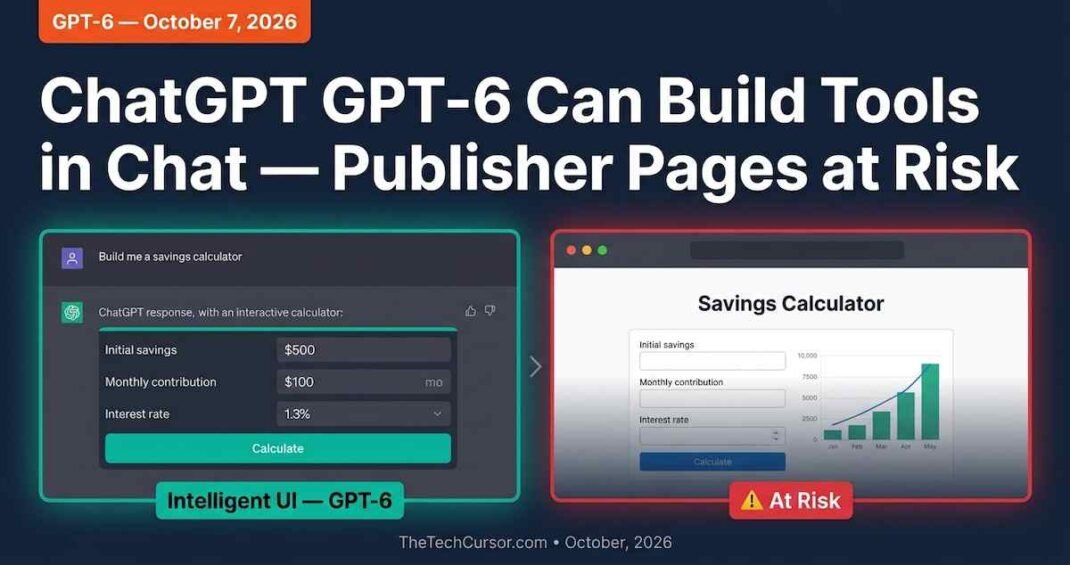
The update pairs a more capable model with a new interface layer. ChatGPT can now respond with charts, buttons, forms, and interactive tools, not just text. For users, this means richer answers without leaving ChatGPT. For publishers and SEO professionals, however, it means another category of content that AI systems can replicate directly in the conversation.
1. What OpenAI Just Released
GPT-6 is rolling out in the Chat tab. Plus, Pro, Business, and Enterprise users got it first on October 7, and Free and Go users follow on October 8.
The release has two distinct parts. First, the model upgrade: GPT-6 replaces the “Latest” option in ChatGPT’s model menu. Second, the Intelligent UI feature, a new response layer that lets GPT-6 decide how to format each answer based on the question.
Both parts matter, but for different reasons. The model upgrade improves general capability, speed, and search behaviour. Intelligent UI, on the other hand, has the most direct implications for publishers, SEO professionals, and anyone whose content strategy includes tool pages or interactive content.
2. GPT-6 Sol and Luna: Which Model Does What
GPT-6 comes in two variants for Chat. Both launched on September 22 for ChatGPT Work, Codex, and the API.
GPT-6 Sol serves Plus, Pro, Business, and Enterprise users in today’s rollout. It is the more capable variant, and it supports Intelligent UI at thinking levels from Instant to Extra High.
GPT-6 Luna serves Free and Go users from October 8. OpenAI designed it for broader availability with appropriate computational efficiency.
The Pro thinking level continues to run on GPT-6 Astra, a separate model, and it does not support Intelligent UI. Furthermore, older ChatGPT desktop apps for macOS and Windows do not support the feature, regardless of which model they use.
Luna’s availability for free users is strategically significant. It means paying subscribers are not the only ones who get Intelligent UI. Consequently, the shift from “ask and receive text” to “ask and receive an interactive tool” will reach the full ChatGPT user base quickly.
3. What Intelligent UI Actually Does
Intelligent UI changes the output format of ChatGPT responses. Instead of always replying in text, GPT-6 decides how to lay out each response based on the question.
OpenAI describes the feature this way:
“You can also ask ChatGPT to create a tool for the task at hand, such as a calculator to explore how savings could grow, a bill splitter for dinner with friends, or a game you can play in the conversation.”
Specifically, responses can now include:
- Buttons for navigating through multi-step answers or comparisons
- Forms for collecting user inputs that shape the response
- Charts for presenting data visually rather than in text
- Interactive calculators and tools built on demand in the conversation
This is not entirely new. ChatGPT already offered interactive charts, added in June 2026, and interactive modules for more than 70 math and science topics, added in March 2026. What Intelligent UI changes is the automation. GPT-6 decides when to use these elements based on what the question requires.
Users who prefer text-only responses can turn off the Layout and visuals setting on the web. Even so, some visual elements may still appear, depending on the question.
4. Answers Start Before Thinking Finishes
Beyond the interface changes, GPT-6 introduces a behavioural change that speeds up search-dependent queries.
GPT-6 can begin answering while it is still thinking or working with search tools. For questions that need web search, GPT-6 Instant starts answering 44% sooner on average than GPT-5.6 Instant. In addition, OpenAI reports that GPT-6 makes better decisions about when to search and more reliably finds information that supports its answer.
This speed matters for how ChatGPT competes with Google AI Mode and Perplexity. An answer that starts arriving while search is still running feels more responsive. Users who are used to near-instant search results will notice the difference.
GPT-6 can also share more insights after the initial response without waiting for a follow-up question. As a result, the conversation extends without explicit prompting. ChatGPT moves further toward an always-active assistant and away from a simple query-and-response tool.
5. The Publisher and SEO Threat: Tool Pages at Risk
The biggest strategic concern for publishers and SEO professionals is Intelligent UI’s tool-creation capability.
OpenAI’s own examples, a savings calculator and a bill splitter, are exactly the tools publishers have long used to attract and retain traffic. Mortgage calculators, tax estimators, BMI calculators, unit converters, and tip calculators are all standard publisher content types. They attract consistent organic traffic and earn backlinks.
These tool pages work because users need to interact with them. Reading an article about how to calculate a mortgage payment is less useful than using the actual calculator. Publishers have capitalized on this by building interactive tools that rank well and drive meaningful organic traffic.
Intelligent UI changes the dynamic directly. A ChatGPT user who needs a mortgage calculation can now ask ChatGPT to build the calculator in the conversation. They never need to visit a publisher’s tool page. They can even customize the calculator’s inputs in real time, which a static publisher tool page cannot easily match.
This connects to a pattern already visible in Google’s AI search features. The Google Dive Deeper feature in Discover and AI Overviews both reduce publisher click-through. They satisfy user needs within the search or discovery interface. Intelligent UI extends the same dynamic into the ChatGPT conversation.
6. What This Means for Content Strategy
The Intelligent UI release reinforces a content strategy principle that has built up across the AI search era. Generic tool pages, meaning calculators and converters that use public formulas and standard inputs, are increasingly easy for AI to replicate.
The content that stays defensible is the content only your brand can provide. Proprietary data, first-hand expertise, original analysis, and tools built on your own methodology are hard to copy. A general-purpose AI model cannot replicate them without access to your information.
A mortgage calculator that uses standard amortization math is easy to replicate. In contrast, a calculator that incorporates your lender’s specific rates, products, and eligibility criteria is not. The same goes for one that connects to a live rate feed.
Our AI Mode follow-up questions content strategy article covered exactly this principle. The content worth building in the AI search era reflects genuine expertise and proprietary knowledge. Generic tools built on public formulas belong in the same category as generic articles that summarize widely available information. AI systems can increasingly replicate both.
The future of content idea economy framework applies here too. The value was never in the words or the calculations themselves. It was in the thinking, expertise, and proprietary information behind them. Content that reflects those inputs remains valuable, whereas content that does not has always been vulnerable.
7. The Citation Problem: Sources in Visual Answers
The GPT-6 announcement introduces a transparency gap that matters for publishers and for the wider question of AI search attribution.
When ChatGPT answers a text question with web search, it includes citations that identify the sources behind the answer. When GPT-6 generates a chart, a comparison table, or an interactive calculator, however, it is not yet clear how it attributes sources.
OpenAI’s announcement does not address this. The search help page notes that answers using web search may include citations in a Sources button “whenever it’s available.” That conditional phrasing suggests citations in visual and interactive responses are not guaranteed.
This matters for publishers in two ways. First, if visual answers do not consistently cite sources, publishers lose the referral attribution that text citations provide. Second, it creates measurement uncertainty. Without consistent citation data, publishers cannot easily track whether their content contributed to a GPT-6 visual answer.
The Google Search Console AI reporting inadequacy problem is already significant for traditional AI Overview citations. If ChatGPT’s visual answers add to that attribution gap, measuring AI search visibility becomes harder across every platform.
8. Bottom Line
GPT-6 with Intelligent UI is a meaningful upgrade to ChatGPT’s capability. It is also a meaningful challenge to a specific category of publisher content.
Interactive tool pages that rely on public formulas and standard inputs face the most direct threat. Users who once visited publisher tool pages for calculators, converters, and comparison tables can now request those tools directly in ChatGPT.
The response is not to stop building tools. Instead, build tools that AI systems cannot replicate. Draw on proprietary data, specialized methodology, or real-time information that only your brand can supply.
What to Do Now
- Audit your tool pages. Identify which ones rely on standard public formulas and which use proprietary data or methodology. The first group is increasingly vulnerable, while the second is defensible.
- Invest in proprietary data tools. Calculators and estimators that need data only your business holds create real differentiation. Intelligent UI cannot replicate them in a general conversation.
- Monitor your tool page traffic. As Intelligent UI rolls out to free users, watch for traffic trends on your interactive content. An early signal gives you time for a faster strategic response.
- Track AI referral attribution. Gemini UTMs are now available, and ChatGPT already has citation infrastructure. Keep AI visibility tracking in place for your tool pages alongside your article content.