
Read time: 6 min
Table of Contents
- What Mueller Actually Said
- The Four Problems With GSC AI Reporting
- Problem 1: Impressions Without Visibility
- Problem 2: Show More Links Are Undercounted
- Problem 3: Position Tracks the Feature, Not Your Link
- Problem 4: It Is a Filtered View, Not a Separate Report
- Why the Ten Blue Links Paradigm Is Breaking GSC
- What This Means for Your Reporting Right Now
- What to Use Instead While GSC Catches Up
- Bottom Line
Google’s John Mueller has officially acknowledged what SEO professionals have been saying since the AI Performance Reports rolled out in June 2026: Search Console’s AI search reporting is built on legacy concepts that do not fit how AI search actually works — and Google does not currently have a better solution.
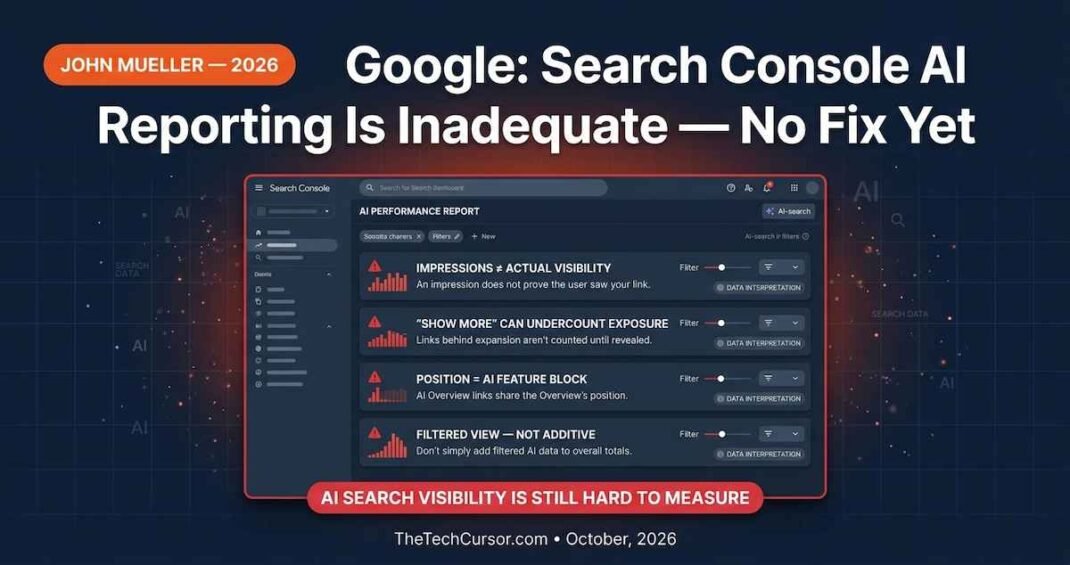
The admission came in a Bluesky response on September 13, 2026, where Mueller confirmed that position reporting for AI search features “is hard to do in a way that makes it useful” — and invited the community to suggest what better reporting would look like.
This is not a minor data quality issue. It is a structural problem with how the most important new reporting surface in SEO works — and understanding its limitations is essential for anyone using GSC data to report on AI search performance.
1. What Mueller Actually Said
The conversation started on Reddit, where a user identified four specific problems with how Search Console reports AI Overview performance. The post explained in detail why the current metrics can be both misleading and incomplete.
Mueller’s response confirmed the critique:
<cite index=”8-1″>” This is pretty much it – we tried to document it as clearly as possible in the help center page (which you can find if you search for ‘impressions clicks search console’); it’s a giant doc in the meantime. Positioning for these is hard to do in a way that makes it useful, so we’re currently tracking it as we do for many search features (as a block), & it’s not separated out in the Gen-AI performance report.”</cite>
He then went further — addressing the broader structural issue:
<cite index=”8-1″>”Search results pages have a lot of ways for users to interact nowadays, so the old ‘position 1 – 10’ is hard to map, or to make useful for site owners. If any of you have thoughts on what would be useful in terms of tracking position, I’d love to hear & am happy to discuss with the team.”</cite>
The invitation to suggest improvements confirms what the data shows: Google knows the current reporting is inadequate and does not yet have a clear path to fixing it.
2. The Four Problems With GSC AI Reporting
The Reddit post that triggered Mueller’s response identified four distinct problems with how Search Console measures AI Overview performance. Mueller’s response validated all four. Understanding each is essential for interpreting your AI Performance Report data correctly.
3. Problem 1: Impressions Without Visibility
<cite index=”8-1″>AI Overviews impression metrics don’t necessarily mean the user actually saw the link. Google counts an impression when the item appears on the page of results that got served, whether or not it was scrolled into view.</cite>
This is not unique to AI Overviews — the same standard applies to regular organic results. However, it creates a more significant distortion for AI search because AI Overviews are often long, complex features that users may not scroll through completely.
Your link could appear as a source citation in an AI Overview that the user never scrolled to — and GSC records that as an impression. A high AI impression count does not mean high AI visibility. It means your link appeared in an AI Overview somewhere on a page that was served to a user.
Practical implication: Do not interpret rising AI impressions as confirmation that users are actually seeing your brand in AI responses. The impression count and actual user exposure may diverge significantly, particularly for AI Overviews that appear below the fold or in expanded sections.
4. Problem 2: Show More Links Are Undercounted
<cite index=”8-1″>Links hidden behind “Show More” are treated differently — the standard rule carves out anything the user has to click to reveal, so links sitting behind that expansion don’t count until someone expands it. Those numbers are understating your exposure rather than inflating it.</cite>
This creates an ironic situation: the impression counting problem works in opposite directions depending on where your link appears in an AI Overview.
Links visible in the collapsed AI Overview may generate impressions even when users do not scroll to them — potentially overstating visibility. Links appearing only after a user expands “Show More” are not counted until expanded — potentially understating visibility.
<cite index=”8-1″>Those numbers are understating your exposure rather than inflating it.</cite>
For sites whose content tends to appear deeper in AI Overview source lists — which is where “Show More” content typically lives — GSC impression data is systematically undercounting their actual AI Overview presence. The most engaged users are also the ones most likely to expand “Show More” — meaning the uncounted impressions may be the most commercially valuable ones.
Practical implication: If you are trying to understand your full AI Overview footprint, GSC impressions alone are an incomplete picture. Some of your most valuable AI Overview appearances may not be counted at all.
5. Problem 3: Position Tracks the Feature, Not Your Link
This is arguably the most misleading element of the current AI reporting — and the one Mueller specifically confirmed in his response.
<cite index=”8-1″>Every link inside an AI Overview gets assigned the position of the AI Overview itself, so the average position you’re looking at is the slot the AI Overview occupied on the page, not where your link sat among the others in it.</cite>
When you look at position data in the AI Performance Report, you are not seeing where your link appeared within the AI Overview — you are seeing where the AI Overview block appeared on the search results page.
This means if an AI Overview appears in position 1 on a results page, every link cited within that AI Overview — whether it is the first citation or the fifteenth — reports position 1 in Search Console.
For competitive analysis and optimization purposes, this makes the position data essentially meaningless at the link level. Knowing your “average position” in AI Overviews tells you where the feature appeared on the page — not how prominently your brand appeared within it.
Practical implication: Ignore AI Overview position data in GSC for link-level analysis. It does not tell you what you need to know. Use prompt tracking and manual monitoring instead to understand how prominently your brand appears within AI responses.
6. Problem 4: It Is a Filtered View, Not a Separate Report
<cite index=”8-1″>The report is a filtered view of data already in your Web search type, not something sitting on top of it, so don’t add the two together.</cite>
The AI Performance Report in Search Console is not a separate data set — it is a filtered subset of your existing Web search performance data. The impressions and clicks recorded in the AI report are already included in your standard performance report.
This means two things practically:
First, you cannot add AI impressions to your regular impressions to get a total picture — you would be double-counting. Second, the AI report shows you which portion of your existing traffic is attributable to AI search surfaces — not additional traffic on top of what you already see.
<cite index=”8-1″>The generative AI performance report is a filtered view, not broken out.</cite>
Practical implication: When building AI visibility reports for clients or stakeholders, make clear that AI impressions are a subset of total impressions — not an additional layer. Presenting them as additive inflates the total visibility number.
7. Why the Ten Blue Links Paradigm Is Breaking GSC
Mueller’s most strategically significant comment isn’t about any specific metric—it is about the fundamental mismatch between how GSC was designed and how search works now.
<cite index=”8-1″>”Search results pages have a lot of ways for users to interact nowadays, so the old ‘position 1 – 10’ is hard to map, or to make useful for site owners.”</cite>
Search Console was built around a simple model: queries produce ten ranked results, each with a position, each generating impressions and clicks. That model made sense when the results page was ten blue links with occasional rich results.
The modern results page is dramatically more complex. AI Overviews appear above organic results. AI Mode replaces the traditional results page entirely. Featured snippets, knowledge panels, shopping carousels, image packs, and local packs all appear as distinct features with their own interaction patterns. Video results, People Also Ask boxes, and Perspectives carousels each represent different user experience surfaces.
None of these fit cleanly into a position 1-10 model. Google has been adapting GSC incrementally — adding impression tracking for featured snippets, rich results, and now AI features — but the underlying reporting paradigm was not designed for this complexity.
Mueller’s invitation for community input on what better position reporting would look like admits that Google does not yet know how to solve this problem. That is both honest and concerning — because the SEO community is making optimization decisions based on data that Google itself describes as hard to make useful.
8. What This Means for Your Reporting Right Now
The GSC AI reporting limitations have direct implications for how to present and interpret AI performance data — both internally and in client reporting.
Do not report AI impressions as equivalent to traditional impressions. The impression counting methodology is different enough that treating AI impressions as a direct analogue to organic impressions misleads the audience for the report. Note the counting difference explicitly when presenting AI impression data.
Do not use position data for AI link-level analysis. The position recorded in the AI Performance Report reflects where the AI Overview block appeared — not where your link appeared within it. Using this number for optimization or competitive benchmarking produces meaningless conclusions.
Do not add AI and organic impressions together. Since AI impressions are a filtered subset of organic impressions, adding them creates double-counting. Present them as a breakdown of organic impressions, not an addition to them.
Do add context about what the data cannot tell you. When the GSC AI Performance Report shows strong impression numbers, be explicit with clients that this reflects appearances in AI Overviews on served pages — not confirmed user exposure to the AI Overview content itself.
9. What to Use Instead While GSC Catches Up
Given the limitations Mueller has confirmed, the most reliable picture of AI search visibility requires sources beyond GSC. The AI visibility dashboard framework covered in detail on this site addresses this directly — here is the specific supplement for the GSC gaps.
For true impression/visibility data: Manual prompt testing and automated prompt tracking tools — Profound, Otterly.ai, Peec.ai — provide direct measurement of how often and how prominently your brand appears in AI responses. This captures what GSC cannot: actual appearance within AI Overview content, not just the presence of the containing feature on the page.
For link-level position within AI Overviews: No tool provides this data reliably at scale yet. Manual testing — submitting prompts and recording where your brand appears in the cited sources — is currently the most accurate method, though it is not scalable for large prompt sets.
For Show More link visibility: Manual testing with prompts that tend to generate longer AI Overviews provides insight into whether your brand typically appears in the expanded or collapsed section. This is qualitative rather than quantitative but directionally useful.
For GA4 AI referral traffic: GA4 AI referral sessions — filtered by referral source to identify traffic from ChatGPT, Perplexity, Claude, Gemini, and Copilot — provide a direct measurement of AI-influenced clicks that GSC currently cannot isolate within its AI impression data.
For brand mention monitoring: Third-party brand mention monitoring tracks how frequently your brand appears in the web content that AI systems draw on — providing a leading indicator of AI citation potential that GSC impression data cannot capture.
10. Bottom Line
Mueller’s confirmation that Search Console’s AI reporting is inadequate — and that Google does not currently have a better solution — is one of the most important acknowledgements Google has made about the limitations of its own tooling in years.
The four problems are real and consequential: impressions without confirmed visibility, undercounted Show More appearances, position data that tracks the feature rather than the link, and a filtered view that is frequently misunderstood as additive.
None of this means the AI Performance Report is useless. It provides directional data about which pages are appearing in AI Overviews and for which queries — that is valuable context even with the measurement limitations.
However, using GSC AI data as if it were a reliable measurement of actual AI visibility — the way organic impressions and positions reflect actual ranking performance — produces misleading conclusions. Understanding what the data can and cannot tell you is the difference between using it correctly and confidently misreporting to clients and stakeholders.
Google knows the reporting is inadequate. Now you do too. Build your AI visibility measurement stack accordingly.