
Read time: 8 min
Table of Contents
- Why Most SEO Problems Start at Onboarding
- Days 1-30: Understanding the Organization, Not Just the Website
- The Four Questions That Define the Engagement
- Establishing Clear Responsibilities From Day One
- The Real-World Lesson: Constraints Matter More Than Recommendations
- Days 31-60: Alignment
- Days 61-90: Momentum
- What Good Onboarding Actually Produces
- Bottom Line
Most SEO problems with clients do not start with the work itself. They start with how the partnership is set up.
Onboarding goes far beyond admin. It is where trust grows, expectations take shape, and ways of working take root. More than anything else, onboarding is about understanding the organization behind the website.
A website does not exist in isolation. Instead, it reflects a business with its own priorities, constraints, internal processes, and ways of making decisions. Agencies that understand this early build strong, lasting client partnerships.
1. Why Most SEO Problems Start at Onboarding
The most common source of client frustration in SEO relationships is not poor results. Rather, it is misaligned expectations about what results will look like and when they will arrive.
That misalignment almost always traces back to a conversation that never happened in the first 30 days. Teams are keen to get into the work, and clients are keen to see results. Consequently, discovery gets rushed, and assumptions accumulate. Problems then surface months later, when they are harder to fix.
Furthermore, the agencies that retain clients the longest are not necessarily the ones with the best technical skills. Instead, they set honest expectations from the start. They also make it easy for both sides to understand what is happening and why.
Good onboarding does not just set up the SEO work. In fact, it sets up the entire client relationship.
2. Days 1-30: Understanding the Organization, Not Just the Website
Good onboarding begins before any audit or keyword research starts. The first priority is to gain a clear understanding of the business. What are its commercial objectives? What does success actually mean to the client?
In practice, teams skip this step more often than they should. Rushing past discovery means making assumptions about what the client needs, and those assumptions tend to create problems several months down the road.
The kickoff call is the natural starting point. Done well, it covers more than introductions. It introduces the team, confirms what the agency will deliver in the first two months, and explains how the agency will communicate work each month. It also collects the access and information the team needs to start.
You should document everything you discuss, send it to the client for confirmation, and store it somewhere both sides can access.
In addition, the first 30 days are not the right time to expect meaningful movement in results. Most of the work in this period should be foundational. That means setting up reporting correctly, tracking the right metrics, and agreeing with the client on what success looks like before results start coming in.
3. The Four Questions That Define the Engagement
The questions worth asking at the start of any SEO engagement are specific. Each one surfaces a different type of assumption that, left unaddressed, causes friction later.
Question 1: How does this business measure success? Clients do not all measure success the same way. Some focus on rankings, while others focus on leads or revenue. Knowing which matters most before any work begins shapes every recommendation that follows.
Question 2: What has this business tried before, and what happened? Previous SEO work, successful or not, shapes what will and will not work now. Furthermore, clients who have had bad experiences with previous agencies bring those experiences into the new relationship. Understanding that history helps you avoid repeating it.
Question 3: Who in this business owns the website, the content, and the development resource? SEO recommendations only produce results when someone implements them. For this reason, knowing who controls implementation before the engagement starts is essential for setting realistic timelines.
Question 4: What does the client expect to see in month one, month three, and month six? This question matters more than most. Misaligned expectations about timelines are one of the most common sources of frustration in agency relationships, and they almost always trace back to a conversation that did not happen early enough.
4. Establishing Clear Responsibilities From Day One
One of the most practical steps during onboarding is building a clear picture of responsibilities. A large proportion of agency and client friction comes from assumptions about who owns what. The earlier both sides surface and agree on those assumptions, the less friction there will be later.
On the agency side: The SEO team owns the strategy, the recommendations, the delivery, and the communication. That includes keeping the client informed while the work happens behind the scenes. It also includes flagging issues early rather than waiting for a reporting cycle.
On the client side: The agency needs more from the client than most clients initially realize. Specifically, it needs access to analytics, Google Search Console, and the CMS. Beyond that, it needs business context, such as product priorities, commercial goals, and information about what the business actually offers and who its customers are.
An agency cannot make smart recommendations without understanding the business it works for. The client has to provide that knowledge, because the agency cannot assume it.
Implementation ownership: Implementation needs a clear owner, whether that is the client, their development team, or the agency itself. In addition, one person or team should be the go-to for signing off on content and recommendations. That person or team should also respond to questions and requests within a reasonable timeframe.
When each side understands its responsibilities from day one, the agency avoids a large proportion of the friction that tends to surface later.
5. The Real-World Lesson: Constraints Matter More Than Recommendations
A useful example illustrates why understanding the organization matters as much as understanding the website.
In one client relationship, the initial discovery work identified several technical improvements that could have a meaningful impact. Rather than immediately turning those into a delivery list, the SEO team spent time understanding how the client’s business actually implemented changes.
That conversation uncovered an important constraint. The client’s development team had limited capacity and a fixed release schedule. As a result, the team could implement some recommendations quickly, while others needed planning alongside larger development projects.
Knowing this early allowed the team to prioritize accordingly. The first phase focused on changes that needed no significant development involvement. Meanwhile, the team documented larger recommendations and aligned them with the client’s existing roadmap.
The result was a realistic plan with clear ownership and fewer surprises. The lesson is straightforward: understanding the organization behind the website matters as much as understanding the website itself. After all, a technically excellent recommendation that cannot ship for six months is less useful than a simpler recommendation that goes live next week.
6. Days 31-60: Alignment
This is where the relationship moves from setup into something more substantive. The first reporting period is a critical moment. How you present findings to clients with varying understandings of SEO will shape how they engage with the work for months to come.
Reporting should lead with business outcomes rather than SEO metrics. For many clients, that means revenue and leads. For others, it might mean visibility in a specific market or share of voice against competitors. The principle is the same in each case: start with what the business cares about, then use SEO metrics to explain how the work contributes to it.
Rankings and traffic are useful context. However, they are not what the business is paying for. A client who sees revenue growing understands the value of SEO, whereas a client who only sees ranking charts may not.
This is also the right time to present the initial roadmap and talk through priorities. A roadmap that reflects the client’s actual capacity and constraints is far more likely to win buy-in and get implemented than an idealized list of recommendations that ignores how the business works.
Communicating When Nothing Visible Is Happening
One of the most common mistakes at this stage is failing to communicate what is happening behind the scenes. Technical SEO work is largely invisible to the client. Without regular updates on what is in progress and when the next deliverable is due, clients can easily assume that nothing is happening.
A brief, consistent communication rhythm stops that assumption from taking hold. It does not need to be long. For example, a short weekly message explaining what the team worked on and what comes next is often enough to maintain confidence during the slower months.
7. Days 61-90: Momentum
The third phase is about moving from planning into execution. It is also about maintaining client confidence while the work builds.
The key principle here is not that SEO takes a long time. Instead, you should never promise outcomes before you fully understand the starting point, implementation speed, and market. Some technical fixes produce visible results within 90 days, but others take longer.
What matters is that the client understands this before they start, not after they have been waiting for three months.
This is where the early groundwork pays off. A client who understands the plan, trusts the team, and knows what to expect is far easier to work with through the slower months. Regular communication, honest reporting, and a roadmap that both sides agreed on rather than one side imposed all contribute to a relationship that holds up under pressure.
Furthermore, by day 90, the agency should have a clear picture of which recommendations the client is implementing and at what pace. That picture allows realistic planning for the next quarter, building on what is working and adjusting what is not.
8. What Good Onboarding Actually Produces
The first 90 days do not need to produce dramatic results. Instead, they need to produce a client who understands the plan, trusts the team, and knows what is coming next.
Agencies that get onboarding right are not necessarily the ones with the most sophisticated processes. Rather, they take the time to understand the organization behind the website. Besides setting honest expectations from the start, they make it easy for both sides to do their part.
This connects directly to the longer-term dynamic covered in the vendor to strategic partner article. The fastest path from being treated as a vendor to being treated as a strategic partner is demonstrating early that you understand the business, not just the website. Onboarding is where that demonstration begins.
In addition, the SEO reporting for executives guide covers how to sustain that trust through the engagement. Still, none of those reporting techniques works if the team did not build the foundation correctly in the first 90 days.
9. Bottom Line
Effective SEO client onboarding is not about impressing clients with sophisticated process documents. Above all, it means understanding the organization behind the website. It also means setting honest expectations and making it clear from day one what each side is responsible for.
The Three-Phase Summary
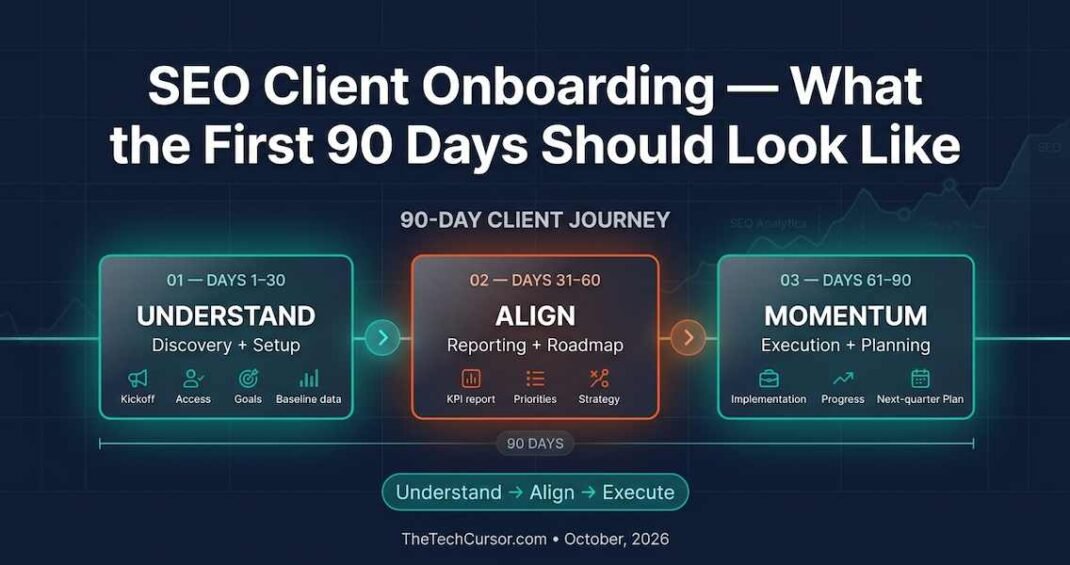
Days 1-30: Understand the business, establish responsibilities, set up reporting correctly, and document everything. Resist the urge to rush into delivery before discovery is complete.
Days 31-60: Present findings in business terms and share the roadmap in the context of client capacity and constraints. Then establish a communication rhythm that keeps the client informed even when nothing visible is happening.
Days 61-90: Move from planning into execution and maintain communication through slower periods. Finally, build the foundation for realistic quarterly planning.
Agencies that do this well do not just get better results. They also keep clients longer, generate more referrals, and spend less time managing friction that should never have existed in the first place.
Pingback: How to Report SEO Results to Executives (2026 Guide) - The Tech Cursor