
Read time: 7 min
Table of Contents
- What the Research Found
- Who Conducted the Study and How
- Finding 1: AI Mode Reduces Clicks to Websites
- Finding 2: Removing AI Overviews Increased Clicks Without Hurting UX
- Finding 3: AI Mode Made Users Switch to Competitor Search Engines
- Finding 4: AI Mode Caused Fewer Search Sessions
- Finding 5: AI Mode Worsened User Perceptions of Google
- Finding 6: Heavy Users Were Hit Hardest
- What Google Has Said, and Why the Research Contradicts It
- What This Means for Publishers and SEO Professionals
- Bottom Line
A peer-reviewed study tracking over 1,100 real Google users has produced findings that directly contradict Google’s official position on AI Mode. Academics from the University of Pennsylvania and Northeastern University conducted the research. They found that Google’s AI Mode reduces clicks to publisher websites, worsens user experience, and causes users to switch to competitor search engines like Bing, DuckDuckGo, and Yahoo.
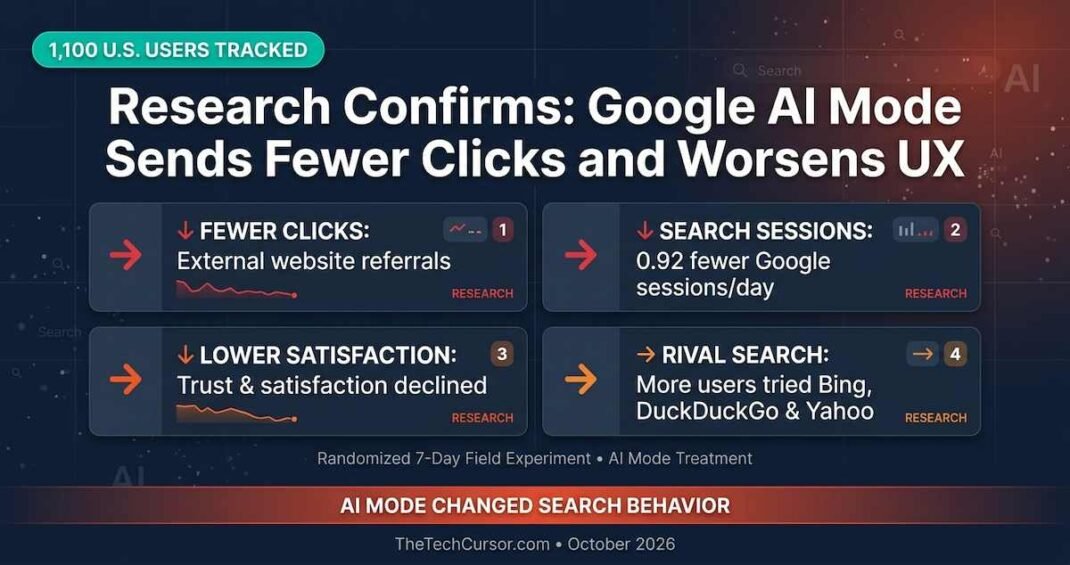
Furthermore, the study found that removing AI Overviews increased clicks to websites without any detectable decline in user satisfaction. That finding alone is significant. It suggests that AI Overviews reduce publisher traffic without giving users a measurable benefit in return.
1. What the Research Found
The paper is titled AI in Search Reduces Publisher Referrals Without Improving User Experience: Experimental Evidence. Researchers from the University of Pennsylvania and Northeastern University published it in August 2026.
The main findings are direct and specific:
- Google’s AI search features reduce traffic to publisher websites.
- Google’s AI Mode produced a poor user experience.
- AI Mode left users less satisfied with Google Search.
- Removing AI Overviews increased clicks to websites without any detectable decline in user search experience.
- AI Mode kept users inside Google’s search experience longer, while sending them to websites less often.
Importantly, these conclusions came from a randomized field experiment that tracked real Google searches. The researchers did not rely on a survey or a modelled estimate.
2. Who Conducted the Study and How
The study enrolled 1,444 participants. Of these, the researchers tracked the actual searches of 1,100 people during a seven-day experiment. In addition, 956 participants completed a post-experiment survey.
A browser extension tracked the participants. It recorded search behaviour, browsing history, and snapshots of Google search results pages. As a result, researchers could see exactly which searches people made, whether AI Overviews appeared, and whether participants clicked through to external websites.
The researchers randomly assigned each participant to one of three conditions:
- Forced Regular Google Search: The extension hid AI Overviews and redirected AI Mode searches to regular Google Search.
- Natural Google Behaviour: Google worked normally, including AI Overviews whenever Google chose to show them.
- Forced AI Mode Search: Every search went into AI Mode.
The random assignment matters because it means the differences between groups reflect the effect of the search experience. They do not reflect differences in the types of people in each group. Consequently, the findings carry more weight than observational studies or surveys.
One limitation is worth noting, though. Google changed the HTML structure of AI Overviews during the experiment, which broke the extension’s ability to hide them. Therefore, the extension hid only 51.1% of AI Overviews in the No AI condition. The researchers addressed this in their methodology, but it still limits the No AI findings.
3. Finding 1: AI Mode Reduces Clicks to Websites
The click-through rate finding is the most commercially significant result in the study.
Experiment subjects who were redirected to AI Mode were substantially less likely to click to external websites. When AI Overviews was removed clicks to external websites increased.
These results confirm what publishers have reported anecdotally for months. AI search features work as substitutes for visiting websites, not as gateways to them. Moreover, they directly contradict Google’s official position that AI Mode sends more traffic than ever.
The publicly available portions of the research do not specify the magnitude of the click reduction. Still, “substantially less likely” is a meaningful description from researchers who have access to the full click-through data.
4. Finding 2: Removing AI Overviews Increased Clicks Without Hurting UX
This is perhaps the most important finding in the entire study, and it carries the clearest policy implication.
When the researchers removed AI Overviews from the search results page, clicks to external websites increased. Furthermore, this increase happened without any detectable decline in how users perceived their search experience.
Users who did not see AI Overviews clicked through to more websites. Yet they were not measurably less satisfied with their search results, and they did not search less. Nor did they express lower trust in Google Search.
In other words, AI Overviews appear to reduce publisher traffic without improving user experience in return. Google implicitly claims a value exchange: users get better answers, and publishers lose some clicks. This study does not support that claim.
5. Finding 3: AI Mode Made Users Switch to Competitor Search Engines
This finding is the most surprising in the entire dataset, and it is the most damaging to Google’s narrative about AI Mode adoption.
Assignment to AI Mode Search significantly increased the fraction of users searching on a competitor engine — Bing, DuckDuckGo, or Yahoo — and intention to switch to Bing.
Users in the AI Mode group were more likely to use alternative search engines during the experiment. They were also more likely to say they intended to switch to Bing as their primary search engine.
This directly contradicts Google’s implicit claim that AI Mode is a reason to use Google more. Instead, exposure to AI Mode appears to push users toward Google’s competitors.
The mechanism is not hard to understand. If AI Mode produces a worse user experience, as the study’s other findings confirm, users who must use it will naturally look for alternatives. For Google, the practical implication is significant. Forcing AI Mode on users may accelerate the very search fragmentation that Google is trying to prevent.
6. Finding 4: AI Mode Caused Fewer Search Sessions
Google has consistently argued that AI search features increase search engagement. However, the study found the opposite.
The researchers had predicted that AI Mode would cause users to increase their search activity, but the exact opposite happened. People who were randomly assigned to use AI Mode conducted fewer search sessions.
Meanwhile, the study reports that exposure to No AI Search had no impact, neither increasing nor decreasing search sessions per day.
The interpretation is straightforward. AI Mode caused users to search less, while removing AI features had no effect on search frequency. Therefore, AI Mode is the variable that reduces search activity.
This finding challenges the core commercial argument for AI Mode. If AI Mode causes users to run fewer searches, it shrinks Google’s total search inventory, which is the foundation of its advertising business. A feature that decreases search frequency threatens Google’s revenue model rather than enhancing it.
7. Finding 5: AI Mode Worsened User Perceptions of Google
The user experience findings are consistently negative across multiple dimensions.
AI Mode generally made users feel worse about Google Search. It also reduced trust, led to a decrease in users’ perception that search was useful or satisfying, and it felt less personally relevant.
Trust fell. Perceived usefulness dropped. Satisfaction declined, and personal relevance slipped too. These are not minor experience degradations. Rather, they represent a fundamental failure to deliver on the core promise of search, which is connecting users with information that is useful and relevant to them.
Notably, the study did not find any clear difference in user perceptions when comparing AI Mode with regular Google Search for news-related searches. In short, AI Mode did not make news searches measurably better.
8. Finding 6: Heavy Users Were Hit Hardest
The negative effects of AI Mode were broadly consistent across different types of users. However, one group experienced significantly worse outcomes.
AI Mode reduced search activity more strongly for heavy users of Google Search than it did for lighter users.
Heavy Google Search users are the people most embedded in Google’s ecosystem and most valuable to its advertising business. They felt the strongest negative impact from AI Mode. Not only did they run fewer searches, but they were also more likely to switch to competitors.
This is strategically significant. Google’s most loyal and highest-value users are the ones most hurt by the feature Google is pushing as the future of search.
9. What Google Has Said, and Why the Research Contradicts It
Google’s official position on AI Mode has been consistently positive. Multiple Google executives, including CEO Sundar Pichai and SVP Liz Reid, have stated that users love AI Mode, engage with it strongly, and that it sends more traffic to the open web than ever before.
Our Google AI clicks controversy article documented how Google SVP Nick Fox claimed AI features send “billions of clicks to websites every week.” This research directly contradicts that characterization of how AI Mode specifically affects click behaviour.
The study does not prove that Google’s claims are intentionally misleading. Nevertheless, it does establish that data from a controlled experiment on user experience and click behaviour does not support the claims Google’s leadership has made publicly. The gap between Google’s official narrative and this study’s findings is substantial.
10. What This Means for Publishers and SEO Professionals
The research has several direct implications for how publishers and SEO professionals should approach their Google AI search strategy.
The click loss is real and confirmed. Publishers who have reported traffic declines from AI search features now have peer-reviewed experimental evidence that supports their observations. This research is methodologically stronger than most previous click studies because it used a randomized controlled design with actual user behaviour tracking rather than modelled estimates.
Removing AI Overviews helps publishers without hurting users. The finding that removing AI Overviews increases clicks without degrading user experience matters for any publisher who advocates for changes to Google’s AI search features. After all, it directly contradicts the argument that publisher traffic loss is an acceptable trade-off for improved user experience.
Heavy users, your best audience, are the most affected. Frequent, engaged searchers are the audience segment that publishers typically care about most. If AI Mode hits heavy Google users hardest, those searchers may be the most likely to shift behaviour. This accelerates the need to diversify away from Google-dependent traffic sources.
The user experience problem creates an opening. If AI Mode produces a worse experience than regular Google Search, users who find alternatives will have reason to stay with them. Publishers who invest in direct audience relationships, such as newsletters, communities, and podcasts, build traffic sources that AI Mode’s click-suppressing effect cannot touch.
Measurement matters more than ever. The study confirms that AI Mode and AI Overviews behave differently from regular search. For that reason, your AI visibility measurement should track AI-specific behaviour separately instead of blending it with traditional organic search metrics.
11. Bottom Line
The University of Pennsylvania and Northeastern University study is the most methodologically rigorous examination of Google AI Mode’s effect on publisher traffic and user experience published to date. Its findings are clear.
First, AI Mode reduces clicks to publisher websites and worsens user experience. Second, it makes users more likely to switch to competitor search engines, and it reduces search frequency. Finally, removing AI Overviews increases clicks without harming user experience.
These findings contradict Google’s official narrative. They also validate the experience of publishers who have reported AI-driven traffic declines. Moreover, they suggest that controlled experimental evidence does not support the user experience case for AI Mode, namely that it helps users find better information.
What Publishers Should Do Now
The research does not change the right strategic response. It confirms it. Build direct audience relationships that do not depend on Google AI Mode clicks. Next, invest in GEO and AI visibility, including invisible PR, so AI responses cite your brand even when clicks are suppressed. In addition, measure your actual AI search impact separately from traditional organic metrics. Above all, diversify your traffic sources before Google AI Mode’s click-suppressing effects compound further.
The evidence is in. Plan accordingly.
Pingback: Google’s AI Content in Discover: What Publishers Must Know - The Tech Cursor