
Category: Google Search | AI Overviews | SEO News
Read time: 5 min
Table of Contents
- What Google Just Started Doing
- What It Looks Like — The Visual Change
- The “Show More” Button Is Disappearing
- What Google Said
- The Click Impact — Why This Is a Big Deal
- The AI Mode Connection — Baby Steps Toward Full AI Search
- What SEOs and Publishers Should Do
- Bottom Line
Google just confirmed a new behaviour that every SEO professional needs to understand — and that Barry Schwartz at Search Engine Land described simply as: “If you thought AI Overviews take away clicks, just wait for this.”
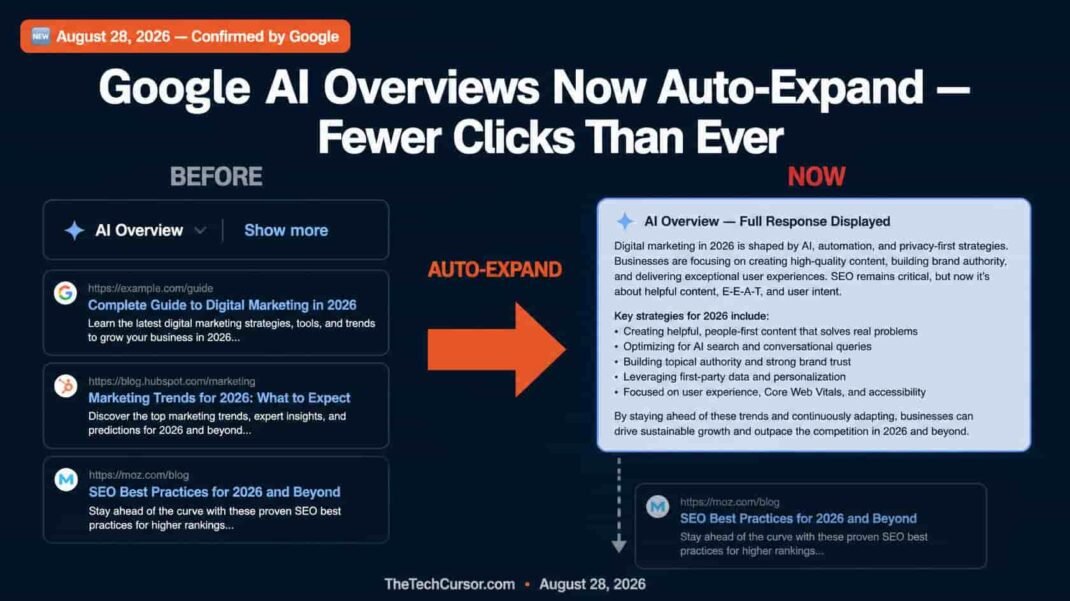
Google is now dynamically expanding AI Overviews to their full state for some queries — automatically, without requiring users to click “Show more.” The result pushes organic search results further down the page and gives users what amounts to an AI Mode experience within the main Google Search interface.
1. What Google Just Started Doing
Traditionally, AI Overviews appeared in Google Search as a condensed snippet — a summary with a “Show more” button that users could click to expand the full response. For most queries, users saw a short AI answer and could then scroll down to see organic results relatively quickly.
The new behaviour changes this. For certain queries, Google’s systems now automatically expand the AI Overview to its full detailed state — without requiring any user interaction. The “Show more” button disappears entirely. The full AI response is displayed immediately. And organic search results are pushed significantly further down the page.
A Google spokesperson confirmed the behaviour directly to Search Engine Land:
“For some queries, AI Overviews may dynamically expand for topics where our systems determine it’s most useful for people.”
2. What It Looks Like — The Visual Change
Chris Long spotted this behaviour on August 27 and posted about it on X, capturing the change in action:
“Holy moly SEOs: Google is now revealing the AI Mode prompt box BY DEFAULT for some queries. This is how Google continues to push AI Mode as the default search experience.”
The visual change is significant. Instead of the typical compact AI Overview that users have become accustomed to — which takes up roughly the same space as a featured snippet — the dynamically expanded version fills a much larger portion of the above-the-fold experience.
For users who have already begun scrolling when the expansion triggers, Google has built in a safeguard: the expansion is cancelled if the user has started scrolling, so they do not lose their reading position. However, for users who land on the results page without scrolling, the full AI response is immediately visible — with organic results pushed well below it.
3. The “Show More” Button Is Disappearing
The removal of the “Show more” button in the dynamically expanded state is more significant than it might initially appear.
The “Show more” button served as a friction point — a small but real moment where users had to choose to engage with the AI response. Users who were not interested in an AI-generated summary and preferred to scroll to organic results could do so without ever engaging with the AI Overview. The button preserved some optionality.
Dynamic expansion removes that optionality. The full AI response is displayed regardless of user preference. Users who want to reach organic results now need to scroll past a significantly longer AI-generated answer rather than a compact summary.
This shift — from opt-in expansion to automatic expansion — represents a meaningful change in how Google surfaces AI content relative to organic results.
4. What Google Said
Beyond confirming the behaviour, Google offered a specific rationale:
“Our research has shown that with this dynamic experience, users find Search more helpful and engage deeper in follow-up exploration.”
The “deeper in follow-up exploration” framing is worth examining. Google is saying that when users receive a full AI response, they engage more with follow-up queries — they ask additional questions rather than clicking through to a publisher’s page. From Google’s perspective, this is increased engagement. From a publisher’s perspective, this is a user who stays on Google’s ecosystem rather than visiting an external site.
The “find Search more helpful” claim echoes Google SVP Nick Fox’s earlier statement that AI features are sending billions of clicks to websites — a claim that has been met with significant skepticism from the SEO community, as covered in TheTechCursor’s analysis of that controversy.
5. The Click Impact — Why This Is a Big Deal
The click impact of this change is where the real commercial significance lives.
As covered in TheTechCursor’s analysis of zero-click search, the percentage of Google searches ending without a click has already reached 68% in 2026. AI Overviews in their standard condensed form have already been documented to reduce clicks by approximately 42% for queries where they appear.
Dynamic expansion — which displays a significantly longer, more comprehensive AI response without any user interaction — will almost certainly accelerate both of these trends for affected queries.
A user who receives a complete, detailed AI answer to their query has less reason to click through to any organic result than a user who received a summary with a “Show more” button. The more complete the AI answer, the lower the marginal value of clicking through to a publisher’s page.
Google has not disclosed what percentage of queries are currently triggering dynamic expansion — or whether that percentage is expected to grow over time. However, as Chris Long noted, the direction is clear: Google is using dynamic expansion as one of several mechanisms to push AI Mode toward becoming the default search experience.
6. The AI Mode Connection — Baby Steps Toward Full AI Search
The most important context for understanding dynamic expansion is its relationship to AI Mode — Google’s fully conversational AI search experience.
AI Mode is currently a separate tab within Google Search, requiring users to explicitly choose it. Dynamic expansion brings AI Mode-like behaviour into the default Google Search experience without requiring any user action or tab selection.
(cite index=”34-1″>Chris Long noted: “This is how Google continues to push AI Mode as the default search experience.”</cite>
The pattern is consistent with how Google has historically evolved its search interface — introducing significant changes gradually in the default experience rather than requiring users to opt into a new interface. Featured snippets, knowledge panels, and shopping carousels all followed the same arc: from optional or minimal to prominent to default.
Dynamic expansion of AI Overviews appears to be Google’s current vehicle for making comprehensive AI responses the default experience for the queries where it judges them most useful — which is almost certainly an expanding set of queries rather than a fixed one.
As covered in TheTechCursor’s earlier article on how Google’s search journey has become a loop, the transition from ranked results to AI-synthesized answers is the defining change in search right now. Dynamic expansion accelerates that transition in the default search experience.
7. What SEOs and Publishers Should Do
Monitor which query types trigger dynamic expansion: Dynamic expansion appears to be query-specific — triggered when Google’s systems determine a comprehensive AI response is most useful. Understanding which query categories in your industry are triggering expansion helps you anticipate where organic click-through rates will face the most pressure.
Prioritize queries where clicks still happen: As covered in TheTechCursor’s SEO priorities article, the highest-ROI SEO investment is increasingly concentrated in queries where AI cannot fully resolve user intent — transactional queries, navigational queries, queries requiring personalized information, and queries where the user needs to take an action rather than receive information.
Redouble investment in being the cited source: Dynamic expansion means more searchers receive comprehensive AI responses — which means more searchers see the sources Google cites within that response. As covered in TheTechCursor’s article on used vs cited in AI search, being cited within an AI Overview is now more valuable than ranking below it. The click may not happen immediately — but the brand impression and citation signal compound over time.
Track branded search and direct traffic carefully: As covered in TheTechCursor’s zero-click AI value framework, AI impressions without clicks are not zero-value. They build brand awareness that translates to branded search lift 4-8 weeks later. Monitor this correlation as dynamic expansion expands to more queries in your category — it is the clearest signal of whether AI visibility is translating to downstream business value.
Use the Search Console AI Performance Report — with caveats: As covered in TheTechCursor’s article on the GSC AI report data bug, the Generative AI Performance Report was affected by a data accuracy issue in August 2026. Verify the bug fix is confirmed before using absolute numbers as baselines.
8. Bottom Line
Google’s dynamic expansion of AI Overviews is a significant development in the evolution of Google Search toward a more AI-first experience. By automatically displaying full AI responses for certain queries — without requiring any user interaction — Google is reducing the friction between a user’s search and a comprehensive AI answer, while simultaneously pushing organic results further down the page.
The click impact is real. The direction is clear. And the percentage of queries triggering dynamic expansion is almost certainly expanding rather than staying fixed.
The brands and publishers best positioned for this transition are those that have already invested in being cited within AI responses rather than relying solely on organic blue link clicks. If your strategy is built around AI citation probability — through topical authority, entity signals, and original content — dynamic expansion is a feature that works in your favour. If your strategy is built entirely around traditional ranking positions, it is one more pressure point to navigate.
AI Mode is coming to the default search experience, one dynamically expanded query at a time.
Pingback: How to Build an AI Visibility Dashboard (2026 Guide) - The Tech Cursor
Pingback: New Study: Google AI Mode Sends Fewer Clicks, Worse UX - The Tech Cursor
Pingback: AI Mode Follow-Up Questions Reveal Your Content Gaps - The Tech Cursor
Pingback: WeatherNext 3: Google Search Is Becoming a Task Engine - The Tech Cursor