
AI Mode Follow-Up Questions Reveal Your Content Gaps
Read time: 7 min
Table of Contents
- The Commodity Content Problem
- How AI Mode Follow-Up Questions Work as a Content Audit
- The 10-Phase Non-Commodity Research Workflow
- The Claim Labelling System — A Critical Control
- What the Workflow Found on a Real Client Page
- Turning Unknowns Into an Evidence Plan
- Using Existing Content as Evidence — The Podcast Transcript Method
- From Brief to Finished Page — What Non-Commodity Looks Like
- Why This Matters Even More in AI Search
- Bottom Line
Most service pages answer the same basic questions as every competitor in their space. They confirm fees are contingency-based. They advise calling quickly. They summarize the relevant law. Then they stop — leaving AI search with nothing distinctive to extract and no reason to cite the page over the ten identical alternatives beside it.
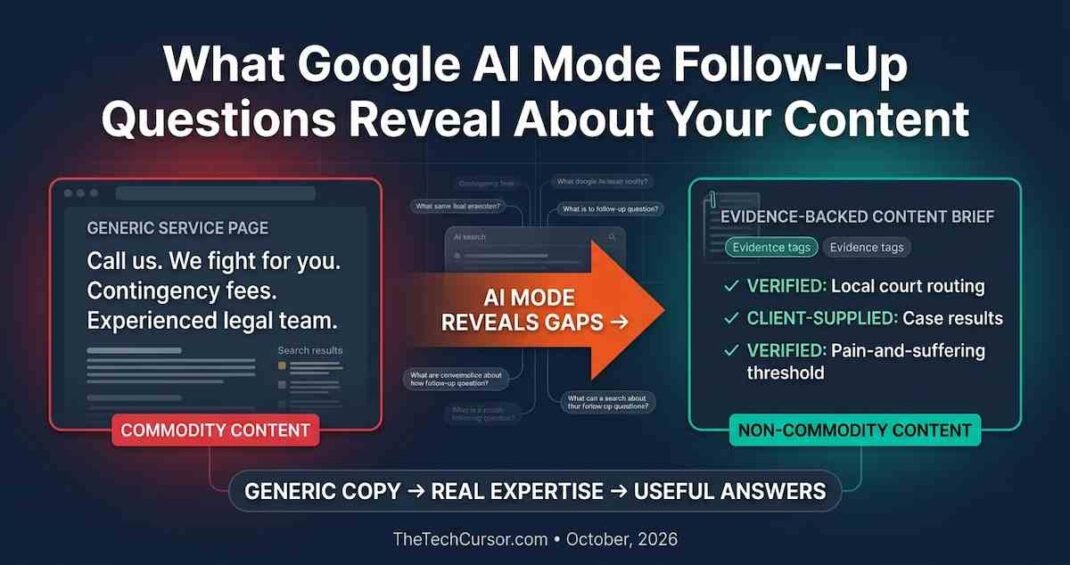
Google AI Mode’s follow-up questions expose this problem directly. When you run a real buyer query through AI Mode and follow the questions it suggests next, you discover the decisions your content is failing to help users make. Those follow-up questions become your content map.
1. The Commodity Content Problem
Consider a car accident legal page. It tells the buyer to call an attorney quickly, explains contingency fees, and summarizes the relevant comparative-fault rule. So does every competing firm. Almost word for word.
“Call us. We fight for you. Contingency means you pay nothing unless we win.” That is commodity content. It is content that an AI model or a potential customer cannot extract anything distinctive from — because the next firm down the street says exactly the same thing.
The problem is not that the content is inaccurate. The problem is that it is identical. Generic claims give AI models nothing distinctive to extract. Consequently, the page gets summarized into the same pile as every competitor’s page. The model then fills the actual decision-making content from wherever else it can find it — which is not from your site.
2. How AI Mode Follow-Up Questions Work as a Content Audit
The technique starts with a query a real person would actually submit after a triggering event. Run that query through Google AI Mode. Then follow the questions the model suggests next.
AI Mode does not stay at the generic “contact an attorney” level. For the car accident example, the model surfaces the decisions people actually need help making: whether a case can clear a pain-and-suffering threshold, how comparative fault affects a settlement, what happens if the other driver is uninsured, where a local claim may be filed, and when vehicle damage belongs in small claims court rather than civil court.
Each follow-up question the model surfaces is a signal. If AI Mode keeps branching into a question, that is a strong signal that the page should give the buyer a clear, evidence-backed answer to it. The follow-up questions reveal exactly where the gap between what the page says and what buyers actually need sits.
Furthermore, Google AI Mode has a specific advantage for local content research. It understands places, businesses, entities, and local context. Consequently, the follow-up questions it generates for local service queries are more contextually specific than questions from general-purpose AI tools.
3. The 10-Phase Non-Commodity Research Workflow
The follow-up question technique becomes most powerful when embedded in a structured research workflow. The workflow covers ten phases that move from audit to finished brief.
Phase 1: Audit the existing page — document every factual claim, identify unsupported assertions, and list what is missing.
Phase 2: Define the buyer question — identify the single natural-language question a real buyer would ask at the moment they land on this page.
Phase 3: Map the follow-up questions — run the buyer question through AI Mode and document every branch the model suggests.
Phase 4: Log how answers vary — record how the answer changes across different branches of the follow-up question tree.
Phase 5: Build a terminology log — identify the technical terms both buyers and AI models use for the key concepts on the page.
Phase 6: Score the gaps — prioritize the identified gaps by their impact on the buyer’s decision.
Phase 7: Build an evidence plan — separate what can be found through public research from what requires client records or subject-matter expert input.
Phase 8: Draft answer-first content briefs — structure each brief around the buyer question, the specific answer, and the evidence required.
Phase 9: Decide on page architecture — determine whether each finding warrants its own page or a section on an existing one.
Phase 10: Deliver with quality controls — sequence the deliverables and attach verification requirements to each claim.
4. The Claim Labelling System — A Critical Control
The most important control in the workflow is the claim labelling system. Every finding is tagged with one of five labels before it can become published content.
OBSERVED — something documented from the existing page or public sources without verification.
VERIFIED — a claim that has been confirmed against a reliable primary source.
CLIENT-SUPPLIED — a fact provided directly by the client from their own records or experience.
INFERRED — a reasonable conclusion drawn from available evidence, not directly stated.
UNKNOWN — a gap where the needed information has not been found or supplied.
The UNKNOWN label is particularly important. It prevents a plausible assumption from becoming a published fact by default. Settlement ranges, years of experience, case volume, and other client-specific facts that cannot be externally verified come back as UNKNOWN — each paired with a precise question for the subject-matter expert.
This labelling approach keeps the workflow honest. Publicly verified facts stay separate from client-supplied claims. Inferences are flagged as inferences. Consequently, every claim on the final page traces back to a verifiable source before publication.
5. What the Workflow Found on a Real Client Page
The workflow was tested against a real client’s car accident practice-area page. The page had a short hero statement, a list of related practice areas, and four brief FAQs. The gap analysis surfaced specifics that no competing firm in the audit had published.
It found which actual local courts a case in that market runs through — information that matters practically to a buyer but appears on almost no competing service page. It identified a separate small-claims threshold for vehicle damage that most pages omit entirely. It surfaced the exact legal test that determines whether a client can recover pain-and-suffering damages — the threshold question that determines whether a case is worth pursuing.
Just as importantly, the workflow did not write around what it could not verify. Settlement ranges, specific case timelines, and experience claims came back as UNKNOWN, each paired with a question for the attorney. The workflow kept verifiable public facts strictly separate from claims that required attorney input to confirm.
The output was four prioritized content briefs. Each brief identified the buyer question, where the answer should live on the site, which facts still required attorney input, and any legal accuracy risk associated with the content.
6. Turning Unknowns Into an Evidence Plan
The UNKNOWN items in the gap analysis become an interview agenda rather than content gaps. Each UNKNOWN is converted into a precise question that the subject-matter expert can answer in a structured call.
This approach has a specific advantage over generic expert interviews. The questions come directly from what AI Mode revealed buyers are actually asking — not from what the SEO team assumed they needed to know. The interview therefore produces exactly the first-party facts that will fill the gaps AI search has identified.
Furthermore, the evidence plan separates two categories of needed information. Public research — court procedures, legal thresholds, comparative-fault rules — can be gathered before the interview. Client-specific information — case timelines, fee structures, outcomes — requires the expert call. This separation makes the interview more efficient and the content brief more complete before the expert conversation happens.
7. Using Existing Content as Evidence — The Podcast Transcript Method
Many subject-matter experts have already answered the follow-up questions publicly — in podcast appearances, YouTube interviews, webinars, or recorded Q&A sessions. That existing content can serve as the evidence source for the brief rather than requiring a dedicated interview.
In the car accident case, the attorney had addressed most of the identified UNKNOWN items in existing YouTube podcast appearances. Feeding those transcripts into an AI tool as the evidence source closed almost every gap the brief had flagged.
The transcripts supplied real numbers: the actual fee structure, how long cases typically take, a full track record with verdict and settlement figures, and an anonymized case example where a client’s injury narrowly missed the legal threshold.
Additionally, the podcast transcript method produced an unexpected benefit. Because every claim traced back to a specific timestamp in the original recording, the finished page could link directly to the relevant moments in the videos. Readers — and AI models — can verify any claim by watching 30 seconds of footage. This creates a verifiable evidence chain that strengthens the page’s credibility with both human readers and AI citation systems.
8. From Brief to Finished Page — What Non-Commodity Looks Like
The finished page that emerged from the workflow was structurally different from the original service page and from every competitor page in the audit.
It named the specific courts a case in that market runs through and explained why the routing matters practically to a client. It walked through comparative-fault math with a worked example rather than just citing the rule. It explained the order in which fees are deducted — and why that order affects the client’s final payout. It laid out the firm’s real case results with the appropriate legal advertising disclaimer.
Every claim traced back to something the attorney had already said publicly. Nothing was inferred without being labelled as an inference. Consequently, the page contained information that no competitor could easily replicate — because it came from the specific experience and judgment of a specific attorney in a specific market.
That is what non-commodity content looks like in practice. It is not more content. It is more specific content — containing the facts, thresholds, and judgment calls that only the business itself can supply.
9. Why This Matters Even More in AI Search
Research examining 17.2 million AI citations found that different AI models draw on meaningfully different source types. Gemini favours official websites. Claude cites reviews and social content significantly more often than other models. Perplexity cites business-owned websites between roughly 37% and 50% of the time depending on the sector.
Every model builds its answer out of different raw materials. Furthermore, every response is different for every user, every platform, and every query variation. The same question produces different answers depending on which AI system processes it and what sources it retrieves.
Generic claims give the model nothing distinctive to extract. The page gets summarized into the same pile as every competitor. The AI fills the actual decision-making content from wherever else it can find it.
The fix is not to write more content. It is to write the specific facts, thresholds, and knowledge that only the business can supply. The AI visibility dashboard covered on this site tracks which content earns citations. However, before tracking citations, the content needs something worth citing.
This connects directly to the 5 GEO pillars framework. The Relevance and Credibility pillars both require exactly what this workflow produces: content that genuinely addresses buyer questions with verifiable, specific information that competitors cannot easily replicate.
Furthermore, the workflow’s claim labeling system aligns with the evidence house concept covered in the MIT Anthropic OpenAI warning article. Getting your evidence house in order means knowing which claims are verified, which are client-supplied, and which still need confirmation — before publishing.
10. Bottom Line
Google AI Mode’s follow-up questions are a free, accessible diagnostic for the most common content problem in local and service business SEO: commodity content that gives AI search nothing distinctive to cite.
The technique is simple. Run a real buyer query through AI Mode. Follow the follow-up questions it suggests. Document where your existing content fails to answer them. Then gather the first-party facts, thresholds, and judgment calls that fill those gaps — through client interviews, existing recordings, or subject-matter expert input.
The Three Principles That Make This Work
First, use AI Mode to find the gaps rather than asking AI to fill them. The follow-up question map reveals what buyers actually need, not what a prompt will generate.
Second, label every claim before it becomes published content. The OBSERVED / VERIFIED / CLIENT-SUPPLIED / INFERRED / UNKNOWN system prevents assumptions from becoming facts and keeps the evidence trail auditable.
Third, treat existing expert content as evidence. Podcast transcripts, recorded interviews, and published Q&A sessions often contain the first-party specificity the page needs — without requiring a dedicated expert session. Furthermore, content with traceable sources strengthens AI citation probability by giving retrieval systems something verifiable to anchor the citation to.