
Read time: 9 min
Table of Contents
- The Two-Proposal Problem
- Why Organic Traffic Is No Longer Enough to Justify SEO
- The GEO Budget Paradox — Same Work, Different Name
- The $1.2M Budget Reframe — A Real Example
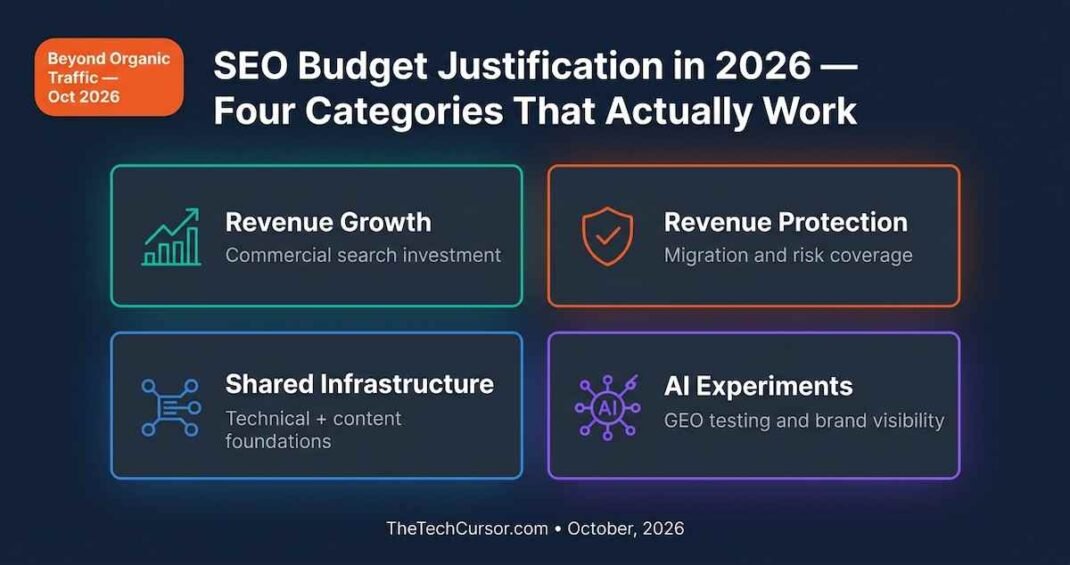
- The Four Investment Categories That Replace Traffic Forecasts
- Stop Evaluating Every Investment Against Incremental Revenue
- Opportunity Cost — The Conversation SEOs Avoid
- How to Build a Better Budget Proposal
- The Budget Should Reflect the Value, Not the Acronym
- Bottom Line
Imagine presenting two proposals to the same executive team. The first requests funding to fix technical SEO debt, improve content architecture, and ensure critical product information is accessible to search engines. Organic traffic has been declining. The CFO wants to know why the company should continue investing in a channel that appears to be delivering diminishing returns.
The second requests funding for a generative engine optimization initiative. It promises to improve visibility across AI-powered discovery platforms by addressing technical accessibility, strengthening content architecture, and making product information easier for machines to retrieve and interpret.
The second proposal sounds considerably more appealing. It may have a better chance of securing funding — even though much of the proposed work is identical.
This is the core problem with how many organizations approach SEO investment. The perceived value of the work can change dramatically depending on which budget line it comes from, even when the underlying business benefit is substantially the same.
1. The Two-Proposal Problem
The two-proposal problem reveals something important. When an executive team rejects SEO spending but approves GEO spending for overlapping work, the issue was never the work itself. It was how the investment was framed and classified.
Carolyn Shelby, principal consultant at CSHEL Search Strategies, identified this disconnect in a detailed analysis of SEO budget frameworks. Her observation is direct: adding a GEO budget or swapping organic traffic for a new collection of visibility metrics does not solve the underlying resource allocation problem. The budget has to reflect what the business is actually purchasing.
This reframing challenge is becoming more urgent. AI search is genuinely changing how consumers discover and evaluate brands. However, the response to that change should not be creating separate budget structures for work that serves the same underlying capabilities.
2. Why Organic Traffic Is No Longer Enough to Justify SEO
The traditional SEO budget justification followed a relatively simple model. Investments produced rankings. Rankings generated traffic. Traffic created opportunities for conversions and revenue.
That model never captured SEO’s full contribution. However, it gave organizations an accessible way to evaluate investment against organic acquisition costs.
The model becomes much less useful when the same capabilities support several discovery environments simultaneously. Furthermore, consumers can now encounter and evaluate a brand without ever visiting its website.
Work that makes product information accessible and consistent can support conventional search, improve the reliability of information consumed by AI systems, and reduce operational inconsistencies across the business. Some of those benefits appear in organic search reports. Others surface elsewhere entirely.
Evaluating the entire investment against incremental organic sessions assumes that the channel receiving the budget is also the only beneficiary. That assumption is increasingly wrong — and it leads to poor resource allocation decisions.
Consequently, when measurable channel returns decline, the capabilities that support the entire discovery ecosystem become vulnerable to cuts. A company may have sound reasons to reduce spending on informational content that no longer earns enough revenue to cover production costs. However, it does not follow that the company should also eliminate technical maintenance that protects commercially valuable pages or supports AI search visibility.
Those expenditures serve different purposes and should be evaluated accordingly.
3. The GEO Budget Paradox — Same Work, Different Name
An executive team may resist additional SEO spending while readily allocating resources to improve visibility in AI-generated answers. The emerging concern may be legitimate. However, before creating an entirely separate GEO program, organizations should examine how much of the required work already sits inside existing SEO responsibilities.
Google’s own guidance on its AI search features is explicit: established SEO fundamentals remain relevant. Pages still need to be accessible to Google, meet the technical requirements for appearing in search, and provide useful content. Google does not prescribe a separate set of technical optimizations exclusively for its AI features.
Furthermore, if a company has unresolved crawlability problems, inconsistent product information, weak internal linking, and outdated content, a new AI visibility platform will not make those deficiencies disappear. The fundamentals did not become obsolete when someone introduced a new acronym.
The appropriate response is to identify shared capabilities — foundational technical SEO work — determine which investments support broader discovery objectives, and fund them accordingly. That approach does not eliminate the need for new investment. It changes how the investment should be justified.
4. The $1.2M Budget Reframe — A Real Example
Shelby presents a specific hypothetical that illustrates how budget reframing works in practice.
Consider an ecommerce company with an established SEO program, declining informational traffic, and executive pressure to invest in AI discovery. Management is considering cutting the SEO budget to finance a separate GEO initiative.
Instead of requesting more money, the SEO leader proposes reallocating the existing $1.2 million investment around the business outcomes it supports.
The current budget is organized around conventional expense categories: agency support, content production, technical SEO, and tools. Those categories explain where the money goes. They do not explain what the organization receives in return.
The proposed budget uses a different classification:
| Investment Category | Scope | Annual Allocation |
|---|---|---|
| Shared Discovery Infrastructure | Technical foundations, structured product information, architecture | $420,000 (35%) |
| Commercial Search | High-intent content, product and category optimization | $360,000 (30%) |
| AI Discovery Experimentation | Platform evaluation, brand representation, controlled tests | $180,000 (15%) |
| Measurement and Operations | Reporting, monitoring, tooling, specialist support | $240,000 (20%) |
| Total | $1,200,000 |
The total budget does not increase. What changes is the financial case.
Instead of defending $1.2 million as the cost of generating organic traffic, the SEO leader can explain how the investment supports commercial acquisition, protects existing revenue, maintains discovery infrastructure, and addresses uncertainty about emerging platforms.
Moreover, the allocation makes trade-offs explicit. Funding AI experimentation requires resources that could otherwise support commercial search, infrastructure, or other priorities. Management can evaluate those choices rather than treating GEO as an entirely new expenditure independent of SEO.
5. The Four Investment Categories That Replace Traffic Forecasts
The four categories in the reframed budget reflect a more honest account of what SEO investment actually does for a business.
Shared Discovery Infrastructure: Technical SEO foundations — crawlability, structured data, content architecture, page speed — serve traditional search, AI search, and other discovery channels simultaneously. Funding these as infrastructure investments, rather than as SEO channel costs, reflects their true scope of contribution.
Commercial Search: High-intent content and product page optimization directly supports revenue generation from organic acquisition. This is the category where incremental revenue forecasts are most appropriate and most reliable.
AI Discovery Experimentation: A defined, bounded budget for testing AI visibility — evaluating brand representation across platforms, identifying inaccuracies in AI-generated responses, testing platform-specific behaviour. Crucially, Shelby notes that AI experimentation budgets need defined objectives and performance expectations. Reclassification is not permission to disguise existing costs or promise outcomes that cannot be demonstrated.
Measurement and Operations: The tooling, monitoring, reporting, and specialist support that make the entire program work. This is an operational cost, not a channel investment, and should be evaluated as such.
6. Stop Evaluating Every Investment Against Incremental Revenue
One of the most important practical arguments in Shelby’s framework is that not every SEO investment is designed to generate incremental revenue — and evaluating it that way produces systematically wrong conclusions.
Consider a major ecommerce platform migration. Redirect planning, URL preservation, crawlability testing, and content validation may not create revenue above the existing baseline. Their purpose is to prevent the business from losing revenue it already generates.
A successful migration may produce very little visible change in organic performance. That is often the desired outcome. If management measures the project only against incremental traffic, the investment can look worthless — when it actually protected significant existing revenue.
The appropriate business case for migration work is not a forecast of additional traffic. It is an assessment of the revenue exposed to disruption, the probability and potential severity of that disruption, and how much risk the proposed work could reasonably reduce.
A hypothetical 10% revenue decline lasting three months on a $10 million organic revenue business represents $250,000 in revenue exposure. The $100,000 migration budget request looks different framed against that exposure than it does framed against a forecast of traffic gains.
The principle extends to infrastructure. Better content management processes may reduce publishing errors, eliminate duplicated work, and help teams maintain consistent information. Those benefits belong in an assessment of operational cost and capability — not an organic traffic forecast.
7. Opportunity Cost — The Conversation SEOs Avoid
Shelby identifies the most uncomfortable part of the budget conversation clearly: an investment can be valuable and still not deserve funding.
A technical improvement may produce measurable benefits while another project could generate substantially greater returns with the same resources. That is the opportunity-cost problem — and it is one that SEO leaders tend to avoid.
The argument that SEO work deserves continued investment because it creates value is only part of the case. The full case requires demonstrating that the proposed expenditure is a reasonable use of company resources relative to available alternatives.
This becomes more urgent when the economics of a particular SEO activity deteriorate. If a publisher’s informational content no longer attracts enough monetizable traffic to cover production costs, continuing to publish more content under the same strategy may be irrational. The same scrutiny should apply to GEO investment. An executive team’s enthusiasm for AI does not establish that every proposed AI visibility initiative deserves funding. If the business cannot identify a meaningful objective, a plausible mechanism for creating value, or a decision the investment will inform, the proposal needs more work.
8. How to Build a Better Budget Proposal
Shelby’s framework distils into a four-category classification that replaces traffic-based justification with purpose-based justification:
| Economic Purpose | Financial Justification | Example |
|---|---|---|
| Generate revenue | Expected incremental commercial return | Expanding high-intent product coverage |
| Protect revenue | Expected loss avoided relative to mitigation cost | Preserving visibility during platform migration |
| Maintain capabilities | Operational value relative to costs | Improving product data and content infrastructure |
| Reduce uncertainty | Value of information produced relative to experiment cost | Testing AI visibility and brand representation |
These categories are not mutually exclusive. A technical improvement might protect existing organic revenue, support AI discovery, and reduce maintenance costs simultaneously. The organization should recognize those benefits — without counting the same financial return more than once.
Before presenting any SEO or GEO initiative, Shelby recommends establishing what the business needs to accomplish and why the investment is necessary. Name the commercial opportunity, operational deficiency, revenue exposure, or strategic uncertainty. Then explain the required work, expected benefits, available alternatives, and the evidence that will be used to judge the result.
Furthermore, measurement requires the same discipline as the investment itself. Organic traffic and attributable revenue remain appropriate when an investment is intended to generate organic customer acquisition. They are less useful as the sole measures of a project designed to prevent a migration failure. AI citations and visibility scores carry their own limitations — a mention in a generated response does not prove that the exposure caused a purchase.
9. The Budget Should Reflect the Value, Not the Acronym
The rise of GEO gives organizations a reason to reconsider how they fund search visibility. It also gives them a fresh opportunity to repeat the same resource allocation mistakes under a more fashionable name.
A separate AI visibility budget makes little sense if the technical and informational foundations supporting that visibility are allowed to deteriorate. Defending every traditional SEO activity on the assumption that it must contribute to AI discovery is equally weak.
The useful approach is to identify the capabilities the business needs, determine where the work overlaps, and allocate resources according to economic purpose.
If the same work suddenly becomes easier to fund when it is called GEO, the problem was never the SEO budget. It was how the organization understood the investment.
This connects to a broader reporting principle covered in the SEO reporting for executives guide — the goal is communicating business value, not channel metrics. Furthermore, the State of Search 2027 survey data confirms that 81% of organizations plan to maintain or increase SEO investment — but only 9% feel confident measuring AI visibility. The budget reframe Shelby describes is precisely the tool that bridges that confidence gap.
10. Bottom Line
The business case for SEO is not becoming weaker. It is becoming broader — and more complex to communicate.
Traffic forecasts made sense when organic search was the primary beneficiary of SEO investment. They make much less sense now that the same foundational work supports traditional search, AI search, and broader discoverability simultaneously.
The four-category framework — revenue generation, revenue protection, shared infrastructure, and uncertainty reduction — gives SEO leaders a more accurate and more defensible way to present investment decisions to executive teams.
The Three Questions Every SEO Budget Proposal Should Answer
First: what is this investment designed to accomplish — generate revenue, protect revenue, maintain a capability, or reduce uncertainty?
Second: what evidence will be used to evaluate whether the investment achieved its purpose?
Third: why is this the best use of these resources compared to available alternatives?
Proposals that answer those three questions accurately will be more fundable — not because they promise more, but because they promise the right things to the right decision-makers.
Pingback: How to Report SEO Results to Executives (2026 Guide) - The Tech Cursor