
Read time: 8 min
Table of Contents
- Why This Research Matters
- Finding 1: Traffic Is Declining — But Conversions Are Not
- Finding 2: GEO Investment Is Outpacing GEO Results 3-to-1
- Finding 3: AI Measurement Confidence Is Very Low
- Finding 4: Search Investment Remains Strong Despite AI Disruption
- Finding 5: Teams Are Pairing AI With Human Expertise
- Finding 6: Proven SEO Work Is Slipping Down the Priority List
- The Three Strategic Questions These Findings Raise
- What to Stop, Measure, and Fund in 2027
- Bottom Line
New industry research surveying search professionals reveals a picture that is more nuanced than either the doom narrative or the business-as-usual narrative about AI’s impact on search. Traffic is declining for many organizations. However, business results are proving more resilient than the traffic numbers suggest.
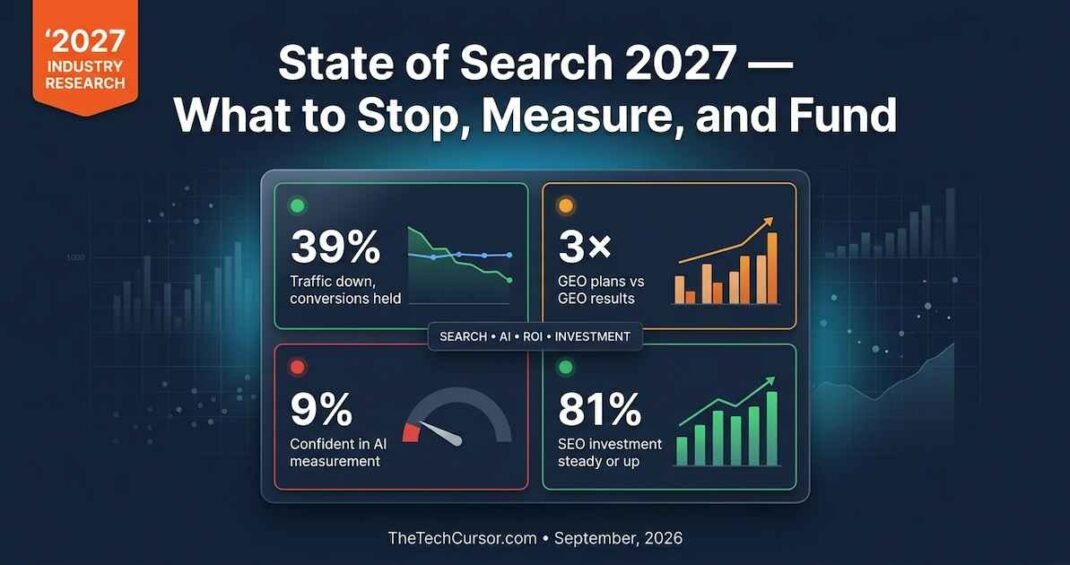
The research examined how marketers are responding as traffic declines, AI search grows, and familiar measurement approaches lose meaning. The findings challenge several widely-held assumptions about what is actually happening in search right now — and where the smart money should be going in 2027.
1. Why This Research Matters
Most trend reports about AI and search rely on expert opinion, tool vendor data, or high-profile case studies. This research is different. It surveys actual search professionals about what they are seeing in their own programs — traffic trends, conversion trends, budget plans, and AI adoption patterns.
The result is a ground-level view of how the industry is actually responding to AI search. It is not how vendors want you to think the industry is responding. It is not how conference speakers frame their keynotes. It is what practitioners are observing in their own Google Analytics, their own Search Console data, and their own conversion reports.
Furthermore, the findings reveal important gaps. The gap between where teams are investing and where results are actually coming from is one of the most practically important findings in the entire dataset.
2. Finding 1: Traffic Is Declining — But Conversions Are Not
(cite index=”8-1″>39% of respondents saw traffic decline or remain flat while leads and conversions held or improved. Only 15% lost both traffic and conversions.</cite>
This finding reframes the entire traffic decline narrative. The story is not simply that AI search is hurting search marketers. The story is more specific. AI Overviews and answer engines are resolving simple informational searches without sending a click. However, the users who do click are arriving with stronger intent. Consequently, conversions are holding even as overall traffic volume declines.
That does not make every lost visit harmless. Publishers who earn revenue from audience scale are genuinely hurt by traffic declines. Brands that need broad visibility to create future demand cannot simply dismiss top-of-funnel traffic losses.
However, for many commercial websites with transaction or lead generation goals, the data suggests that the traffic decline is not necessarily translating into business decline. The right question is not “is our traffic declining?” It is “are our conversions declining?” Those are increasingly different questions with increasingly different answers.
3. Finding 2: GEO Investment Is Outpacing GEO Results 3-to-1
This is the most striking finding in the entire research — and the one with the most direct implications for budget decisions.
(cite index=”8-1″>Only 14% of respondents named optimization for AI answer engines as one of their strongest result drivers. Yet 43% plan to invest in or prioritize GEO during the next year — nearly three times its current proof point. That is the largest gap between reported results and future investment priorities in the survey.</cite>
Let that sink in. Nearly three times as many search professionals plan to prioritize GEO as are currently seeing results from it. That is a significant gap between ambition and evidence.
This finding does not mean GEO is not worth investing in. AI search is growing rapidly. The 5 GEO pillars framework and the Freshpet GEO playbook both demonstrate that systematic GEO work can produce measurable results. Moreover, building AI visibility now while competition is lower is a reasonable strategic bet.
However, the 3-to-1 gap between current results and planned investment is a warning signal. Teams rushing to prioritize GEO without measurement frameworks may be investing ahead of their ability to evaluate what is working. Furthermore, they may be pulling budget and attention away from proven activities that are still producing results.
What the Investment Gap Means Practically
The safe interpretation is this. GEO deserves meaningful investment. However, that investment should be built on a measurement foundation. As covered in the AI visibility dashboard guide, measuring AI citation share, prompt tracking, and AI referral traffic before scaling GEO investment is essential. Otherwise, the 43% who plan to invest in GEO will struggle to know whether their investment is actually working.
4. Finding 3: AI Measurement Confidence Is Very Low
The measurement finding contextualizes the GEO investment gap perfectly.
(cite index=”8-1″>Only 9% feel very confident measuring and interpreting AI visibility. Measurement confidence remains just as low among organizations planning to prioritize GEO. 92% of that group lack full confidence in their data.</cite>
This is a genuinely alarming number. Nine percent. That means 91% of search professionals who are working in AI search do not feel very confident about whether their measurement is accurate or meaningful. Furthermore, this confidence gap is just as large among the organizations that plan to increase GEO investment.
Teams are planning AI-search work before they can measure it with confidence. That creates a specific risk. Budget will be allocated to GEO. Activities will be executed. However, without confident measurement, teams will not know whether those activities are working. They will either continue investing regardless — wasting budget if the activities are ineffective — or pull back at the first sign of difficulty, even if the activities were beginning to work.
The Google Search Console AI reporting limitations article covers exactly why measurement confidence is so low. The tools are genuinely inadequate right now. Building alternative measurement approaches — prompt tracking, brand mention monitoring, GA4 AI referral segmentation — is essential infrastructure before scaling GEO investment.
5. Finding 4: Search Investment Remains Strong Despite AI Disruption
Despite the measurement challenges, traffic declines, and AI disruption, search investment plans remain broadly positive.
(cite index=”8-1″>81% of respondents expect SEO investment to increase or remain steady during the next year. Organizations reporting the greatest harm from AI search are also continuing to invest. Within the group experiencing a significant negative impact, 44% expect investment to increase. 16% expect a decrease.</cite>
This finding tells an important story about practitioner confidence in search as a channel. Even organizations that are being hurt by AI search are not abandoning it. They are adapting and continuing to invest.
That confidence is consistent with the ecommerce search trends data showing that Google search volume for transactional product keywords grew 2.2% year-over-year. Traditional search is not dying. It is evolving. The organizations that maintain investment during the transition will be better positioned than those that cut and scramble to rebuild later.
6. Finding 5: Teams Are Pairing AI With Human Expertise
The research reveals a nuanced picture of how search teams are actually using AI tools — one that differs from both the “AI is replacing everything” and the “AI is just a drafting tool” narratives.
(cite index=”8-1″>66% use AI for research, outlines, or briefs. 49% use AI-generated drafts with heavy human shaping. At the same time, 54% name the flood of AI-generated content as a major concern.</cite>
The majority of search professionals are using AI in their workflows. However, the most common uses are assistive rather than generative — research, outlining, briefing. The 49% using AI-generated drafts are specifically described as using heavy human shaping, not accepting AI output as-is.
Furthermore, the 54% who name the flood of AI-generated content as a major concern reveals an industry that is aware of the quality risk even while adopting the tools. This is consistent with the MIT, Anthropic, and OpenAI warnings article — the industry is not blindly embracing AI production but actively managing the tension between efficiency and quality.
The pattern emerging is that skilled search teams are using AI to handle repeatable tasks while keeping humans accountable for accuracy, editorial judgment, and the final decision to publish.
7. Finding 6: Proven SEO Work Is Slipping Down the Priority List
This finding is the most concerning in the entire dataset — and the one most likely to cause problems for organizations that act on it without careful consideration.
As GEO investment rises and AI tools are adopted more broadly, content refreshes and technical SEO are moving down the priority list. However, these were among the activities most often credited with producing strong results in the research.
Teams are potentially pulling attention away from proven foundations toward unproven activities. The activities most associated with actual results — content refreshes, technical SEO — are being deprioritized in favour of activities with the largest investment-to-results gap.
This pattern deserves scrutiny. Content refreshes improve content quality signals that drive both traditional rankings and AI citation probability. Technical SEO improvements fix the structural barriers that prevent AI systems from accessing and correctly understanding your content. Both directly support GEO performance.
Ironically, deprioritizing content refreshes and technical SEO to focus on GEO is likely to undermine GEO results — because those proven activities are foundational to the AI visibility that GEO work is trying to improve.
8. The Three Strategic Questions These Findings Raise
Reading the six findings together, three strategic questions emerge for any search marketing leader making decisions for 2027.
Question 1: Are you measuring the right things? If you are reporting primarily on traffic, you may be making the situation look worse than it is — or missing a genuine problem with conversion quality. The traffic-to-conversion separation means that traffic alone no longer tells the full story. Add conversion rate, pipeline contribution, and revenue attribution to your reporting before concluding search performance.
Question 2: Is your GEO investment built on measurement? If you plan to increase GEO investment in 2027, do you have a measurement framework in place to evaluate whether it is working? The 9% measurement confidence figure suggests most teams do not. Build the measurement infrastructure before scaling the investment — or accept that you are making a faith-based bet rather than a data-driven one.
Question 3: Are you protecting your proven foundations? Content refreshes and technical SEO are producing results. GEO is receiving three times its current result rate in planned investment. Before shifting resources from proven activities to unproven ones, ensure the shift is justified by evidence specific to your program — not by industry trend pressure.
9. What to Stop, Measure, and Fund in 2027
Based on the six findings, here are specific recommendations for each category.
What to Stop
Stop reporting traffic as a proxy for business value. Traffic and conversions are separating. A traffic decline that does not affect conversions is not the crisis it appears to be in a traffic-only report. Conversely, a traffic gain that does not improve conversions is not the success it appears to be either.
Stop investing in GEO without measurement infrastructure. 43% planning GEO investment with 9% measurement confidence means the majority will be unable to evaluate their investment. Build measurement first.
Stop deprioritizing content refreshes and technical SEO before you have evidence that GEO can replace their contribution to your results.
What to Measure
Measure conversion rate and pipeline contribution from organic search — not just traffic and rankings.
Measure AI citation share through prompt tracking across ChatGPT, Gemini, Claude, and Perplexity for your priority queries.
Measure AI referral traffic in GA4 — segmented by platform — to understand whether AI systems are sending you direct traffic today.
Measure content freshness and technical health — these are the inputs that drive both traditional SEO and GEO results.
What to Fund
Fund GEO — but proportionally to your measurement confidence. Start with the measurement infrastructure, then scale investment as you develop confidence in what is working.
Fund content refreshes — they are proven result drivers that also support GEO performance.
Fund technical SEO fixes — particularly those that affect AI crawler accessibility, schema markup, and entity clarity.
Fund audience diversification — newsletter subscribers, community members, and direct relationships that are immune to search algorithm changes.
10. Bottom Line
The state of search in 2026 is more nuanced than the headlines suggest. Traffic is declining for many organizations — but conversions are holding for the majority. GEO is attracting investment well ahead of its current result rate. Measurement confidence is dangerously low. Search investment plans remain strong. AI tools are being used thoughtfully, not blindly.
The organizations that will perform best in 2027 are not those that simply follow the trend toward GEO investment. They protect their proven SEO foundations, build measurement infrastructure before scaling new investments, and report on business outcomes rather than traffic metrics.
The research makes the path clear. Stop measuring the wrong things. Start measuring what connects to revenue. Fund what is proven while building toward what is emerging. That balanced approach is what separates smart 2027 search strategy from budget misallocation dressed up as innovation.
Pingback: The Business Case for SEO Is Changing: Justify Your Budget - The Tech Cursor