
Read time: 7 min
Table of Contents
- Why Competitor Reviews Are a PPC Goldmine
- Where to Find Competitor Negative Reviews
- What to Look For — The Four Pain Point Categories
- Step-by-Step: Mining Reviews for Ad Copy
- Turning Pain Points Into Ad Headlines
- Turning Pain Points Into Ad Descriptions
- Turning Pain Points Into Landing Page Copy
- Ethical Boundaries — What to Do and What to Avoid
- Testing and Measuring the Results
- Bottom Line
Your competitors’ unhappy customers are telling you exactly what your ads should say. Most PPC advertisers are not listening.
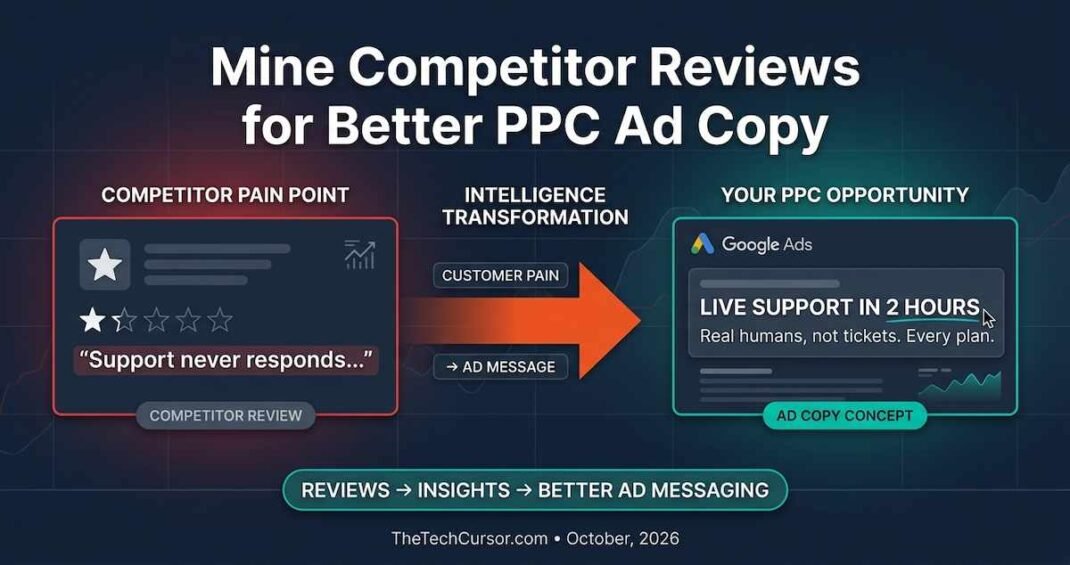
Negative reviews on G2, Capterra, Trustpilot, Reddit, and Google Business Profile contain something that no keyword research tool can produce: the exact words real buyers use to describe their frustrations. Those frustrations are your positioning opportunities. Those words are your ad copy.
Mining competitor negative reviews for PPC ad copy is one of the most underutilized competitive intelligence tactics available — and one of the most directly effective. Here is the complete process.
1. Why Competitor Reviews Are a PPC Goldmine
Traditional ad copy development starts with a brief, moves through creative development, and ends with headlines and descriptions that sound good to the marketing team. The problem is that marketing teams are not the audience.
Buyers are. And buyers describe their problems, needs, and objections in language that is almost never the language marketing teams choose naturally.
Competitor negative reviews solve this problem directly. They contain:
Authentic voice of customer language. The phrases real buyers use to describe frustrations are the phrases that resonate with other buyers experiencing the same frustrations. Using this language in ad copy creates immediate recognition — “that is exactly my problem.”
Verified pain points. A complaint that appears repeatedly across dozens of reviews is a validated pain point — not a hypothesis. It represents a real, widespread frustration that multiple buyers care enough to document.
Positioning opportunities. Every pain point your competitor’s customers consistently experience is a potential differentiator for your brand. If competitor customers consistently complain about slow customer support, your ad headline “24/7 Support — Real Humans, No Tickets” addresses a verified market frustration directly.
Objection intelligence. Negative reviews reveal not just what buyers dislike, but what they expected and did not receive. That expectation gap is exactly what ad copy needs to address to convert browsers into buyers.
2. Where to Find Competitor Negative Reviews
Different review sources serve different purposes in the mining process. Each captures a different segment of your competitor’s customer base and a different type of feedback.
G2 and Capterra: These are the highest-value sources for B2B software and service categories. Reviews are verified, detailed, and structured — meaning reviewers typically explain both what they disliked and why. The “What do you dislike?” field is pure ad copy research material. Filter for one- and two-star reviews to isolate the most significant pain points.
Trustpilot and Google Business Profile: These sources cover a broader range of business types and tend to capture more transactional, experience-based feedback. They are particularly valuable for e-commerce, local services, and consumer-facing brands. Look for reviews that describe specific moments of failure — “the delivery was three weeks late” — rather than general dissatisfaction.
Reddit: captures the most candid competitive feedback available. Users discussing products in relevant subreddits — r/entrepreneur, r/smallbusiness, category-specific subreddits — frequently name specific tools and describe their experiences in detail. Furthermore, Reddit discussions are indexed and retrieved by AI systems, making this research valuable for GEO strategy as well as PPC.
App stores: For software-as-a-service products with mobile apps, the Apple App Store and Google Play Store contain reviews that capture a different user segment — typically less technical, more focused on usability and reliability. One- and two-star reviews here often surface issues that enterprise-focused review platforms miss.
Social media and community platforms Twitter/X, LinkedIn comments, and niche community platforms occasionally surface detailed competitive complaints. These are less systematic to mine but can reveal emerging issues before they appear in formal review platforms.
3. What to Look For — The Four Pain Point Categories
Not all negative feedback is equally useful for PPC ad copy. The most valuable insights fall into four categories — each mapping to a different type of ad copy opportunity.
Category 1: Core product failures: These are complaints about the fundamental product not working as promised. “The reporting is inaccurate.” “The integration breaks constantly.” “The feature they advertise doesn’t actually work.” Core product failures map directly to reliability and accuracy claims in your ad copy.
Category 2: Support and service failures: These complaints center on the experience of getting help when something goes wrong. “Support takes three days to respond.” “They just send you to documentation.” “No phone support available.” Support failures map to service and responsiveness claims — some of the highest-converting differentiators in competitive ad copy.
Category 3: Pricing and value failures: These complaints address the perceived value equation. “Hidden fees not mentioned during sales.” “Price increased 40% with no notice.” “Cheaper alternatives do the same thing.” Pricing complaints map to transparency, predictability, and value claims.
Category 4: Onboarding and usability failures: These complaints cover the experience of getting started and using the product day-to-day. “Setup took weeks.” “The UI is confusing.” “Required a dedicated person to manage.” Usability complaints map to simplicity, speed-to-value, and ease-of-use claims.
4. Step-by-Step: Mining Reviews for Ad Copy
Step 1: Build your competitor list: Identify three to five direct competitors whose customers overlap most closely with your target audience. Focus on competitors who are actively bidding on the same keywords as you — their customers are the most likely to be evaluating your brand as an alternative.
Step 2: Extract reviews systematically: For each competitor, collect 50-100 negative reviews from the sources most relevant to your category. Copy the review text into a spreadsheet with columns for: source, star rating, date, and the specific complaint text.
Step 3: Code by pain point category: Tag each review with one of the four pain point categories. This step reveals which category of complaint is most prevalent for each competitor — and therefore which positioning angle has the most market evidence.
Step 4: Extract exact phrases: Within each category, highlight the specific phrases reviewers use. Do not paraphrase yet — collect the exact language. “It took forever to set up” is more useful than “onboarding is slow” because the first is how buyers talk, and the second is how marketers talk.
Step 5: Frequency rank the pain points: Count how many reviews mention each specific pain point. Pain points mentioned in 10+ reviews are validated — they represent consistent market frustration rather than individual experience. Pain points mentioned in 30+ reviews are significant competitive weaknesses worth building campaigns around.
Step 6: Cross-reference with your brand’s strengths: Match the validated pain points against your brand’s genuine strengths. A pain point you can credibly address is a positioning opportunity. A pain point your product also has is not — do not build ad copy around promises you cannot keep.
5. Turning Pain Points Into Ad Headlines
Google Ads headlines have a 30-character limit — which forces compression of the insight into its most essential form.
The translation process:
Start with the reviewer’s exact phrase. “Support takes forever to respond” becomes the insight. The headline translates that insight into a promise: “Real Support in Under 2 Hours.”
Headline formulas that work for competitor pain points:
The direct contrast: “[What competitor fails at] — [What you do instead]”
- “No Hidden Fees. Ever.” — addresses pricing transparency complaints
- “Setup in Under 30 Minutes” — addresses onboarding time complaints
- “Live Support, Not Tickets” — addresses support response complaints
The specific number: Quantified claims outperform general claims consistently in ad testing.
- “24/7 Phone Support Included” rather than “Great Support”
- “Import Data in 15 Minutes” rather than “Fast Onboarding”
- “Flat Rate. No Surprises.” rather than “Transparent Pricing”
The implicit contrast: Addressing the pain point without naming the competitor.
- “Finally, Software That Actually Works” — implies reliability problems elsewhere
- “Support That Answers in Minutes” — implies slow support elsewhere
- “Pricing You Can Predict” — implies unpredictable pricing elsewhere
What to avoid: Do not name competitors directly in headlines — Google’s policies restrict comparative advertising in ways that create compliance risk. The implicit contrast approach achieves the same positioning effect without the risk.
6. Turning Pain Points Into Ad Descriptions
Ad descriptions (90 characters) allow more detail than headlines — enough to address the pain point directly and add evidence.
Description formula:
Pain point acknowledgement + specific solution + credibility signal.
“Tired of [pain point]? [Your solution] — [evidence].”
Examples from each pain point category:
Core product: “Tired of inaccurate reports? Our data is certified accurate to 99.9% — verified by independent audit.”
Support: “No more support tickets. Every plan includes phone support with a 2-hour response guarantee.”
Pricing: “One flat monthly fee. No setup costs, no overages, no surprises. See full pricing before you sign.”
Onboarding: “Live in 48 hours, guaranteed. Our team handles your complete setup — or your first month is free.”
Each description does three things: acknowledges the pain point using language close to how reviewers described it, offers the specific solution your brand provides, and adds a credibility element that makes the claim believable.
7. Turning Pain Points Into Landing Page Copy
Ad copy that addresses competitor pain points works best when the landing page continues the same narrative. A disconnect between ad copy and landing page kills conversion rates regardless of how good the ad is.
Above the fold: The landing page headline should echo the ad’s core pain point promise. If the ad said “Live Support in Under 2 Hours,” the landing page headline should reference support speed immediately — not pivot to a different value proposition.
Objection section: Add a dedicated section that addresses the top three competitor pain points directly. Framing it as “Why [Category] Buyers Switch to [Your Brand]” or “What Our Customers Said They Were Tired Of” creates a natural, authentic positioning section.
Social proof alignment: Select testimonials and case studies that specifically mention the pain points your ad addresses. A testimonial that says “We switched because support at our old tool was terrible — [Your Brand] responds in an hour” is far more powerful than a generic five-star quote.
Trust signals: If pricing transparency is a core pain point you are addressing, show your full pricing on the landing page — do not hide it behind a “Contact Sales” form. If onboarding speed is the promise, show the setup timeline visually.
8. Ethical Boundaries — What to Do and What to Avoid
Competitor review mining is legitimate competitive intelligence. However, several practices cross ethical and legal lines.
What is legitimate:
- Reading publicly available reviews and extracting insights about market frustrations
- Building ad copy that addresses validated market pain points your brand genuinely solves
- Using the language patterns of reviews to inform copy — not the specific quotes themselves
- Implicit competitive positioning that contrasts your strengths without naming competitors
What to avoid:
- Directly quoting competitor reviews in ad copy — this creates intellectual property risk
- Making specific claims about named competitors that you cannot verify with evidence
- Fabricating or exaggerating your own capabilities to match pain points you cannot genuinely address
- Using this research to make false comparative claims — “better than [competitor]” requires substantiation
The core ethical test: Does your ad copy promise something your product genuinely delivers? If yes, the source of the insight — competitor reviews — is irrelevant. If no, the issue is false advertising, regardless of how the copy was developed.
9. Testing and Measuring the Results
Competitor review-informed ad copy should be tested systematically — not just deployed and assumed to work.
A/B test structure: Create two ad variants for each pain point theme: one using competitor review-informed copy and one using your existing control copy. Run both for at least two weeks or until statistical significance is reached at a 95% confidence level.
Metrics to track:
- Click-through rate — does the pain-point-informed copy generate more clicks?
- Conversion rate on the landing page — does it attract more qualified buyers?
- Cost per acquisition — does the improved relevance reduce CPA?
- Quality Score — Google rewards relevant ad copy with better Quality Scores and lower CPCs
Segmentation insight: Run pain-point-informed copy specifically against competitor branded keywords — searches that include your competitor’s name. Users searching for a competitor by name are already category-aware and often already experiencing the frustrations described in those reviews. This audience responds especially strongly to copy that acknowledges those specific frustrations.
Furthermore, align this research with AI Max’s intent-based matching to capture conversational queries that reflect the same frustrations. A user who types “alternatives to [competitor] with better support” is expressing a pain point in a query. AI Max can match your support-focused ad to that query even without an exact keyword match.
10. Bottom Line
Competitor negative reviews contain some of the most valuable market research available for PPC advertisers — and most advertisers ignore it entirely.
The process is straightforward. Collect reviews from G2, Capterra, Reddit, and relevant review platforms. Code them by pain point category. Frequency-rank the most common complaints. Match them against your genuine strengths. Then translate those validated pain points into headlines, descriptions, and landing page copy that speaks directly to what frustrated buyers are actually experiencing.
The result is ad copy that does not sound like marketing — it sounds like someone who understands the buyer’s problem. That recognition is what drives clicks, improves Quality Scores, lowers CPAs, and converts browsers into buyers.
Your competitors’ unhappy customers are the best copywriters you have never paid. Start listening to them.