Category: Google Ads | AI Max | Performance Max | Digital Marketing
Read time: 6 min
Site: TheTechCursor
Table of Contents
- What Google Just Announced
- AI Max Is Now Out of Beta — What That Means
- The Performance Numbers
- How Gemini Is Expanding Search Ad Inventory
- New AI Mode Ad Formats
- What This Means for Advertisers
- The Trade-Off — More Reach, Less Visibility
- How to Prepare Your Campaigns
- Bottom Line
Google used its Alphabet Q2 2026 earnings call to deliver a significant announcement for advertisers: AI Max is officially out of beta — and Google says it is unlocking billions of previously unmonetized searches for advertisers.
<cite index=”58-1″>Google SVP and Chief Business Officer Philipp Schindler said AI Max is helping the company match ads to searches that were too complex or ambiguous for traditional keyword targeting.</cite> The result, according to Google, is that entirely new categories of search queries — queries that previously generated no ad revenue — are now becoming monetizable inventory.
For advertisers, this is one of the most significant paid search developments of 2026. Here is everything you need to know.
1. What Google Just Announced
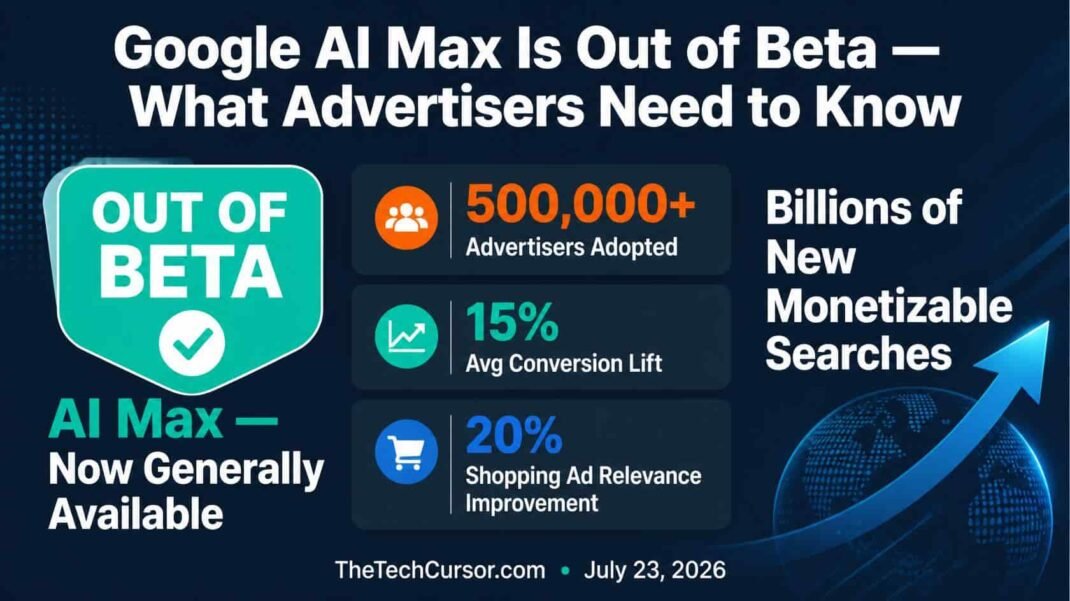
During the Alphabet Q2 2026 earnings call on July 22, 2026, Google revealed several headline figures about AI Max:
- AI Max has been adopted by more than 500,000 advertisers
- Advertisers using AI Max or Performance Max see an average 15% lift in conversions or conversion value at a similar return on ad spend
- <cite index=”58-1″>Gemini has improved the relevance of Shopping ads for complex queries by about 20%</cite>
- AI Max is creating “billions” of new monetizable search opportunities that traditional keyword targeting could not reach
These are the first major performance benchmarks Google has shared publicly for AI Max since its launch — and they are significant enough to change how advertisers should think about their campaign structure priorities.
2. AI Max Is Now Out of Beta — What That Means
AI Max launching out of beta means it is now a stable, generally available product — no longer an experimental feature with potential limitations or breaking changes. For advertisers who have been waiting for AI Max to stabilize before investing in it, that moment has arrived.
<cite index=”58-1″>AI Max is now out of beta and has been adopted by more than 500,000 advertisers.</cite> The 500,000 adopter figure is significant context — it means AI Max has already been tested at scale across a wide range of advertiser types, campaign objectives, and industries. The 15% conversion lift claim is therefore based on substantial real-world performance data, not just limited beta testing.
Furthermore, out-of-beta status typically signals that Google will begin making AI Max the default for new campaign creation — a pattern consistent with how Performance Max evolved from an optional campaign type to the default for many campaign objectives. Advertisers who have not yet evaluated AI Max should treat this announcement as a prompt to do so before the feature becomes more deeply integrated into Google’s default campaign infrastructure.
3. The Performance Numbers
The headline performance claim — 15% average lift in conversions or conversion value at similar ROAS — is worth examining carefully.
What “similar ROAS” means in practice: Google is claiming that AI Max improves conversion volume without degrading return on ad spend. For advertisers optimizing primarily for conversion value efficiency, this is the most compelling framing — the implication is that AI Max delivers more conversions without requiring a reduction in ROAS targets.
What “average” means: A 15% average lift across 500,000 advertisers encompasses significant variation. Some advertisers will see larger gains — particularly those in categories with complex, conversational search behaviour where traditional keyword targeting struggled. Others may see smaller improvements or need to restructure their campaigns to realize the full benefit.
Shopping ads specifically: <cite index=”58-1″>Gemini has improved the relevance of Shopping ads for complex queries by about 20%.</cite> For e-commerce advertisers, this is particularly significant — complex shopping queries like “sustainable running shoes for overpronators under $120 that ship in two days” are exactly the kind of intent-rich queries that traditional keyword matching struggled with and that Gemini’s language understanding handles more naturally.
4. How Gemini Is Expanding Search Ad Inventory
The most strategically significant element of Google’s announcement is not the conversion lift — it is the inventory expansion claim.
<cite index=”58-1″>Google said Gemini can better understand longer, conversational searches, interpret commercial intent, and match those searches with relevant ads — helping Google turn more searches into ad opportunities without relying only on exact keyword matches.</cite>
This represents a fundamental expansion of the addressable search ad market. Traditional keyword targeting left a significant portion of search volume unmonetized — queries that were too long, too conversational, or too ambiguous for keyword-based matching to confidently pair with relevant ads. Gemini’s language understanding changes that equation.
When a user searches “I’m renovating my kitchen and need something that works as both a dining table and workspace for two people who work from home,” no traditional keyword set reliably captures that intent. Gemini can interpret the commercial intent within that conversational query and match it to relevant furniture or home office advertisers — creating an ad opportunity that previously did not exist.
For Google, this is a significant revenue growth lever — new inventory without requiring more searches. For advertisers, it means reaching users earlier in their research journey, through queries they would never have bid on with traditional keywords.
5. New AI Mode Ad Formats
Beyond AI Max itself, Google shared updates on how advertising will work within AI Mode — its fully conversational search experience.
Highlighted Answers: <cite index=”58-1″>Google is testing Highlighted Answers, an AI Mode ad format that places clearly labelled sponsored links inside AI-generated list responses. Google said the format is already showing early traction with users.</cite> This format is significant because it places sponsored content directly within AI-generated answers — not below them — while maintaining clear labelling as sponsored. The early traction signal suggests users are accepting this format rather than perceiving it as intrusive.
Contextual sitelinks: Google is generating sitelinks from the context of ongoing AI Mode conversations — meaning ad extensions are dynamically generated based on what the user has been discussing, not just based on the initial query. This is a meaningful step toward advertising that feels genuinely relevant to the conversational context rather than disconnected from it.
Direct Offers: <cite index=”58-1″>IHG Hotels & Resorts was named as an upcoming partner for Direct Offers, which surface promotions during planning journeys.</cite> Direct Offers — surfacing specific deals and promotions within AI conversations — represents one of the clearest commercial monetization pathways for AI Mode, and IHG’s involvement signals that major hospitality brands are beginning to invest in this format.
6. What This Means for Advertisers
The AI Max graduation from beta combined with the earnings call performance data has clear implications for how advertisers should approach their Google Ads strategy in the second half of 2026.
AI Max is no longer optional to evaluate: At 500,000 adopters with a 15% average conversion lift, AI Max has crossed from “promising experiment” to “established performance lever.” Advertisers who have not yet tested AI Max should begin evaluation immediately — particularly for Search campaigns where conversational query matching is most valuable.
Campaign structure needs to evolve: AI Max operates on intent-based matching rather than keyword lists. This requires a different approach to campaign structure — one that provides Google’s AI with clear signals about audiences, goals, and creative assets rather than relying on precise keyword control. As covered in TheTechCursor’s earlier analysis of how AI is merging paid and organic search, the shift from keyword-based to intent-based advertising requires fundamentally different campaign architecture.
Creative and feed quality become more important: <cite index=”58-1″>As Gemini handles more complex searches, advertiser performance may depend more on product feeds, creative assets and landing pages that give Google enough signals to match ads to user needs.</cite> With AI doing the query matching, the advertiser’s primary leverage points shift to the quality of inputs — product feed completeness, creative asset variety, and landing page relevance — rather than keyword bid management.
7. The Trade-Off — More Reach, Less Visibility
Google’s AI Max announcement comes with an important caveat that advertisers should understand clearly.
<cite index=”58-1″>The announcements show how Google is building ad products around intent, not just keywords. As Gemini handles more complex searches, advertiser performance may depend more on product feeds, creative assets, and landing pages that provide Google with enough signals to match ads to user needs.</cite>
The trade-off is straightforward: AI Max delivers more reach and better conversion matching — but gives advertisers less visibility into exactly how queries are being matched. Traditional keyword targeting lets advertisers see precisely which search terms triggered their ads and optimize accordingly. AI Max’s intent-based matching is more opaque — you see the outcomes, not always the exact queries that generated them.
For advertisers comfortable with automation and focused on outcome metrics, this trade-off is acceptable. For advertisers who require granular query-level control — for brand safety, competitive intelligence, or highly regulated industries — it requires careful management through negative keyword lists, audience controls, and brand exclusions.
8. How to Prepare Your Campaigns
Based on Google’s AI Max announcement and the DSA migration deadline covered in TheTechCursor’s earlier article, here is the priority action list for advertisers:
Audit your AI Max readiness: Review your current campaign structure and identify which campaigns would benefit most from AI Max’s intent-based matching — typically those targeting informational or research-phase queries, complex purchase decisions, or categories with long, conversational search behaviour.
Strengthen your product feeds: For Shopping and e-commerce advertisers specifically, feed completeness becomes more important as Gemini takes over query matching. Every attribute that helps Gemini understand what your product is, who it is for, and what use case it serves improves matching quality. As covered in TheTechCursor’s product feed AI resume guide, this is now as important for paid ads as it is for AI search visibility.
Expand your creative asset library: AI Max generates ad copy and creative combinations from your uploaded assets. The wider and higher quality your asset library, the more effectively the system can tailor creative to different query contexts. Provide multiple headline variations, descriptions, images, and, if applicable, video assets.
Begin DSA to AI Max migration planning: As covered in TheTechCursor’s DSA migration delay article, the deadline for Dynamic Search Ads migration to AI Max is February 2027. With AI Max now out of beta and showing strong performance data, the case for voluntary early migration has strengthened significantly. Use the remaining window to migrate and optimize before the forced deadline arrives.
Monitor the new AI Mode formats: Highlighted Answers and Direct Offers are in testing now. Advertisers in travel, hospitality, and retail should monitor for access to these formats — early adoption of new Google ad formats consistently provides a first-mover performance advantage before competition increases.
9. Bottom Line
AI Max graduating from beta is one of the most significant Google Ads developments of 2026. The combination of 500,000 adopters, a 15% average conversion lift, and billions of new monetizable searches from conversational queries makes a compelling case for every advertiser to prioritize AI Max evaluation and adoption.
The shift from keyword-based to intent-based advertising is accelerating. Advertisers who build the campaign structure, creative assets, and product feeds that AI Max needs to perform well will capture the expanding inventory and conversion opportunity it is generating. Those who stay with traditional keyword approaches alone will find their reach increasingly constrained as Google continues building its ad products around AI-driven intent matching rather than exact keywords.
The beta is over. The opportunity is real. Now is the time to act.
Pingback: 9 Ecommerce Search Trends for 2027: Real Store Data - The Tech Cursor