Category: LinkedIn | SEO | AI Search | Digital Marketing
Read time: 7 min
Site: TheTechCursor
LinkedIn is the world’s largest professional network — and one of the most underoptimized search surfaces in digital marketing. Most professionals treat their LinkedIn profile as a digital resume. Most brands treat their company page as a broadcasting channel.
In 2026, both of those approaches leave significant visibility on the table — not just within LinkedIn’s own search, but in Google Search and AI search systems that increasingly surface LinkedIn content in response to professional and brand queries.
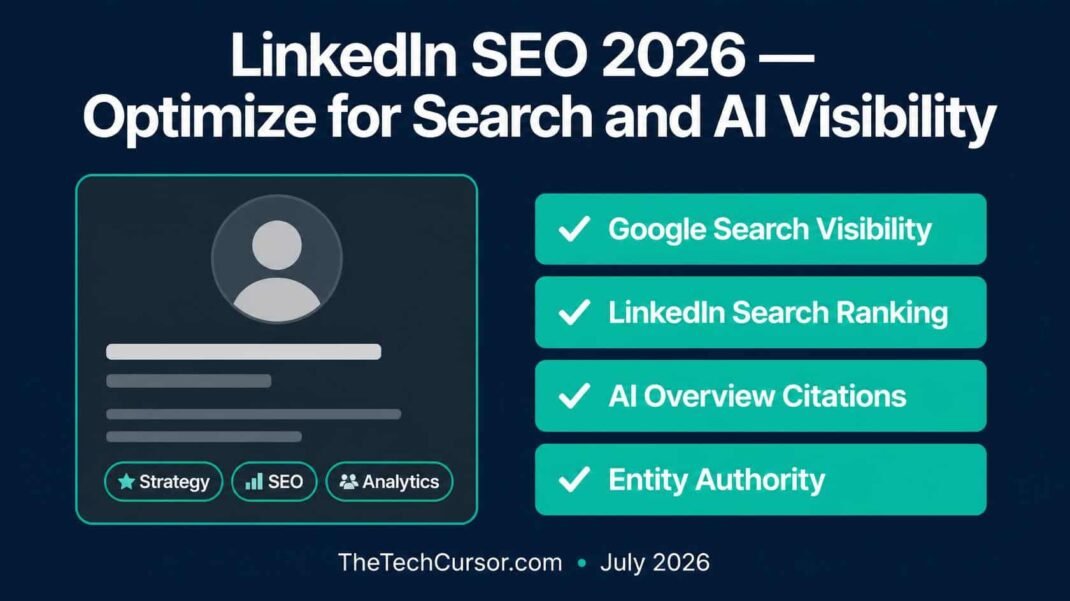
Here is a complete optimization guide for LinkedIn search visibility in 2026 — covering profiles, company pages, content strategy, and the AI search angle that most LinkedIn guides do not address.
Table of Contents
- Why LinkedIn SEO Matters More Than Ever in 2026
- How LinkedIn Content Appears in Google and AI Search
- Profile Optimization — The Foundation
- Headline Optimization — Your Most Important Field
- About Section — Your Entity Description
- Experience and Skills — Keyword and Entity Signals
- Content Strategy for LinkedIn Search Visibility
- Company Page Optimization
- LinkedIn and AI Search — The Direct Connection
- Bottom Line
1. Why LinkedIn SEO Matters More Than Ever in 2026
Three converging trends make LinkedIn SEO more important in 2026 than at any previous point:
Google indexes LinkedIn content more prominently. Google has significantly increased the prominence of LinkedIn profiles and posts in search results over the past two years. A well-optimized LinkedIn profile frequently appears on the first page of Google results for someone’s name. LinkedIn company pages and posts appear regularly for brand and topic queries.
AI systems weight LinkedIn content heavily; LinkedIn content is well-represented in AI training data and retrieval systems. A professional’s LinkedIn profile, posts, and articles contribute to how AI systems understand their expertise and entity. As covered in TheTechCursor’s E-E-A-T 2026 article, named authorship with verifiable credentials is an increasingly important signal for both traditional SEO and AI search visibility — and LinkedIn is the primary platform where professional credentials are publicly verifiable.
LinkedIn’s own search is improving; LinkedIn’s internal search algorithm has become significantly more sophisticated. For professional services, B2B companies, and individual consultants, appearing in LinkedIn search for relevant queries drives meaningful business development activity.
2. How LinkedIn Content Appears in Google and AI Search
Understanding what Google and AI systems can actually access from LinkedIn determines where to focus optimization effort.
What Google indexes from LinkedIn:
- Public LinkedIn profiles — headline, about section, experience, and featured content
- LinkedIn articles (long-form posts published natively on LinkedIn)
- LinkedIn company pages — about section, specialties, and posts
- LinkedIn posts — public posts from profiles with public settings
What Google does not reliably index:
- Content visible only to connections or followers
- Activity visible only when logged in
- Most comments and reactions
What AI systems draw on: AI systems draw on LinkedIn content both through direct indexing (for retrieval-based AI search) and through training data (for model-based knowledge). LinkedIn articles are particularly well-represented — they are longer-form, more substantive, and more consistently published than most social posts, making them valuable both for LinkedIn’s own search and for external AI systems.
3. Profile Optimization — The Foundation
A LinkedIn profile optimized for search has several distinct components that require different optimization approaches.
Profile photo and banner: These do not directly affect search ranking — but they significantly affect click-through rate when your profile appears in search results. A professional headshot and a branded banner that communicates your expertise area are baseline requirements.
Profile URL: Customize: your LinkedIn URL to include your name — linkedin.com/in/yourname — rather than the default alphanumeric string. This improves both the appearance of your profile link in search results and the slight SEO benefit of having your name in the URL.
Location and industry: Accurate location and industry settings affect your appearance in location-filtered searches and industry-specific queries. Ensure both reflect your actual current situation — not where you were two jobs ago.
Contact information: Complete contact information — including website links — improves both user experience and the completeness signals that LinkedIn’s algorithm considers when ranking profiles in search.
4. Headline Optimization — Your Most Important Field
Your LinkedIn headline is the single most important field for LinkedIn search optimization. It appears in search results, connection requests, comment sections, and anywhere your profile is previewed — making it both the highest-impact SEO field and the highest-impact first impression.
The optimization approach:
LinkedIn allows up to 220 characters in the headline field. Most professionals use fewer than 60. That unused space represents a significant missed keyword opportunity.
Default headline (low optimization): “SEO Manager at TheTechCursor”
Optimized headline (high optimization): “SEO Manager | AI Search & GEO Specialist | Off-Page SEO & Link Building | Helping Brands Win in Google AI Overviews & Perplexity”
The optimized version includes: job title, specific skill areas, and the outcomes you deliver — all using language that both LinkedIn’s algorithm and Google’s crawlers can associate with relevant search queries.
Key principles:
- Lead with your current role or most important identity
- Include specific skill keywords rather than generic labels
- Mention the outcomes or audience you serve
- Use the full character allowance
- Avoid buzzwords like “passionate,” “results-driven,” or “guru” — these add no search value
5. About Section — Your Entity Description
The About section is where your profile’s entity description lives — the text that AI systems and Google use to understand who you are, what you do, and why you are credible.
LinkedIn allows 2,600 characters in the About section. Most profiles use fewer than 300.
A well-optimized About section includes:
Opening hook (2-3 sentences): What you do and who you help — stated in plain language that a potential client, employer, or collaborator would immediately understand.
Expertise description (3-5 sentences): The specific areas where you have genuine depth. Name specific methodologies, tools, frameworks, or topic areas. This is where keyword density matters — but in the context of genuine description, not keyword stuffing.
Evidence of expertise (3-5 sentences): Specific outcomes, notable clients, published work, speaking engagements, or recognition. Concrete evidence carries more weight than general claims.
Current focus (2-3 sentences): What you are working on now. This signals recency and activity — both of which LinkedIn’s algorithm considers.
Call to action (1-2 sentences): How to connect, what conversations you welcome, or what you are looking for.
The About section should read naturally for a human visitor while containing the keyword signals that LinkedIn’s search and external crawlers use to classify your profile’s topic area.
6. Experience and Skills — Keyword and Entity Signals
Experience section: Each position in your experience section should have a description — not just a title and company name—both LinkedIn and Google index these descriptions. A well-written position description includes: your specific responsibilities, the skills you applied, the outcomes you achieved, and relevant keywords for your field.
Furthermore, current positions carry more weight than historical ones in LinkedIn’s ranking algorithm. Ensure your current role has the most complete and keyword-rich description.
Skills section: LinkedIn allows up to 50 skills. Most profiles list fewer than 20. The skills section directly influences which searches your profile appears in — LinkedIn’s search algorithm uses skills as a primary matching signal for skill-based queries.
Priority skills are those that your target audience searches for when looking for someone with your expertise. Review job postings, client briefs, and competitor profiles to identify the skill keywords that appear most frequently in your specific area.
Endorsements: Endorsements for specific skills add a social proof layer to your skills section. While their direct ranking impact is limited, highly endorsed skills signal genuine competence to both visitors and the algorithm.
7. Content Strategy for LinkedIn Search Visibility
Publishing content on LinkedIn is where profile optimization and invisible PR intersect — because LinkedIn content creates indexed, crawlable text that builds both internal and external search visibility.
LinkedIn Articles vs Posts:
LinkedIn Articles (long-form, native blog posts) are indexed by Google and appear in Google Search results. They are particularly valuable for building AI visibility because they create substantive, expertise-demonstrating text content associated with your name and expertise area.
LinkedIn Posts (shorter updates) are indexed by LinkedIn’s internal search and sometimes by Google for very recent content. They are more effective for engagement and follower growth than for sustained search visibility.
Content optimization principles:
Topic focus: Publish consistently within your specific expertise area rather than across diverse topics. Topical consistency builds authority signals in LinkedIn’s algorithm — similar to how topical depth builds entity authority in Google’s systems.
Keyword integration: Include the specific keywords your target audience searches for within the first few lines of posts and articles — LinkedIn’s search algorithm weights early content more heavily.
Engagement signals: Comments, reposts, and reactions all contribute to content visibility within LinkedIn’s algorithm. Questions at the end of posts, specific calls to share perspectives, and responses to comments all build engagement that amplifies content reach.
Publishing frequency: LinkedIn’s algorithm rewards consistent publishing. Two to three posts per week is a sustainable frequency that maintains algorithmic favour without requiring unsustainable content production.
8. Company Page Optimization
LinkedIn company pages receive different treatment from personal profiles in both LinkedIn search and Google indexing — and are particularly important for brand-level AI visibility.
About section: The company page About section (2,000 characters) is the primary text field Google indexes for company pages. It should describe what the company does, who it serves, and what makes it distinctive — using the language that potential clients and partners search for.
Specialties: The Specialties field (up to 20 entries, comma-separated) is directly indexed by LinkedIn’s search algorithm for company searches. Include the specific service areas, technologies, and expertise domains that your company is known for.
Consistent publishing: Company pages that publish consistently receive more algorithmic distribution than inactive pages. A minimum of two to three posts per week maintains visibility. Furthermore, posts that generate employee engagement — comments and reposts from team members — receive significantly more distribution than posts that generate only external engagement.
Employee profiles: The collective optimization of employee LinkedIn profiles contributes to company page visibility. When employees list the company accurately, use relevant skills, and engage with company content, the collective signal strengthens the company page’s authority in LinkedIn’s algorithm.
9. LinkedIn and AI Search — The Direct Connection
LinkedIn’s connection to AI search visibility is direct and growing — for several specific reasons.
Named authorship validation: As covered in TheTechCursor’s E-E-A-T 2026 article, named authors with verifiable professional credentials are increasingly important for AI search citation. LinkedIn is the primary public platform where professional credentials can be verified — by both human readers and AI systems crawling the web.
When you publish content under your name, and that name is associated with a detailed, credible LinkedIn profile in the same expertise area, AI systems have a stronger entity signal to attach to your content. This directly improves citation probability.
AI Overview source eligibility: LinkedIn articles appear in Google AI Overviews for professional and expertise-related queries. A well-written LinkedIn article that demonstrates genuine expertise on a topic relevant to your brand can appear in AI Overviews — extending your AI search visibility to a surface that your own website might not reach for the same query.
ChatGPT and Perplexity source coverage: LinkedIn content is indexed by Bing — which means it is accessible to ChatGPT’s web search and Perplexity’s retrieval systems. LinkedIn articles that rank in Bing search for relevant professional queries therefore have a pathway into ChatGPT and Perplexity responses as well.
Google Search Console Platform Properties: As covered in TheTechCursor’s recent article on Google Search Console’s new Platform Properties feature, LinkedIn can now be connected to your Search Console account — giving you direct data on how your LinkedIn content performs in Google Search. This makes LinkedIn the only major social platform with native Google Search Console integration, significantly improving your ability to measure and optimize LinkedIn’s contribution to your overall search visibility.
10. Bottom Line
LinkedIn SEO in 2026 is not just about appearing in LinkedIn’s internal search. It is about building a professional entity presence that influences Google Search rankings, AI Overview citations, and the ambient brand signals that AI systems use to understand your expertise and credibility.
The optimization steps are practical and achievable: a keyword-rich headline using all available characters, a comprehensive About section that reads like a genuine expertise description, consistent content publishing in your specific topic area, and connecting your LinkedIn presence to Google Search Console for measurement.
Start with your headline. Rewrite your About section. Begin publishing one to two posts per week in your core expertise area. Connect your LinkedIn to Google Search Console for performance tracking.
LinkedIn is one of the most underoptimized channels in most professionals‘ and brands’ digital presence. The gap between current optimization levels and what is possible is larger here than almost anywhere else — and closing that gap in 2026 pays dividends in LinkedIn search, Google search, and AI search simultaneously.