
Category: Local SEO | AI Search | Gemini | Digital Marketing
Read time: 6 min
Table of Contents
- What the Study Found
- The Citation Rate Gap — Why Most Local Businesses Are Invisible in AI Search
- Factor 1: Website Quality and Depth
- Factor 2: Structured Data Implementation
- Factor 3: Google Business Profile Completeness
- Factor 4: Third-Party Review Presence
- Factor 5: Topical Authority and Content Depth
- What Local Businesses Should Prioritize
- Bottom Line
A new study examining how Gemini cites local business websites in AI search responses has produced findings that every local business owner and local SEO professional needs to understand.
The research — analyzing how Google’s Gemini AI system selects and cites local business sources in response to local queries — reveals a significant and growing gap between businesses that appear in AI-generated local answers and those that are systematically excluded.
The gap is not random. It is driven by specific, measurable signals that local businesses can address.
1. What the Study Found
The study analyzed how Gemini responds to local intent queries — “best [business type] near me,” “[service] in [city],” and “[business type] for [specific need]” — and specifically examined which local business websites were cited as sources in AI-generated responses.
The core finding: local business citation in Gemini responses is heavily concentrated among a small percentage of businesses in any given category. The majority of local businesses — even those with established Google Business Profiles and reasonable search rankings — receive little to no citation in AI-generated local answers.
Furthermore, the factors that determine citation probability are distinct from — and not fully captured by — traditional local SEO signals like proximity, review count, and GBP completeness alone.
2. The Citation Rate Gap — Why Most Local Businesses Are Invisible in AI Search
AI-generated local responses face a challenge traditional search does not: Gemini must synthesize information about local businesses into a coherent, confident recommendation — not just rank a list of options.
To make a confident recommendation, Gemini needs sufficient, consistent, well-structured information about each business. When that information is missing, thin, or contradictory across sources, Gemini either excludes the business from its response or hedges its recommendation so heavily that the citation provides minimal value.
Most local business websites fail this standard not because their service is inferior but because their digital presence does not give Gemini enough to work with.
3. Factor 1: Website Quality and Depth
The most significant differentiator between cited and uncited local businesses in the study was website content quality and depth.
Businesses with cited websites consistently had:
Service pages with genuine depth. Not just a list of services, but pages that explain what each service involves, who it is for, what the process looks like, and what outcomes clients should expect. Gemini needs enough content to confidently describe what a business does — a single paragraph is rarely sufficient.
About pages with real information. Named team members with credentials, years in business, service area specifics, and a genuine description of the business’s approach and values. Generic “we are committed to excellence” copy provides no entity signal that Gemini can use.
Locally specific content. Content that mentions the city, neighbourhood, or region in natural, contextually accurate ways — not keyword-stuffed location mentions, but genuine references to local context, local projects, or local community involvement.
Contact and location information. Complete, accurate, and consistently formatted NAP (Name, Address, Phone) data — matching exactly what appears in the Google Business Profile and other directory listings.
4. Factor 2: Structured Data Implementation
As covered in TheTechCursor’s schema markup guide, structured data helps AI systems understand and extract information from web pages efficiently. For local businesses, the impact is particularly direct.
The study found that local businesses with properly implemented LocalBusiness schema were cited significantly more frequently than equivalent businesses without it.
Key structured data elements for local citation:
LocalBusiness schema — including business name, address, phone, hours, price range, and the most specific available business type (not just “LocalBusiness” but “Dentist,” “Restaurant,” “PlumbingBusiness,” etc.)
Review and AggregateRating schema — pulling in verified review data from your website and reflecting accurate star ratings and review counts
Service schema — explicitly marking up each service you offer with name, description, and price where applicable
GeoCoordinates — latitude and longitude coordinates that confirm your physical location to Gemini’s spatial understanding
The study found that businesses with complete structured data implementations were between 2 and 3 times more likely to receive citations in local AI responses than equivalent businesses with no structured data.
5. Factor 3: Google Business Profile Completeness
Google Business Profile remains a primary data source for Gemini’s local business understanding — even when the AI response does not explicitly cite the GBP listing.
The study confirmed findings from Google’s own published GBP data: businesses with complete, actively maintained GBP listings were significantly more likely to receive AI citations than businesses with sparse or outdated profiles.
GBP completeness factors most strongly correlated with citations:
- Business category accuracy — the primary and secondary categories must precisely match the business’s actual services. Gemini uses category data to match businesses to specific query intent.
- Hours and special hours — complete, accurate hours including holiday hours and special schedules
- Services section — each service explicitly listed with descriptions in the Services section
- Photo recency — businesses with photos added within the last 90 days showed higher citation rates than those with only older imagery
- Question and answer activity — active Q&A sections with accurate, detailed answers contributed to entity completeness signals
As covered in TheTechCursor’s GBP Playbook article, 29% more consumers are likely to consider purchasing from a business with a complete GBP. The AI citation data from this study suggests the gap is even larger for AI-mediated discovery.
6. Factor 4: Third-Party Review Presence
The study reinforced the importance of third-party reviews — not just on Google, but across multiple platforms — for AI citation probability.
Gemini draws on review signals from multiple sources when evaluating local businesses. A business with 200 Google reviews but no presence on Yelp, TripAdvisor, or industry-specific platforms showed lower citation rates than comparable businesses with reviews distributed across multiple credible platforms.
Key review signals for AI citation:
Review volume and recency on Google — still the primary platform, but not the only one Gemini evaluates
Third-party platform presence — Yelp, TripAdvisor, Houzz, Angi, Healthgrades, Avvo, and other industry-specific platforms depending on business category
Review response rate — businesses that consistently respond to reviews showed stronger entity signals than those that do not engage with reviewer feedback
Review content specificity — reviews that mention specific services, staff members, or outcomes by name provide richer entity signals than generic positive reviews
As covered in TheTechCursor’s July 2026 article on Google’s review snippet guideline update, fake and undisclosed incentivized reviews now explicitly violate Google’s policies — and the same authenticity standards apply to AI citation evaluation.
7. Factor 5: Topical Authority and Content Depth
The study identified a fifth factor that separates the most-cited local businesses from the rest: topical authority within their service category.
Local businesses that had published substantive, genuinely helpful content related to their service area — beyond standard service pages — showed meaningfully higher citation rates for queries that matched that content.
Examples of topical authority content for local businesses:
A plumbing company that published detailed guides on “How to identify a water heater that needs replacement” earned citations for queries like “how do I know if my water heater is failing” — even when the query had no explicit local intent.
A dental practice that published accurate, detailed content about specific procedures earned citations for informational queries about those procedures — building AI visibility that translated into local citations for related service queries.
A landscape company that documented specific local projects — with photos, descriptions of the challenge, and the approach taken — earned citations for “landscaping for [local soil type]” and similar hyper-local queries.
The pattern is consistent: local businesses that invest in genuine, helpful, topically relevant content earn AI citations that purely service-page-focused businesses do not — regardless of GBP completeness or review volume.
8. What Local Businesses Should Prioritize
Based on the study’s findings, here is a prioritised action list for local businesses seeking to improve their Gemini citation rate:
Priority 1: Deepen your service pages: Each service you offer deserves a dedicated page with genuine depth — not a paragraph but a full explanation of what the service involves, who it is for, and what to expect. If you currently have a single “Services” page listing everything, break it into individual service pages.
Priority 2: Implement complete LocalBusiness schema: Use the most specific available business type in your schema markup. Include all required fields — name, address, phone, hours, price range. Add Review schema where applicable. Validate your implementation using Google’s Rich Results Test.
Priority 3: Complete every GBP field: Review your GBP against Google’s official completeness checklist. Pay particular attention to the Services section, business categories, and photo recency. Add fresh photos monthly.
Priority 4: Build cross-platform review presence: Identify the two or three most relevant review platforms for your business category beyond Google. Build a systematic process for encouraging authentic reviews on those platforms consistently.
Priority 5: Publish topically relevant content: Identify the questions your customers ask most frequently before, during, and after engaging your services. Publish genuine, helpful answers to those questions. This is the highest-leverage long-term investment for AI citation visibility.
9. Bottom Line
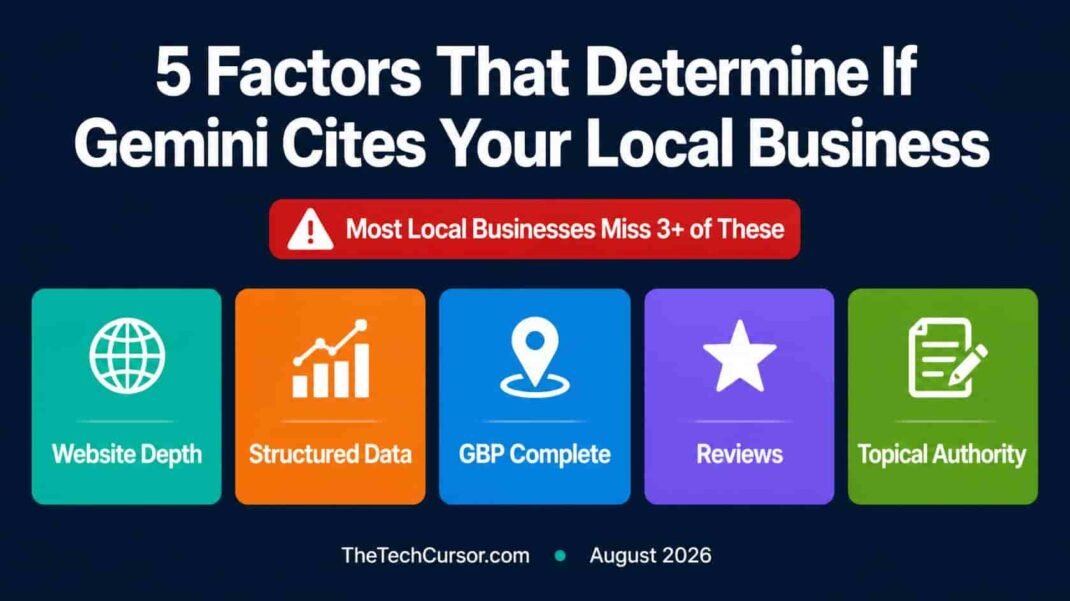
The gap between local businesses that appear in Gemini’s AI-generated responses and those that do not is driven by five measurable factors: website content depth, structured data implementation, GBP completeness, third-party review presence, and topical authority.
None of these factors is new to local SEO. However, their collective importance for AI citation — and the degree to which most local businesses have not optimized for all five simultaneously — represents a significant and growing competitive gap.
Local businesses that close this gap systematically will be better positioned as AI-mediated local discovery continues to grow. Those that do not will find themselves increasingly invisible to the AI systems that are becoming the first stop for local purchase decisions.
Pingback: Calls and Clicks From Google Maps Are Falling — Here's What the Data Shows and What to Do - The Tech Cursor
Pingback: Local SEO Services in 2026: What's Changed, What Still Works - The Tech Cursor