
Category: AI Search | Content Strategy | Digital PR | SEO
Read time: 10 min
Table of Contents
- Why Most AI Visibility Strategies Are Incomplete
- The 85% Insight That Changes Everything
- Phase 1: Make Your Pages Accessible to LLMs
- Phase 2: Build Fresh Owned Content — New and Repurposed
- Phase 3: Earn Third-Party Authority Through Digital PR
- Phase 4: Monitor and Measure Your AI Citation Performance
- Phase 5: Optimize and Compound Based on What the Data Shows
- How the 5 Phases Work Together — The Compounding Logic
- How to Sequence Your Investment
- Bottom Line
There is plenty of noise about what moves the needle for AI visibility. FAQ schema, content volume, llms.txt, structured data — these are all legitimate considerations. However, they are components of a larger system, not the system itself.
The real goal is not just to be mentioned in AI responses. It is to be cited — with a link back to an owned property, driving real traffic and building real authority. Mentions and citations are two different outcomes. They require different strategies to achieve — and a structured, sequential framework to sustain.
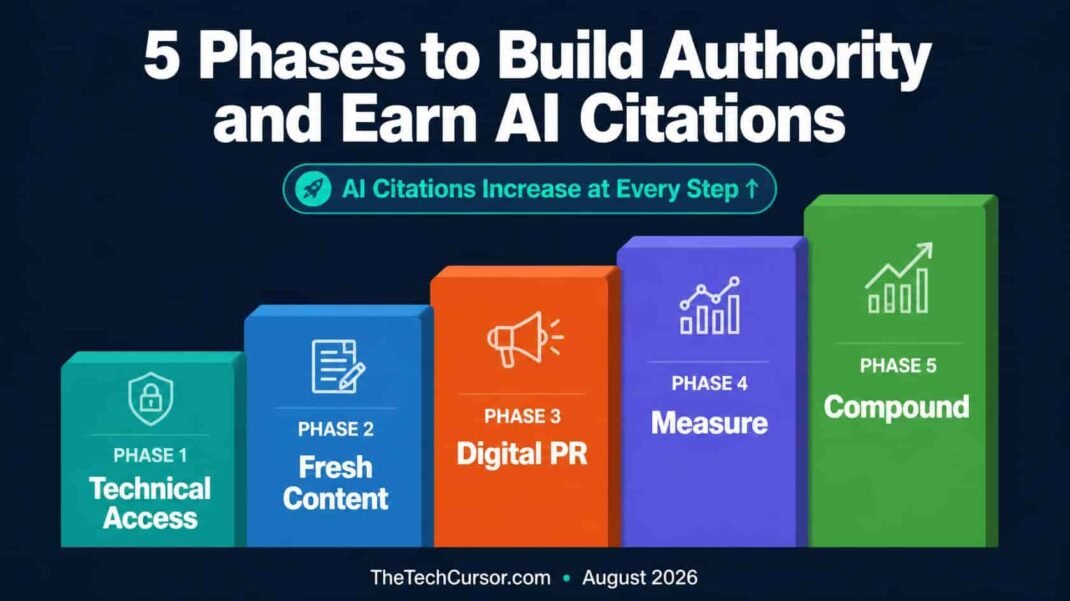
Here is the complete five-phase framework for building AI citation authority that compounds over time.
1. Why Most AI Visibility Strategies Are Incomplete
Most brands approach AI visibility from one direction only. Technical teams focus on accessibility. Content teams focus on publishing volume. PR teams focus on placements. Each of these is necessary. None is sufficient alone.
The problem is not effort — it is sequencing and integration. Brands that invest heavily in content without technical accessibility produce content that AI crawlers cannot read. Brands that optimize technically without content have nothing for AI systems to cite. Brands that pursue PR without owned content have no authoritative source for coverage to point back to.
Furthermore, most brands stop at execution without measurement — which means they have no way to know whether any of it is working, which phases are underperforming, and where to focus the next cycle of investment.
The five-phase framework solves all of these problems by sequencing the work and closing the measurement loop.
2. The 85% Insight That Changes Everything
Before examining each phase, one data point reframes the entire strategy.
<cite index=”34-1″>Up to 85% of top-of-funnel B2B brand mentions in AI search come from third-party content, according to AirOps research.</cite>
This single figure has significant implications for where content budgets should go. Most brands spend the majority of their content investment on owned channels — website, blog, social. However, if 85% of the AI mentions that matter for top-of-funnel visibility come from external sources, owned content alone cannot close the gap.
Owned content remains essential — as a foundation, source of truth, and authority signal for AI systems. However, the external content that third parties publish about your brand is often what AI systems cite most prominently. Building a strategy that systematically generates that external content is what separates brands with strong AI citation rates from those with weak ones.
3. Phase 1: Make Your Pages Accessible to LLMs
<cite index=”34-1″>This is where much of conventional SEO comes into play, along with classic UX. Proper, logical navigation, machine-readable page structure, SEO and accessibility-focused tagging, and updates to existing website content can all improve initial accessibility and understanding.</cite>
Phase 1 is the non-negotiable foundation. Without it, everything built in subsequent phases has nowhere to resolve. AI systems cannot cite pages they cannot access, parse, or understand — regardless of how good the content is or how strong the external coverage is.
Key Phase 1 actions:
Site architecture and navigation: Logical hierarchies, consistent internal linking, and no orphaned pages. AI crawlers follow the same paths Googlebot does — broken navigation reduces accessibility.
Machine-readable page structure: Proper heading hierarchy (H1, H2, H3), semantic HTML, and clean markup. AI systems use heading structure to identify what a page covers and what each section addresses.
Key takeaways sections: Add a brief “key takeaways” block to popular editorial pieces. This makes the most citable content immediately extractable — reducing the work AI systems must do to identify what to cite from a long article.
Product detail pages: <cite index=”34-1″>Make sure all PDPs follow a logical path — product-focused H1s and H2s, segmented feature bullets, descriptions, comparisons. All this feeds into retail results in AI.</cite>
Structured data: As covered in TheTechCursor’s schema markup guide, structured data gives AI systems explicit information that supports citation — particularly for product pages, articles, and local business content.
Crawl access verification: Check your robots.txt for any rules accidentally blocking AI crawlers — GPTBot, ClaudeBot, PerplexityBot, and Google-Extended. As covered in TheTechCursor’s product feed AI guide, many sites block these crawlers inadvertently through legacy robots.txt configurations.
Phase 1 pays dual dividends: it improves both traditional search rankings and AI accessibility simultaneously — making it the highest-leverage starting point in the framework.
4. Phase 2: Build Fresh Owned Content — New and Repurposed
<cite index=”34-1″>Google Search loves fresh content. LLMs love fresh takes.</cite>
Phase 2 is where owned content strategy becomes an AI visibility driver — not just a traffic driver. The purpose is twofold: to control your brand’s baseline messaging across AI systems and to give AI retrieval systems something current and substantive to cite.
Content gap analysis as the starting point:
The most effective Phase 2 strategy begins with identifying genuine gaps — topics where users are asking questions that AI systems cannot currently answer well from existing content in your category.
<cite index=”34-1″>I recently worked with an insurance provider to guide a 12-month organic content roadmap, based on 3+ years of keyword research, SEO insights, and an analysis of assets that were being cited by AI.</cite>
This approach — combining historical keyword data with AI citation analysis — identifies not just what people search for, but where your brand is specifically absent from existing AI citations for important queries.
The Fresh vs Refreshed distinction:
Fresh content targets genuine gaps. Refreshed content extracts more value from existing assets.
<cite index=”34-1″>Have a successful informational blog post? Build that out as an infographic. Is there a topic you’ve written about on-site but need to share on socials? Create a hub-and-spoke approach with granular breakdowns of that topic for organic social, and post short-form videos on Instagram or TikTok.</cite>
This repurposing serves a specific AI visibility function. Content that exists in multiple formats — article, infographic, short-form video, newsletter — accumulates citation signals across more crawler touchpoints than content in a single format. Furthermore, refreshing existing content extends its freshness signal — AI systems strongly favour recent content, with the majority of LLM crawler attention on content from the past year.
First-party proprietary data:
As covered in TheTechCursor’s earlier analysis of what earns AI citations, original data and proprietary research generate 30-40% higher AI citation rates than generic content. Along with a content roadmap, include first-party, proprietary, data-backed studies — content that AI systems cannot generate from existing training data and must cite externally.
5. Phase 3: Earn Third-Party Authority Through Digital PR
<cite index=”34-1″>Connecting with authoritative third-party sources, including publications, podcasts, and Substacks, drives valuable trust from sources not directly invested in a brand, making citations from them as valuable as a Google or Yelp review.</cite>
Phase 3 is where owned content becomes externally validated — transforming brand claims into third-party endorsements that AI systems weight significantly more than self-promotional owned content.
The query fan-out approach to PR targeting:
<cite index=”34-1″>Keyword research must be combined with understanding the types of prompts users are asking. From there, you can build a query fan-out list to really dive into the topics and solutions your potential customers are trying to achieve.</cite>
This reframes PR targeting entirely. Rather than pursuing high-authority placements generally, identify specifically which publications AI systems already cite for your target queries — and concentrate outreach on those sources. Topically relevant coverage from a mid-tier industry publication may contribute more to AI citation probability than general coverage from a major national outlet with no topical connection to your category.
You don’t need Tier 1 placements:
<cite index=”34-1″>Not everyone needs constant Tier 1 placements to win the AI results race. Targeting highly authoritative, niche blogs and editorial sites can have a lasting impact on AI citations because industry experts in your brand’s field are going to be the main storytellers for LLMs.</cite>
For smaller brands, regional businesses, and niche B2B companies, the publications that AI systems trust for your specific topic may be industry newsletters, trade publications, category-specific blogs, or podcast communities — not necessarily major national media.
Subject matter experts as PR assets:
<cite index=”34-1″>Most organisations already have internal members on hand who would be more than happy to produce shareable, citable insights for journalists to use when writing about your industry. These are your subject matter experts.</cite>
Internal experts who contribute bylined commentary to industry publications create entity associations that benefit both the expert and the brand — directly connecting to the named authorship and E-E-A-T signals covered in TheTechCursor’s E-E-A-T 2026 guide.
Microinfluencer and community outreach:
For consumer brands, microinfluencers in highly specific niches carry disproportionate weight for AI citation. Their content appears in authentic community contexts — the same contexts AI systems weight heavily when building entity understanding. As covered in TheTechCursor’s Invisible PR article, community presence is AI visibility infrastructure in 2026.
6. Phase 4: Monitor and Measure Your AI Citation Performance
This is the phase most brands skip — and its absence is precisely why so many AI visibility initiatives cannot be justified to leadership or optimized over time.
Only 14% of marketers currently track AI citation visibility, despite 43% naming AI search optimisation as a core 2026 strategy. The gap between strategic intent and measurement reality represents the largest actionable opportunity in digital marketing right now.
What to measure in Phase 4:
AI citation frequency: How often does your brand appear as a cited source in AI-generated responses for target queries? Tools like Otterly.ai, Goodie AI, and Semrush’s AI Visibility Overview track citation rates across ChatGPT, Perplexity, Google AI Overviews, and Google AI Mode.
Citation share vs competitors: For the same set of target queries, what percentage of AI responses cite your brand versus your top competitors? This share of voice metric is a directional measure of your relative AI authority.
Branded search lift: As covered in TheTechCursor’s zero-click AI value article, AI citations build brand awareness that translates to branded search growth 4-8 weeks later. Track branded search volume in Search Console alongside citation rate improvements.
AI referral traffic and conversion: Use GA4 channel groupings to track sessions, engagement, and conversions from AI referral sources — ChatGPT, Perplexity, Google AI Mode. As covered in TheTechCursor’s LLM traffic conversion guide, AI-referred visitors convert at 20% — 61% higher than paid search.
GSC AI Performance Report: As covered in TheTechCursor’s Search Console AI reports coverage, the Generative AI Performance Report shows impressions by page, country, and device. Note: a data bug was confirmed in August 2026 — verify the fix is live before using absolute numbers as baselines.
Phase 4 creates the feedback loop that makes Phases 1-3 improvable. Without measurement, you cannot know which content is earning citations, which PR placements translated to AI visibility, or which Phase 1 technical changes improved crawl accessibility for AI systems.
7. Phase 5: Optimize and Compound Based on What the Data Shows
Phase 5 is where the framework transforms from a one-time initiative into a compounding system. It uses Phase 4 measurement data to continuously improve each of the first three phases — and to identify where the next cycle of investment will generate the highest return.
Content optimisation based on citation data:
Which pages are being cited most frequently in AI responses? What do they have in common — length, format, heading structure, data inclusion, question-answer organisation? Apply those patterns to underperforming content systematically.
Which queries generate AI responses that do not cite your brand? These are your priority content gap opportunities for the next Phase 2 cycle.
PR targeting refinement:
Which third-party sources that covered your brand in Phase 3 subsequently appeared as AI citations? Those are your highest-value PR targets for ongoing relationship investment. Which placements generated coverage but no citation improvement? Deprioritise those sources in favour of publications with stronger topical alignment to your AI citation targets.
Technical accessibility improvements:
Phase 4 data often reveals specific technical issues affecting AI crawl and citation. Pages with strong Phase 3 coverage but low AI citation rates may have crawlability issues. Pages with high GSC AI impressions but low citation rates may need content restructuring to improve AI extractability.
The iteration cadence:
- Monthly: Review AI citation rates and share of voice trends
- Quarterly: Full citation gap analysis — identify new targets for Phase 2 and Phase 3
- Annually: Full framework audit — Phase 1 technical review, Phase 2 content audit, Phase 3 relationship mapping
Each cycle of optimisation compounds the results of the previous cycle — because each citation earned makes the next one more likely, each technical improvement makes content more accessible, and each PR placement builds the topical authority that makes future placements easier to secure.
8. How the 5 Phases Work Together — The Compounding Logic
<cite index=”34-1″>These three phases don’t work in isolation. They’re a sequence, with each one strengthening the next. Technical accessibility gets you found. Fresh, brand-informed content gets you understood. Earned coverage and digital PR get you chosen — because that’s the trust no brand can manufacture about itself.</cite>
The five-phase version extends this logic:
Phase 1 enables Phase 2. Without technical accessibility, content cannot be crawled, parsed, or cited regardless of quality.
Phase 2 enables Phase 3. Without substantive owned content, there is nothing for third-party sources to reference or journalists to cite.
Phase 3 amplifies Phases 1 and 2. Each third-party citation creates a new signal pointing to owned content and validating brand authority in the category.
Phase 4 makes all three optimizable. Without measurement, the framework runs blind — producing activity without the data to improve it.
Phase 5 compounds everything. Each optimisation cycle informed by Phase 4 data improves the effectiveness of Phases 1-3 in the next cycle — creating a compounding system rather than a static program.
<cite index=”34-1″>Each citation reinforces the last. Every piece of earned coverage makes your owned content more credible. Authority in AI results is built the same way it always has been in marketing: with consistency across every channel.</cite>
9. How to Sequence Your Investment
Month 1-2: Phase 1: Technical audit and accessibility fixes. Crawlability, heading structure, structured data, robots.txt, page speed. This is the foundation — do not skip it.
Month 2-4: Phase 2: Content gap analysis and roadmap development. Begin publishing against the highest-priority gaps. Set up AI citation monitoring tools before publishing — so you have pre-publication baselines to measure against.
Month 3-6: Phase 3: Begin Phase 3 outreach while Phase 2 content is accumulating. Use your existing relationships first. Expand outward to niche publications and podcast opportunities. Build the subject matter expert visibility program.
Month 4 onward: Phase 4: Begin systematic measurement. Monthly citation rate reviews. Quarterly gap analyses. Track branded search lift and AI referral traffic in GA4.
Month 6 onward: Phase 5:First optimisation cycle based on 90 days of Phase 4 data. Identify highest-performing content patterns and apply them to underperformers. Refine PR targeting based on which placements translated to citation improvement.
10. Bottom Line
The five-phase framework — technical accessibility, fresh owned content, earned digital PR, measurement, and compounding optimisation — is not a new set of tactics. It is a sequenced system that aligns existing marketing disciplines with how AI systems evaluate, understand, and cite sources.
<cite index=”34-1″>AI visibility compounds when technical accessibility, useful content, and third-party authority work together.</cite>
Phases 4 and 5 ensure that compounding actually happens — by closing the measurement loop and creating the feedback mechanism that makes each subsequent cycle more effective than the last.
The brands running all five phases simultaneously — maintaining technical hygiene, publishing fresh content consistently, earning third-party coverage from topically relevant sources, measuring citation performance, and optimising based on what the data shows — will build AI citation authority that compounds over time.
Those that treat any of the five phases as optional will find their AI visibility fragile, inconsistent, and impossible to improve systematically.
Build the foundation. Create the content. Earn the citations. Measure what works. Compound the results.