
Category: Google Ads | API | Developer Tools | Digital Marketing
Read time: 5 min
Site: TheTechCursor
Table of Contents
- What Google Ads API v25.1 Adds
- Enhanced Measurement Features
- New Insights Capabilities
- AI Max and Performance Max Updates
- What Developers Need to Do
- Migration Timeline Reminder
- Bottom Line
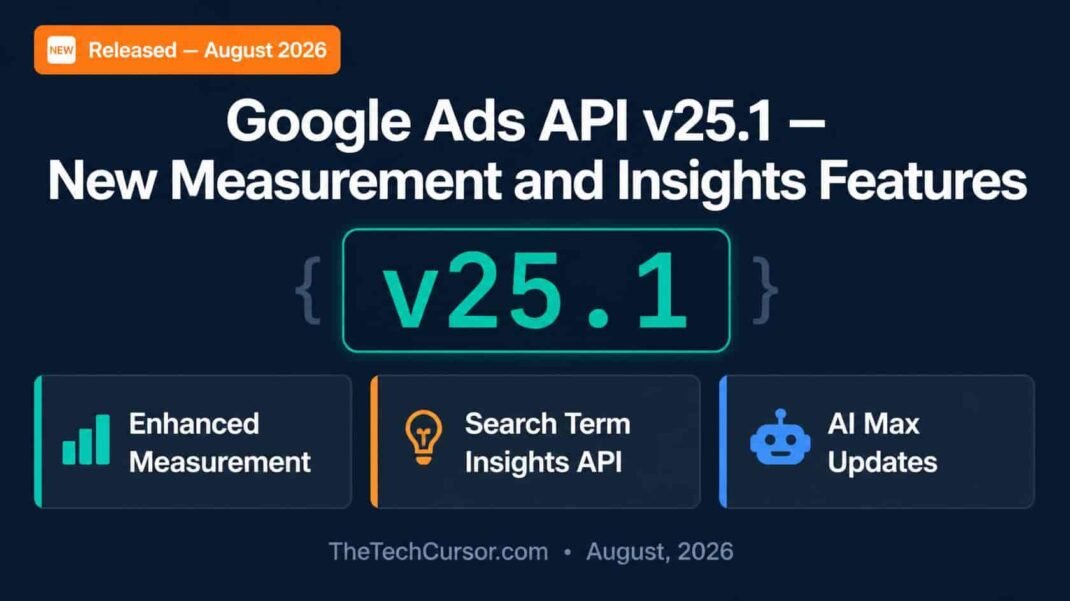
Google has released Google Ads API v25.1 — a minor version update that expands measurement and insights capabilities for developers building on the Google Ads platform.
While minor version releases typically receive less attention than major API updates, v25.1 contains several additions that are directly relevant to the AI Max migration and the broader shift toward intent-based campaign measurement covered in TheTechCursor’s recent coverage of Google’s advertising roadmap.
1. What Google Ads API v25.1 Adds
Google Ads API v25.1 focuses primarily on two capability areas: expanded measurement options that give developers more granular access to conversion and attribution data, and new insights endpoints that surface AI-generated performance analysis programmatically.
The update also includes several additions specific to AI Max and Performance Max campaigns — reflecting the ongoing migration of Search campaigns to AI Max covered in TheTechCursor’s article on the official migration timeline.
2. Enhanced Measurement Features
Expanded conversion tracking access:v25.1 adds new fields to conversion tracking resources that allow developers to access more granular attribution data programmatically — including data that was previously only available through the Google Ads UI reporting interface.
This is particularly relevant for teams building custom attribution models or integrating Google Ads conversion data with external measurement systems. The additional fields allow more precise matching between Google Ads conversions and CRM or first-party data sources.
Enhanced audience signal reporting: New reporting fields expose audience signal performance data for AI Max and Performance Max campaigns — showing how different audience segments contribute to conversion performance within automated campaigns.
Previously, audience signal contribution data was available in limited form through the UI’s asset group performance reports. The API now exposes this data programmatically, enabling developers to build automated reporting on audience signal effectiveness.
Improved data freshness v25.1 includes improvements to data freshness for several high-frequency reporting resources — reducing the lag between when campaign data is generated and when it is available through the API. For teams building real-time or near-real-time reporting dashboards, this improvement reduces the time gap between campaign activity and reporting visibility.
3. New Insights Capabilities
Programmatic access to Search Term Insights: One of the most practically useful additions in v25.1 is expanded programmatic access to Search Term Insights — Google’s AI-generated analysis of search term patterns within campaigns.
Search Term Insights groups search terms into thematic clusters and provides AI-generated descriptions of what users in each cluster are searching for. Previously available only in the UI, v25.1 makes these clusters and descriptions accessible through the API — enabling developers to incorporate search intent analysis into automated reporting and optimisation workflows.
Performance Insights API access: Performance Insights — Google’s automated anomaly detection and explanation system — is now more accessible through the API in v25.1. Developers can query for performance insights programmatically and surface them in external dashboards or notification systems.
This connects directly to the AI agents roadmap covered in TheTechCursor’s recent 7-step guide — one of the key steps in building agentic Google Ads systems is connecting live performance data and automated insights to AI analysis tools. v25.1’s expanded insights API access reduces the engineering work required to build that connection.
4. AI Max and Performance Max Updates
v25.1 includes several additions specific to AI Max and Performance Max:
Asset group performance reporting expansion: New metrics and dimensions for asset group performance reports give developers more detailed visibility into how individual creative assets are contributing to campaign performance within AI Max and PMax campaigns.
Audience signal management improvements: New API resources for managing audience signals in AI Max campaigns — allowing programmatic addition, modification, and removal of audience signals without requiring UI access.
Brand safety controls: Additional API support for brand inclusion and exclusion settings in AI Max campaigns — extending the programmatic management capabilities for brand controls that were previously only partially accessible through the API.
These additions are particularly relevant for agencies and tool vendors managing AI Max campaigns at scale. As AI Max becomes the default campaign structure following the September 2026 migration, programmatic management of AI Max settings through the API becomes increasingly important.
5. What Developers Need to Do
Review the v25.1 release notes: Google’s official release notes for v25.1 contain the complete list of additions, changes, and deprecations. Developers should review these before updating their integrations to identify any breaking changes alongside the new features.
Evaluate new measurement fields for your reporting needs: The expanded conversion tracking and audience signal reporting fields in v25.1 may enable measurement capabilities you have been building workarounds for. Review the new fields against your current reporting gaps before building custom solutions.
Plan Search Term Insights integration: If your team does regular search term analysis — which is essential for AI Max optimisation as covered in TheTechCursor’s articles on the migration timeline — the programmatic Search Term Insights access in v25.1 is worth integrating. It reduces the manual data export cycle and enables automated theme-level analysis.
Update audience signal management workflows: If you are managing AI Max campaigns programmatically and have been working around limitations in audience signal management through the API, v25.1’s improvements may simplify those workflows significantly.
6. Migration Timeline Reminder
v25.1 arrives during a critical period in the Google Ads API migration timeline. As covered in TheTechCursor’s article on the official AI Max migration timeline:
- August 3, 2026: Creation of new Campaign-level Broad Match and legacy ACA campaigns blocked
- September 1-30, 2026: Automatic migration of Campaign-level Broad Match and ACA to AI Max
- February 1-28, 2027: Automatic DSA migration begins
- ~September 2027: Older API versions supporting legacy entities reach sunset
Developers should note that future API versions released after September 1 will remove support for legacy Campaign-level Broad Match and ACA entities. v25.1 is a minor update within the current major version — but the next major version release will likely reflect these entity removals.
Teams that have not yet audited their API integrations for legacy entity dependencies should treat the September timeline as a firm deadline for that audit.
7. Bottom Line
Google Ads API v25.1 expands access to measurement and insights in ways that are directly relevant to the AI Max migration and the shift toward automated, intent-based campaign management.
The most impactful additions for most development teams are programmatic access to Search Term Insights and expanded audience signal reporting — both of which reduce manual data work and enable more sophisticated automated analysis of AI Max campaign performance.
Review the release notes. Update your integrations. And use the new insights capabilities to build the measurement infrastructure that makes AI Max performance visible and optimizable — not just automated and opaque.