Category: SEO | PPC | AI Search | Digital Marketing Strategy
Read time: 8 min
Site: TheTechCursor
Table of Contents
- Search Is Now a Loop, Not a Line
- The Data Behind the Shift
- Stage 1 — AI Answers Shape the Consideration Set
- Stage 2 — Paid Ads Capture the Filtered Demand
- Stage 3 — Organic Reinforces the Decision
- Stage 4 — Follow-Up Queries Restart the Loop
- What AI Overview Citations Are Actually Worth
- How to Measure the Full Loop
- Key Adjustments for Your Campaigns Right Now
- Bottom Line
SEO and PPC have traditionally been managed as two channels that share a results page. The coordination questions were simple: where does paid overlap with organic? Which channel gets credit for the conversion?
That model no longer fits how search actually works.
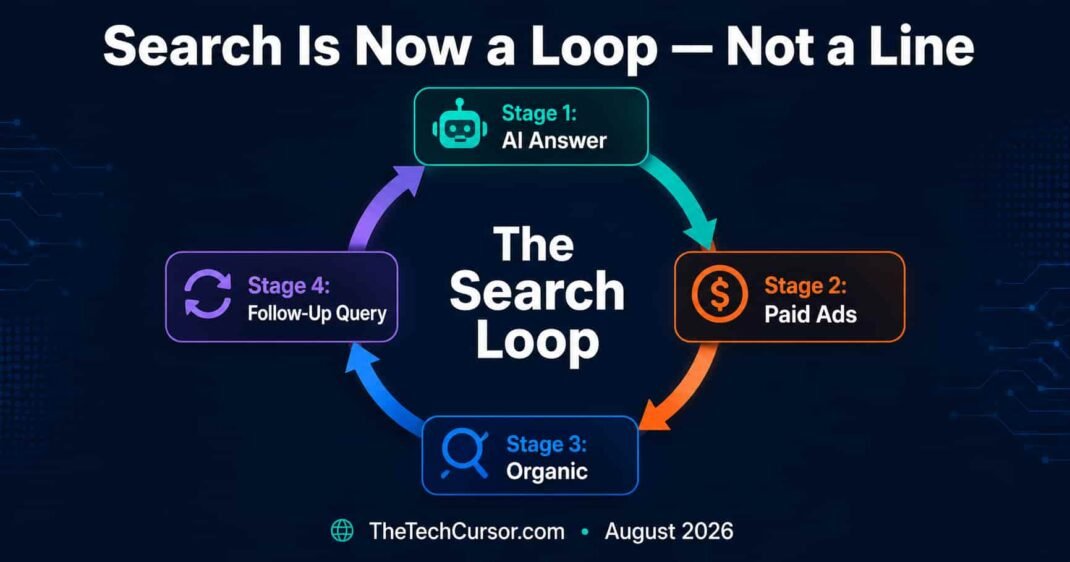
<cite index=”59-1″>An AI Overview answers the query and cites sources. Ads compete for the remaining attention. Organic results appear alongside Reddit threads and related searches. Searchers move between those surfaces, refine their query, and repeat the process until they know enough to act.</cite>
Search is now a loop — not a line. What happens on one surface changes the outcome on another. And most SEO and PPC teams are still optimizing isolated pieces of a journey that now operates as one connected system.
1. Search Is Now a Loop, Not a Line
<cite index=”59-1″>SparkToro’s 2026 analysis found that 68% of Google searches now end without a click. More importantly, the share of searches that led to another Google query rose 7.2 percentage points.</cite>
Refining and re-querying is not new. However, what changed is the answer layer now sitting at the top of each step. It absorbs clicks that used to happen along the way — and influences which brands get seen at every subsequent stage.
Consider a familiar B2B journey. In 2023, a search for “best project management software for remote teams” drove clicks to comparison articles and vendor sites, with conversions occurring a week or two later.
<cite index=”59-1″>The same search plays out differently today. An AI Overview names three tools and the user doesn’t click. Instead, they search “asana vs monday for agencies,” see another AI Overview and ads from both brands, and click one. Then they search “monday.com implementation problems,” read an organic article, and start a trial.</cite>
That is three queries inside a single loop — with each stage creating a different opportunity for visibility. The brands that understand all four stages will consistently outperform those optimizing just one.
2. The Data Behind the Shift
The numbers tell a clear story about how traffic is redistributing across the search loop:
| Metric | 2025 | 2026 |
|---|---|---|
| Google searches ending without a click | ~61% | 68% |
| Searches leading to another Google query | Baseline | +7.2 percentage points |
| Paid CTR on AI Overview queries | 14.6% | 16.2% |
| Paid CTR on non-AI Overview queries | 26% | 21.8% |
| Organic CTR (queries without AI Overview) | 2.93% | 3.97% |
<cite index=”59-1″>In Seer Interactive’s 2026 study of 53 brands and 5.47 million queries, comparison queries triggered an AI Overview 95.4% of the time, and question-format queries 85.9%.</cite>
These numbers reveal the critical pattern: when an AI Overview appears, paid CTR rises while organic CTR falls. When no AI Overview appears, organic gains. The two channels are now performing on opposite sides of the same divide — defined by whether an AI Overview is present.
3. Stage 1 — AI Answers Shape the Consideration Set
AI Overviews show up most often at the start of a search journey — when someone runs broad questions before they know enough to get specific.
<cite index=”59-1″>A searcher arrives with a general question and leaves the first query with two or three specific names in mind. That narrowing used to happen across articles, listings, and ads. Now it happens inside the AI answer.</cite>
This is the most consequential change in the search journey. The AI Overview does not just answer a question — it constructs the consideration set. The brands named in that AI answer enter the rest of the loop with a significant trust advantage over those that are not mentioned.
Furthermore, a brand cannot buy its way into an AI Overview. The overview either cites it as a source or it does not. That citation is the foundational asset the entire loop depends on — and it is earned through content quality, topical authority, and entity signals, not through bidding.
For SEO teams, this means the most commercially important content to optimize is not necessarily the content that ranks highest. It is the content most likely to be cited in AI Overviews for high-intent, comparison-stage queries.
4. Stage 2 — Paid Ads Capture the Filtered Demand
<cite index=”59-1″>Most advertisers assume the AI layer is bad for paid search. The data says otherwise.</cite>
<cite index=”59-1″>When an AI Overview appears, paid CTR actually rose from 14.6% to 16.2%. On queries without one, it fell from 26% to 21.8%.</cite> Paid is not being hurt by the AI answer. It is capturing the demand that the AI answer filters and passes along.
The same pattern shows up in click share across categories. <cite index=”59-1″>Similarweb compared January 2025 to January 2026 and found organic losing share in every category tracked. In headphones, organic went from 73% of clicks down to 50%. Text ads were the only surface to gain share.</cite>
As the AI answer takes the early clicks, the paid slots below it become where the remaining — and higher-intent — demand converts to a click. Furthermore, there is a compounding trust effect at work. The brand the AI answer cited that also appears in a paid ad below it carries an implicit endorsement that a competitor bidding in the same position does not have.
5. Stage 3 — Organic Reinforces the Decision
By Stage 3, the AI Overview has built the shortlist and paid ads have shown the options. The organic click at this stage serves a different purpose than it did in 2023. It confirms a choice rather than discovering one.
Two segments of organic traffic remain strong in this environment:
Queries where no AI Overview appears. <cite index=”59-1″>Seer found organic CTR on those queries rose from 2.93% to 3.97% in 2025.</cite> Fewer people click overall — but those who do are past the quick-answer stage and want genuine depth.
Post-consideration deep research. Searchers who have narrowed their options through AI answers and paid ads often return to organic for validation — checking reviews, reading detailed comparisons, and confirming their shortlist through independent sources.
<cite index=”59-1″>Seer found that brands cited inside an AI Overview earned 35% more organic clicks and 91% more paid clicks than uncited brands on the same queries.</cite> The citation acts as a trust signal that lifts both the organic listing and the paid ad appearing on the same page simultaneously.
6. Stage 4 — Follow-Up Queries Restart the Loop
<cite index=”59-1″>The stage most strategies ignore is the one growing fastest. That 7.2-point rise in searches leading to another search means people cycle back through the system again and again before they act.</cite>
Each new query resets the board. A brand can win the first search and disappear from the next. Ranking first for “best project management software” counts for nothing if a competitor owns “asana vs monday for agencies” — and the complaint threads behind “monday.com implementation problems.”
This is why tracking one query at a time hides how much is actually moving. Rank reports and cost per click both measure a single query in isolation. What competes now is the full chain of searches — not just the first one. Showing up consistently across that chain matters more than owning a single head term.
7. What AI Overview Citations Are Actually Worth
The 35% organic lift and 91% paid lift for cited brands versus uncited brands on the same queries is the most commercially significant data point in Seer’s research.
It demonstrates that AI Overview citation is not just an SEO metric — it is a performance advertising metric. The citation earned through SEO work pays off across both organic and paid simultaneously. That shared payoff means citation share belongs in the same reporting dashboard as CPA and average position — owned jointly by SEO and PPC teams rather than claimed by either.
<cite index=”59-1″>A case study covering 10 domains and roughly 150,000 pages found that generic how-to content underperforms in AI citations because models can already write it themselves. What gets cited is original data and proprietary research.</cite>
This finding has a direct content strategy implication. The “what is” and “how to” library that anchored a decade of SEO content strategy is increasingly being resolved by AI without citing the source. The content that earns citations — and therefore lifts both organic and paid performance through the loop — is content that contains something the AI cannot generate itself.
8. How to Measure the Full Loop
Standard measurement tools were built for a linear journey. Measuring the loop requires a different approach.
Build one view organized by query path
Start with 90 days of Google Ads query data. Layer in AI Overview presence data from a third-party tracker. For each priority journey, record five facts side by side across the head query and its follow-up queries: AI Overview presence, citation status, organic position, paid position, and combined click share.
Separate channel reports cannot describe interactions that happen on the same page. Those page-level interactions are now the interactions that matter most.
Use Search Console AI reports — with their limitations in mind
As covered in TheTechCursor’s detailed breakdown of Google Search Console’s AI Performance Reports, these reports cover AI Overviews and AI Mode impressions by page, country, device, and date. However, they do not yet include click data. Pair them with query-level tracking to understand where AI visibility actually translates into performance downstream.
Segment by citation status before making channel decisions
<cite index=”59-1″>Comparison and question queries trigger AI Overviews more than 85% of the time and sit at the loop’s entry point. For uncited queries with CTR below half the account average, standard optimization applies. For cited queries, the instinct reverses — those are where organic and paid perform best together and warrant maintained or increased investment.</cite>
9. Key Adjustments for Your Campaigns Right Now
Audit your citation status for comparison queries first. These are the highest-risk queries for the new loop — triggering AI Overviews 95% of the time. For any comparison query where you are not cited, identify whether the gap is a content problem or a distribution problem. Are you publishing comprehensive, original comparison content? Are you appearing in the trusted sources AI systems draw from for your category?
Stop optimizing SEO and PPC separately for the same queries. If a query triggers an AI Overview and you are cited, that citation is simultaneously improving your organic CTR and your paid CTR on that page. The work that earns the citation — content quality, topical authority — should be shared context for both the SEO and paid teams making decisions about that query.
Invest in original data as a system asset. <cite index=”59-1″>Original research is the infrastructure for the whole loop. It scales to the business — a national SaaS brand needs proprietary research, a regional service company may need genuinely useful local expertise that a model cannot generate.</cite> Either way, the investment pays dividends across every stage of the loop simultaneously.
Map follow-up queries for your highest-value journeys. For each of your most commercially important head queries, identify the two or three most common follow-up searches. Check whether you appear across all of them — in AI answers, paid positions, and organic results. The gaps in that map are your priority coverage investments.
10. Bottom Line
<cite index=”59-1″>SEO and PPC are now stages in one system that searchers loop through: an AI answer that shapes the shortlist, ads that capture the filtered demand, organic that reinforces the decision, and follow-up queries that restart it.</cite>
The brands winning in 2026 are not choosing between channels. They are mapping the full journey, measuring citation status alongside CPA and organic position, and investing in the original content that lifts performance across every stage simultaneously.
Plenty of searches still work the old way — navigational queries, local searches, and strong branded terms still resolve in a single click. However, for research-heavy, consideration-phase journeys, no channel operates independently anymore.
The advertisers who restructure around the loop rather than the line will compound their advantages as AI search continues to mature. Those who keep optimizing isolated channels will keep leaving the loop’s biggest payoffs — the citation-driven lifts to both organic and paid — on the table.