
Category: SEO | Topical Authority | Content Strategy
Read time: 8 min
Site: TheTechCursor
Table of Contents
- Beyond Keywords — The Query Template Concept
- Two Ways to Build Topical Authority
- What a Query Template Actually Is
- The Hybrid Methodology — The Strongest Approach
- The Query Deserves a Page Principle
- Microsemantics — The Small Changes With Large Impact
- Core and Outer Sections of a Topical Map
- Query Templates and AI Search — The Direct Connection
- How to Apply Query Templates to Your Own Site
- Bottom Line
Most SEO content strategies start and end with keywords. Find a keyword, create a page, target that keyword, repeat. It is a reasonable starting point — but it is increasingly insufficient for building the kind of topical authority that AI search systems recognize and cite.
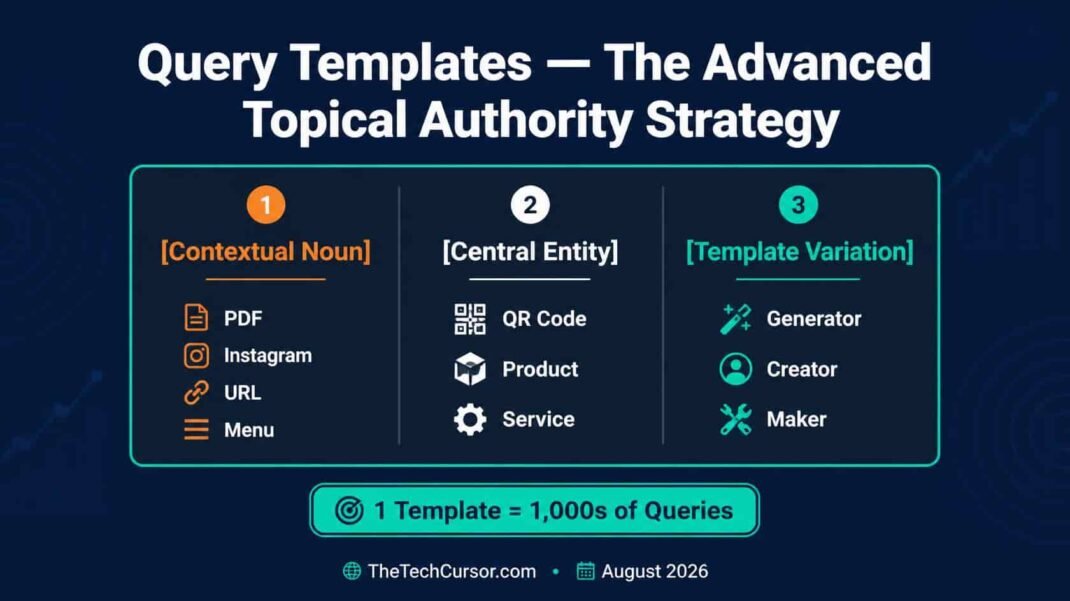
Query templates are a more advanced framework for content strategy — one that maps not just which topics to cover, but all the different ways people search for those topics. When implemented correctly, ranking for one variation of a query template helps you rank for thousands of related variations simultaneously.
Here is what query templates are, how they work, and how to apply them to your own content strategy.
1. Beyond Keywords — The Query Template Concept
A keyword is a single search phrase. “QR code generator” is a keyword. However, people searching for that tool do not just type those three words — they search for “PDF QR code generator,” “Instagram QR code maker,” “dynamic QR code creator,” “free QR code designer for websites,” and hundreds of other variations.
These variations follow a pattern. They share a central entity — “QR code” — surrounded by contextual nouns that specify the use case and synonymous verbs that describe the action. Together, they form a query template:
[Contextual noun] + [Central entity] + [Tool synonym]
PDF / Instagram / URL / Menu / Event → QR Code → Generator / Creator / Maker / Designer
A single query template can contain thousands of variations. Furthermore, when you rank well for one variation in that template, Google begins testing whether your content is also relevant for the other variations — because the underlying intent is similar enough that a single source could satisfy all of them.
This is not a minor SEO tactic. It is a fundamental shift in how to think about content coverage.
2. Two Ways to Build Topical Authority
Koray Tuğberk GÜBÜR, one of the SEO community’s leading experts on semantic search, describes two primary methodologies for building topical authority — each with different strengths.
Methodology 1: Entity-attribute coverage. Every entity within a topic class shares the same set of attributes. “Calorie” is an attribute of every entity in the “food” class. “Symptom” is an attribute of every entity in the “disease” class.
By covering every entity within a class across all its shared attributes, you signal comprehensive coverage of a topic to search engines. This is the depth-first approach — going deep within a defined topic area.
Methodology 2: Query template coverage. Query templates do not require topical relevance between the variations. WikiHow holds authority for the “how to” query template — which allows it to rank across completely unrelated topics simultaneously. The authority attaches to the query format rather than to any single topic.
This is the breadth-first approach — building authority across a query pattern regardless of topic.
The hybrid approach is the strongest of all. It covers all entities from the same class, with all of their attributes, across all query template variations — uniting topical depth with query format breadth in a single content network.
3. What a Query Template Actually Is
A query template is a pattern that a group of related searches follow. It can be decomposed into positional components — the parts of the query that stay consistent versus the parts that vary.
Simple example: Template: [Social media platform] + [metric or action] Variations: “Instagram engagement metrics,” “TikTok growth strategies,” “YouTube promotion tips,” “Facebook influencers”
More complex example: Template: Does [substance] cause [negative outcome] Variations: “Does alcohol cause addiction,” “Does caffeine cause anxiety,” “Does sugar cause inflammation”
The key insight is that these variations are not just different keywords — they are a connected query network. Search engines recognize the structural similarity and use performance on one variation to inform how they evaluate others.
When your content consistently satisfies users who search for one variation, it builds historical click and engagement data that Google uses as evidence that your content would also satisfy users searching for related variations. As Koray notes, quoting Paul Haahr of Google: “If there is a query with wrong results, we won’t fix it. If this query belongs to a cluster, we will fix it.” Google thinks in query clusters — and your content should map to those clusters deliberately.
4. The Hybrid Methodology — The Strongest Approach
The most powerful content networks combine entity-attribute depth with query template breadth. Here is what this looks like in practice.
Example: Social media marketing site
- Core section (commercial): Social media marketing services by platform and objective
- Outer section — entity-attribute: Coverage of each platform’s specific metrics, algorithms, and content types
- Outer section — query templates:
[Social media platform] + promotion[Social media platform] + engagement metrics[Social media platform] + growth[Social media platform] + guidesDoes [social media platform] pay for [engagement type]
Each outer section page covers one template variation for one entity. However, because they follow consistent query patterns and internally link back to the core section, the ranking signals they accumulate transfer throughout the network.
The result: ranking for “Does TikTok pay for views?” helps rank for “Does YouTube pay for likes?” — because they sit in the same query template. And both help the core commercial page rank for “social media marketing services.”
5. The Query Deserves a Page Principle
One of the most practical frameworks that emerges from query template thinking is the Query Deserves a Page (QDP) principle.
Not every query variation needs its own page. Creating a separate page for every single variation would produce an unmanageable content library with significant duplication. The QDP principle provides a decision framework:
Create a separate page when:
- The query’s search demand exceeds a meaningful threshold
- The query involves a different entity or a clearly different pattern
- The predicates — the actions and attributes associated with the query — differ significantly from existing pages
Keep it on an existing page when:
- The predicates are nearly identical to another variation
- The entity difference is minor enough that both queries are satisfied by the same content
- The search demand is too low to justify a separate URL
Real example: “PDF QR code generator” and “URL QR code generator” share almost all predicates — create, download, scan. They are probably the same page with slight variations. However, “Facebook QR code generator” has different predicates — share, follow, link to profile — and deserves its own page.
This principle reduces crawl waste, concentrates ranking signals per URL, and helps search engines classify your content more efficiently — which is one of the primary goals of query template optimization.
6. Microsemantics — The Small Changes With Large Impact
Microsemantics is the concept that small differences in sentence structure significantly affect relevance for different query variations — even when the factual content is identical.
Consider two sentences:
- “Financial advisors help families achieve financial independence.”
- “Financial independence is achieved by families with the help of financial advisors.”
Both sentences contain the same fact. However, if the query template positions “financial advisor” as the subject — as in “what do financial advisors help with?” — the first sentence scores higher for relevance. If the query positions “financial independence” as the subject — “how is financial independence achieved?” — the second sentence is more relevant.
This matters at scale. If you are targeting a query template with 3,000 variations, a small structural difference in sentence construction is multiplied by 3,000 and becomes a significant ranking factor across the entire template network.
Practical application:
- Identify the primary entity in your target queries — is it the subject or object of most queries?
- Structure your key sentences to match the query’s subject-predicate-object pattern
- Vary sentence structure across a page to improve relevance for different variations within the same template
This is not keyword stuffing. It is matching the semantic structure of your content to the semantic structure of the queries you are targeting.
7. Core and Outer Sections of a Topical Map
Query template strategy requires a clear content architecture — specifically, the distinction between core and outer sections of a topical map.
Core section:
- Primarily commercial content — service pages, product pages, category pages
- Contains the most important entities and concepts in your topic area
- Receives internal links from the outer section to accumulate ranking signals
Outer section:
- Primarily informational content — guides, comparisons, FAQs, template-based content
- Covers query template variations that bridge users from informational intent toward commercial intent
- Links back to the core section to transfer ranking signals
Internal links always flow from the outer section toward the core section. However, the traffic and engagement generated by the outer section — every click, impression, and AI grounding event — reinforces the topical authority and ranking signals of the core commercial pages it supports.
Important insight: Outer section content should be commercially adjacent even when informational. A “festival outfit checklist” page that embeds product recommendations is informational and commercial simultaneously — satisfying user intent while driving conversion opportunities.
Furthermore, a topical map can sometimes be a single page. One well-structured, comprehensive page can satisfy multiple query template variations when those variations share enough semantic overlap. The decision between one page and many pages comes back to the QDP principle — create separate pages only when the query’s predicates genuinely diverge.
8. Query Templates and AI Search — The Direct Connection
Query template thinking is not just relevant for traditional SEO — it is directly connected to how AI search systems like Google AI Overviews and ChatGPT generate and cite responses.
As covered in TheTechCursor’s query fan-out article, AI search systems break a single user query into multiple related sub-queries simultaneously before generating a response. That sub-query generation process follows patterns — specifically, the same kind of template variations that query template SEO maps out deliberately.
When your content network covers a query template comprehensively — addressing the entity across multiple attributes and variations — it provides exactly the depth that AI systems draw on when generating responses about your topic. Furthermore, content that satisfies multiple variations of the same template accumulates the historical click and engagement data that AI search systems use as quality signals.
Additionally, outer section template content — particularly question-format pages like “Does [entity] cause [outcome]?” — is explicitly useful for earning AI citations. As Koray notes, these question pages “help earn the first LLM approvals for generative AI search engagement, along with semantics-related SERP features such as People Also Ask and Featured Snippets.”
Question-format query templates are therefore dual-purpose: they build topical authority for traditional search while simultaneously creating the explicit question-answer pairs that AI systems cite.
9. How to Apply Query Templates to Your Own Site
Applying query template thinking to your content strategy does not require rebuilding everything from scratch. Start with these five steps.
Step 1: Identify your core entity and class. What is the central entity your site is about? What class does it belong to? All members of that class share the same set of attributes — and covering them systematically builds entity-level topical authority.
Step 2: Map your current query templates. Pull your top 90 days of Google Search Console queries. Group them by pattern rather than individual phrase. Look for structural similarities — what changes between queries? That changing element is the variable in a template.
Step 3: Identify template gaps. For each template you identify, list the complete set of possible variations — every entity in the class × every relevant attribute or contextual noun. Which variations have no corresponding content? Those are your content gaps.
Step 4: Apply the QDP principle to prioritize. For each gap, evaluate: does the query demand justify a new page? Are the predicates significantly different from existing content? Only create new pages where both answers are yes.
Step 5: Improve microsemantics on existing pages. For existing template content, review sentence structure. Are key sentences structured to match the subject-predicate-object pattern of the queries you are targeting? Small adjustments here can improve relevance across hundreds of query variations simultaneously.
10. Bottom Line
Query templates extend topical authority beyond individual keywords into the full network of variations that users search for around a topic. Covering a template comprehensively — rather than chasing individual keywords — builds the kind of deep, coherent content networks that both traditional search algorithms and AI search systems recognize as authoritative.
The hybrid approach is the most powerful: combine entity-attribute depth with query template breadth, organize content into core and outer sections, apply the QDP principle to avoid unnecessary page fragmentation, and use microsemantics to maximize relevance across template variations.
This is advanced SEO — but it is also the natural evolution of the topical authority and content cluster strategies that are already part of most serious content programs. The shift is from thinking about which keywords to cover to thinking about which query patterns to own — and building content networks that cover those patterns completely.
Pingback: Google DeepMind's ARR Model Could Rewrite Search Ranking - The Tech Cursor
Pingback: Google R4T-Diffusion: Query Fan-Out Up to 20x Faster - The Tech Cursor