
Published: June 20, 2026
Read time: 7 min
When you type a question into Google AI Mode, ChatGPT, or Perplexity, something happens behind the scenes that most people never see. Your single question is immediately broken down into dozens of related searches — running simultaneously — before a single word of the answer appears on your screen.
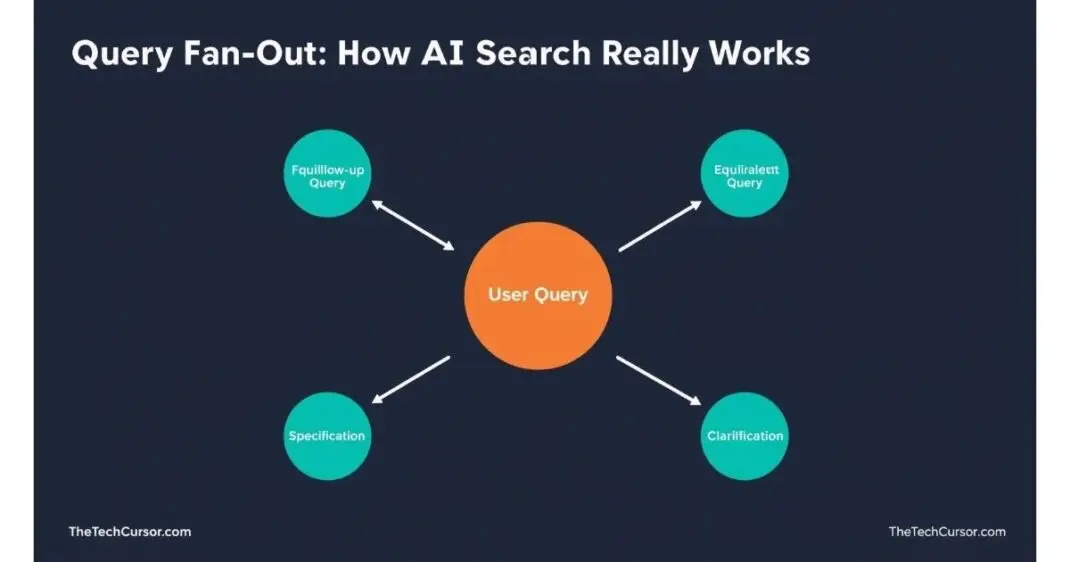
This process is called query fan-out. It is one of the most important concepts in AI search today — and understanding it changes how you should think about creating and optimizing content for 2026 and beyond.
What Is Query Fan-Out?
Query fan-out is the process AI search engines use to turn one user question into many related searches before generating a response.
Traditional search was simple: type a keyword, get a list of ranked links. AI search works differently. When you submit a question, the AI system does not just look for pages that match your exact words. Instead, it generates multiple related sub-queries — exploring different angles, implications, and follow-up questions — and runs all of them simultaneously before synthesizing the results into one coherent answer.
The name comes from the visual idea of something fanning out from a central point. Your original question is the center. The sub-queries fan outward in multiple directions.
A simple example: A query like “best cleanser for teenage girls with oily skin” might trigger sub-searches on skin-type suitability, age-appropriate ingredients, gentleness ratings, acne-prone skin considerations, and real-world product reviews — even though the user never mentioned any of these specifically. The AI infers what a complete answer requires and searches for all of it simultaneously.
Is “Query Fan-Out” an Official Term?
Not exactly. “Query fan-out” is industry shorthand that SEOs and researchers use to describe a behaviour that exists across all major AI search platforms — even though each platform uses different internal terminology for it.
Google’s patents, for example, describe the same behaviour as “query variant generation“ (Patent US11663201B2), where a single query is used to generate multiple related query variants using a trained generative model. Other platforms use terms like query decomposition, multi-query retrieval, query expansion, iterative retrieval, or agentic planning.
Different names, same underlying behaviour: one user question leads to many related searches, with results synthesized together into a single response.
Which AI Platforms Use Query Fan-Out?
All major AI search systems use some form of query fan-out. Here is how each platform approaches it:
Google AI Overviews and AI Mode: Google’s systems issue multiple related searches across subtopics and data sources while generating a response — gathering supporting pages as the answer forms. This allows Google to surface a broader and more diverse set of sources than a classic keyword search would return.
Gemini: When a prompt requires external information, Gemini automatically generates one or multiple search queries and executes them before responding — filling in missing context through additional searches rather than relying solely on its training data.
ChatGPT expands and rewrites user prompts into related search queries when current information is needed. A question like “what are good restaurants near me?” might be rewritten into “top restaurants in San Francisco” based on location context — and multiple related searches may follow.
Perplexity previously displayed its intermediate search steps visibly to users — showing how a single question was broken into multiple focused searches before the final answer appeared. While this visual step display is no longer shown, the underlying process continues.
Microsoft Copilot uses an iterative form of query expansion — issuing a series of related searches where each result helps shape the next one, grounded in Bing’s search index and, in enterprise environments, internal organizational data.
Grok uses a more constrained approach — expanding the query but within tighter limits, focusing on verification through authoritative sources and closely related search variations rather than broad parallel expansion.
How Query Fan-Out Works: 5 Steps
Understanding the mechanics helps clarify why content strategy needs to change in response to this process.
Step 1: Decomposition. The AI analyzes your query to identify its core topics, important attributes, implied comparisons, and likely follow-up questions. Without this step, the system would treat every query as flat and literal — which fails for exploratory or decision-based searches where understanding intent matters more than matching words.
Step 2: Expansion. The system expands the original question into multiple related sub-queries, each targeting a different facet of the original intent. These sub-queries are not shown to the user — they function as supporting research questions that define the full information space the system needs to search.
Step 3: Execution. All sub-queries run simultaneously across the web or other data sources. Running searches in parallel speeds up response generation and prevents the system from committing to one narrow interpretation too early.
Step 4: Synthesis A large language model reviews all retrieved information, identifies recurring themes, resolves contradictions where possible, and organizes the findings into a readable response. Raw search results are converted into something structured and immediately useful.
Step 5: Contextual Response Generation. The final output reflects the entire fan-out process — a synthesized explanation with supporting citations, sometimes including images, tables, or structured data. From the user’s perspective, it feels like a direct answer. Behind the scenes, it is the result of many related searches combined.
The 8 Types of Sub-Queries Google Generates
Google’s query fan-out process follows predictable patterns. Research has identified eight distinct types of sub-queries the system generates from a single seed query:
| Sub-Query Type | What It Does | Example (seed: “best cleanser for teenage girls with oily skin”) |
|---|---|---|
| Equivalent query | Alternative phrasing of the same question | Best face wash for teenage girls with oily skin |
| Follow-up query | Logical next questions after the original | Does oily teenage skin need a foaming or gel cleanser? |
| Generalization query | Broader version of the question | Best cleanser for oily skin |
| Specification query | More detailed or constrained version | Best gentle cleanser for teenage girls with oily acne-prone skin |
| Canonicalization query | Standardized phrasing | Recommended cleanser for teenage girls with oily skin |
| Language translation query | Translated versions for multilingual content | Mejor limpiador para chicas adolescentes con piel grasa |
| Entailment query | Implied questions that logically follow | Can teenagers with oily skin use salicylic acid cleansers? |
| Clarification query | Questions to narrow user intent | Are you looking for acne control or oil balance? |
This table explains why AI responses feel broader than traditional search results — the system is answering eight different related questions simultaneously, not just one.
Query Fan-Out vs. Traditional Keyword Research
This is where the practical SEO implication becomes clear.
Traditional keyword research approach:
- Select a primary keyword
- Create a page targeting that specific keyword
- Optimize headings, copy, and metadata for that phrasing
- Build additional pages for each related keyword variation
Query fan-out approach:
- AI systems evaluate whether your page answers all the related questions that emerge when a query fans out
- A single well-structured page can address multiple sub-queries simultaneously
- Pages that cover a topic comprehensively are more likely to be cited across multiple fan-out variations
In practical terms, what previously required ten separate articles targeting ten keyword variations can now potentially be served by one genuinely comprehensive page that covers the topic’s full information space.
Furthermore, ranking for a single keyword phrase no longer guarantees AI search visibility. A page can rank well in traditional search while never being cited in AI-generated answers — and conversely, a page can appear in AI Overviews without ranking highly for any specific keyword.
How to Optimize Content for Query Fan-Out
Understanding query fan-out changes content strategy in several specific ways:
Cover the full topic, not just the primary keyword. Ask yourself: what are all the related questions someone would logically ask about this topic? What follow-up questions naturally emerge? What comparisons or decisions does the topic involve? Your content should address these comprehensively rather than staying narrowly focused on one phrasing.
Use clear headings that match sub-query patterns. The eight sub-query types above are predictable. Structure your content with headings that directly address equivalent queries, follow-up questions, generalizations, and specifications of your main topic.
Answer implied questions explicitly. Entailment queries — the implied questions that logically follow from a topic — are particularly important. These are the questions users have but do not ask directly. Addressing them makes your content more likely to be surfaced for those downstream sub-queries.
Avoid fragmenting one topic across many thin pages. In a query fan-out environment, multiple thin pages on related subtopics are less likely to be cited than one comprehensive resource. Consolidation — as covered in our content pruning guide — directly supports query fan-out optimization.
Structure content for AI parseability. Clear headings, bulleted lists, tables, and well-organised sections make it easier for AI systems to extract relevant answers to specific sub-queries from within your content.
Bottom Line
Query fan-out is not just a technical curiosity — it is the fundamental mechanism that explains why AI search behaves so differently from traditional keyword-based search. One user’s question becomes many related searches. Your content is evaluated against all of them simultaneously.
For SEO in 2026, this means optimizing for topics and comprehensive coverage rather than individual keywords. It means asking not “did I target the right keyword?” but “does this page cover the full set of questions someone would logically ask about this topic?”
The brands and websites that build content around this reality — comprehensive, well-structured, genuinely useful — are the ones that will consistently appear in AI-generated answers across the full range of query variations their topics generate.
Pingback: Google R4T-Diffusion: Query Fan-Out Up to 20x Faster - The Tech Cursor