
Published: June 20, 2026
Read time: 6 min
AI search is not just sending more traffic to websites. It is sending better traffic.
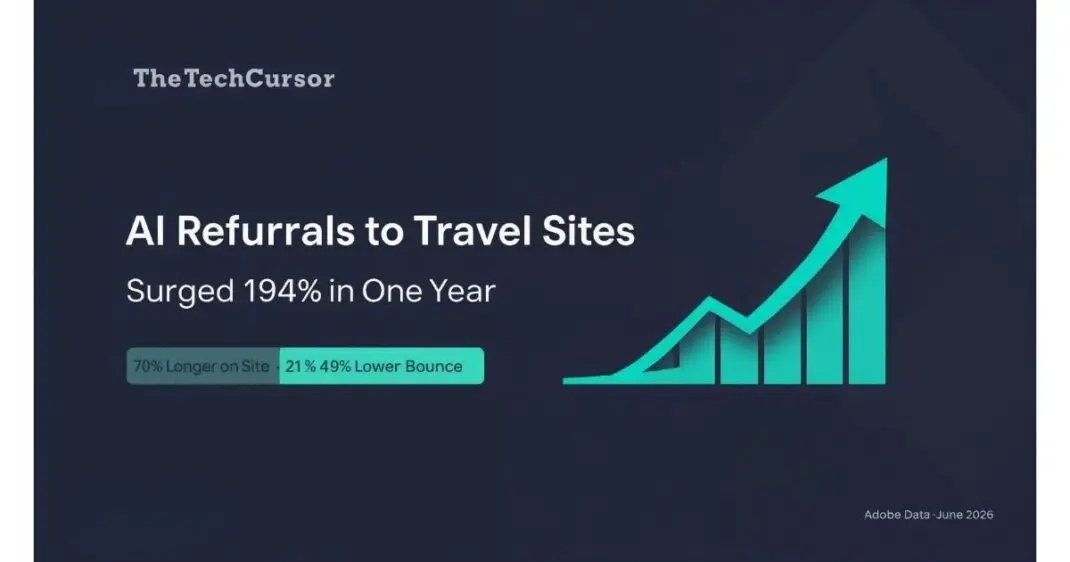
New data from Adobe, based on more than 8 million visits to U.S. travel sites and over 1 trillion visits to U.S. retail sites, reveals that visitors arriving from AI sources — ChatGPT, Google AI Mode, Perplexity, and others — are spending significantly more time on site, bouncing far less, and in retail, now converting at dramatically higher rates than non-AI visitors.
Here are the numbers, what they mean, and what your website needs to do to capture this growing channel.
The Traffic Growth Numbers
The scale of AI referral growth is striking across both sectors:
| Sector | YoY Growth (May 2026) | Growth Since Oct 2024 |
|---|---|---|
| Travel sites | +194% | +2,215% |
| Retail sites | +138% | +1,324% |
Travel AI referrals nearly tripled in a single year. Retail AI referrals hit a record high in May 2026. These are not gradual shifts — they represent a rapid acceleration in how consumers are using AI tools as their primary research and discovery channel before making purchase decisions.
AI Visitors Are More Engaged — By a Wide Margin
Beyond raw traffic volume, the quality of AI-referred visitors is what makes this data genuinely significant. Adobe’s analysis found that AI-referred travel visitors showed substantially stronger engagement than visitors from traditional sources:
- 21% more engaged than non-AI visitors
- 70% longer average time spent per visit
- 41% lower bounce rates
Adobe’s interpretation: these engagement patterns suggest more purposeful, high-intent behavior. Users who arrive via AI referral have typically already gone through a research and filtering process within the AI tool before clicking through. Consequently, when they arrive on a website, they are further along in their decision-making journey — more focused, more motivated, and more likely to engage meaningfully with the content they find.
The Conversion Gap Is Narrowing — Fast
One important nuance in Adobe’s data: AI-referred travel visitors still converted at rates 28% lower than non-AI traffic as of May 2026. However, that gap has narrowed by nearly 70% since October 2024 — meaning AI-referred travel visitors are becoming commercially valuable at an accelerating pace.
Furthermore, in retail, the story is even more advanced. AI-referred retail visitors now convert 54% better than non-AI traffic — a complete reversal from last year, when AI conversion rates were nearly half as high as those of traditional search visitors.
The retail conversion reversal is particularly significant. It demonstrates that AI referrals are not permanently lower-converting by nature — they can and do surpass traditional search traffic as the user behavior around AI research matures.
AI Readability: Is Your Website Actually Visible to AI Systems?
Adobe also measured something most marketers have not yet thought about: how readable travel websites actually are to large language models. Using its AI Content Visibility Checker, Adobe scored how much page content AI systems can successfully parse and use.
The results reveal a significant visibility gap across the travel sector:
| Page Type | AI Readability Score |
|---|---|
| Hotel product pages | 73% |
| Car rental product pages | 71% |
| Hotel homepages | 63% |
| Car rental homepages | 59% |
Even among leading travel sites, more than one-third of content remained unreadable to AI systems. This means that even on well-maintained, high-traffic travel websites, a substantial portion of content is effectively invisible to the AI tools now driving nearly 200% year-over-year traffic growth.
Which Travel Sectors Score Best — And Worst
Adobe’s readability analysis broke down performance by travel sector across different page types:
Leading sectors by page type:
- Hotels led across destination guides, activities pages, search results, customer service, and promotions
- Car rentals led to FAQ pages
- Cruises led blog and news content
- Airlines trailed the leading travel sectors across every single page type that Adobe measured
The pattern that emerged was clear: pages with rich, structured, detailed information scored highest. Property details, amenity descriptions, vehicle specifications, and core offering descriptions gave AI systems more parseable content to work with. Generic, image-heavy, or JavaScript-rendered content with limited structured text consistently scored lower.
What Makes Content AI-Readable
The readability findings point to a practical content strategy insight. AI systems can only recommend and cite content they can actually read and understand. Several factors consistently reduce AI readability:
Content blocked or buried in JavaScript rendering. AI crawlers handle JavaScript less reliably than HTML. Content that only appears after JavaScript execution — product details, pricing, availability — may be partially or fully invisible to AI systems.
Image-heavy pages with limited text. Visual content without descriptive alt text, captions, or accompanying structured text gives AI systems very little to work with.
Unstructured information. Information presented in tables, bulleted lists, clear headings, and well-labeled sections is significantly more parseable than equivalent information buried in dense prose or presented as visual graphics.
Missing or incomplete structured data. Schema markup helps AI systems understand what type of content a page contains and what specific details — prices, availability, specifications — mean in context.
What This Means for Your Website
Adobe’s data makes a compelling case that AI referral traffic is transitioning from an experimental channel to a commercially significant one — particularly in retail, where AI-referred visitors now convert better than traditional search visitors.
For businesses in travel, retail, or any category where consumer research typically precedes purchase, these findings have direct strategic implications:
Audit your AI content readability. If more than a third of your content is unreadable to AI systems, you are invisible to a channel growing at 194% annually. Identify what is blocked or inaccessible and fix it.
Prioritize structured, text-rich product and service pages. The pages that scored highest for AI readability shared one characteristic: rich, detailed, structured information about specific offerings. Amenity lists, specification tables, detailed descriptions, and FAQ sections all help AI systems understand and recommend your content.
Invest in content that supports the full research journey. AI-referred visitors have already done initial filtering before arriving on your site. Content that helps them complete their research — comparisons, detailed specifications, clear pricing, availability information — aligns with where these visitors are in their decision journey.
Track AI referral traffic separately. Most analytics setups do not clearly distinguish AI referral traffic from other sources. Setting up proper tracking for ChatGPT, Perplexity, Google AI Mode, and other AI referral sources is now a basic measurement requirement, not an optional enhancement.
Do not wait for conversion parity to invest. Retail AI referral traffic already converts better than traditional search. Travel is closing that gap rapidly. The brands investing in AI visibility now are building advantages that will compound as this channel continues to scale.
The Connection to Adobe Brand Visibility
This data was released alongside Adobe’s launch of Adobe Brand Visibility — the company’s new GEO platform combining Adobe LLM Optimizer with Semrush’s AI Optimization tool, covered in our previous article. The AI Content Visibility Checker referenced in this report is one component of that broader platform.
Together, these tools represent Adobe’s bet that AI search visibility measurement is becoming as fundamental to digital marketing as traditional SEO tracking has been for the past two decades — and that the data infrastructure to support it needs to exist at enterprise scale.
Bottom Line
AI referral traffic is growing at triple-digit rates, arriving with higher engagement, and in retail already converting better than traditional search visitors. Meanwhile, more than one-third of content on leading travel websites remains invisible to AI systems.
The opportunity and the gap exist simultaneously. Brands that close the readability gap and optimize their content for AI visibility will capture a disproportionate share of a channel that is growing faster than any other in digital marketing right now.