
Published: June 20, 2026
Read time: 8 min
Most website owners focus on creating more content to improve their search visibility. However, in 2026’s AI-driven search environment, the opposite move — removing, redirecting, or consolidating existing content — is often what actually improves AI visibility most effectively.
Content pruning is not a new SEO technique. However, AI search has changed how it works, what to prioritize, and why it matters more than ever. Here is a complete, step-by-step guide to pruning your content specifically for AI search visibility.
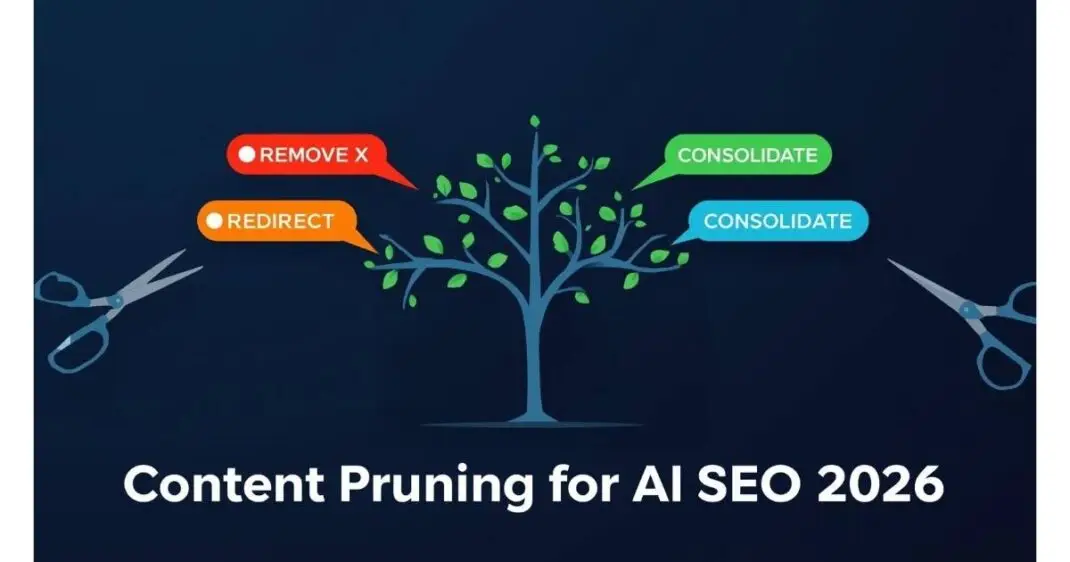
Why Content Pruning Still Matters in the AI Era
A reasonable question: if AI search engines are now sophisticated enough to understand comprehensive content and extract useful summaries, why not simply keep everything and let AI find the valuable parts?
The short answer is that more pages do not mean more authority. In fact, for AI search systems, a website cluttered with thin, outdated, or overlapping content sends weaker topical authority signals than a leaner site with fewer, more comprehensive pages covering the same ground.
Additionally, AI search has reinforced the shift from keyword-based content to topic-based content in three specific ways:
Lower keyword importance. Large language models understand semantic relationships between concepts far better than traditional search algorithms. This reduces the need to target specific keyword phrases and increases the value of genuinely comprehensive topic coverage.
Fan-out queries. When an AI system processes a user’s question, it typically generates multiple related sub-queries simultaneously. These fan-out queries can pull relevant information from deep within a single well-structured page — meaning comprehensive pages often outperform multiple thin pages covering the same topic in fragments.
Multiple citations. AI-generated responses can cite several sources for different facts within a single answer. Content buried deep in search results now has real opportunities to appear as a citation — but only if it is genuinely useful and well-organized.
The Key Benefits of Pruning for AI Visibility
Removing or consolidating content delivers several concrete advantages in the AI search era:
Consolidated topical authority. Combining related content into single, comprehensive pages concentrates your authority signals in one place — making it easier for AI systems to recognize your expertise on a topic rather than distributing thin signals across multiple weak pages.
Reduced cannibalization. Multiple pages competing for the same topic confuse both AI systems and human visitors about which page is the authoritative resource. Consolidation resolves this ambiguity.
Improved crawl efficiency. Fewer URLs means AI crawlers spend more of their crawl budget on pages that actually matter, increasing the likelihood that your best content gets indexed and surfaced.
Eliminated content decay. All websites accumulate outdated, inaccurate, or no-longer-relevant content over time. Pruning removes this dead weight before it dilutes your site’s overall quality signals.
Preserved backlink authority. Redirecting pruned pages to relevant consolidated pages transfers their link authority rather than discarding it.
Step 1: Inventory Your Content
Before making any pruning decisions, you need a complete picture of every URL on your site — including orphaned pages that have no internal links pointing to them.
Several approaches work well in combination:
- SEO crawl tools like Screaming Frog or Semrush Site Audit navigate your internal link structure and export a complete URL list
- Google Search Console exports a list of indexed pages
- Google Analytics 4 shows pages that actually receive traffic
- Your sitemap provides a structured list of intended public pages
- CMS export — WordPress and most major CMS platforms can export URL lists directly
Using multiple methods together is recommended, as each approach has potential gaps. After gathering URLs, clean the list by removing tracking parameters (UTM codes, session IDs), combining duplicate versions (HTTP vs HTTPS, trailing slash variations), and removing any gated or login-protected pages.
Step 2: Identify Pruning Targets With the Right Metrics
Data should drive pruning decisions — not guesswork. When pruning specifically for AI search visibility, filter your metrics against AI referral traffic where possible, alongside overall traffic data.
Referral metrics to examine:
- AI citations — which pages are AI systems actually crawling, indexing, and linking to in generated responses?
- Number of referral sources — pages receiving traffic from multiple AI tools (Google AI Overviews, ChatGPT, Perplexity, Claude) demonstrate broad topical relevance; pages with only one AI referral source may be consolidation candidates
- Topical relevance — does each page align clearly with your core business expertise and audience?
- Backlinks — pages still earning diverse backlinks are generally worth keeping
Engagement metrics to examine:
- Click-through rate from AI citations — pages cited but rarely clicked may need content improvements
- Conversions — pages driving goal completions, especially from AI traffic, are high-value assets
- Average engagement time — short engagement after AI referral suggests the page is not delivering what users expected
- Engaged sessions in GA4 — visits of at least 10 seconds, multi-page sessions, or conversions
Step 3: Decide — Remove, Redirect, or Consolidate
For each identified target page, work through this decision process:
Does the page meet your AI visibility metric thresholds? Yes → Keep as is. No → Continue to the next question.
Does the content overlap with or cannibalize other pages? Yes → Merge content into the strongest-performing page on that topic. Set a 301 redirect from the merged page to the consolidated destination. No → Continue.
Does the page have a strong backlink profile or authority signals? Yes → Redirect it to the most topically relevant page to preserve that authority. No → Continue.
Is the page required for any other reason — legal disclosures, policies, etc.? Yes → Noindex the page and keep it published. No → Remove the page and return a 410 Gone status (preferred over 404).
Summary of HTTP status codes to use:
| Action | HTTP Code |
|---|---|
| Keep page | 200 OK |
| Merge into another page | 301 Redirect |
| Delete with strong backlinks | 301 Redirect to the closest topic |
| Delete with no backlink value | 410 Gone |
| Keep but hide from search | Noindex tag |
Step 4: Post-Pruning Actions — Do Not Skip These
After completing your removals, redirects, and consolidations, four specific follow-up steps ensure your pruning work actually delivers its full benefit:
Update dates. For any pages where you have merged in new content, update the published or modified date. This signals to AI crawlers that the content has changed and should be reindexed — important for getting updated, consolidated pages surfaced in AI search results promptly.
Update structured data. Ensure that schema markup on consolidated pages accurately reflects all the content that has been merged in. Outdated or incomplete structured data limits how well AI systems can interpret and cite the page.
Fix internal links. Redirects handle external backlinks pointing to pruned pages — but internal links on your own site should be updated to point directly to the new consolidated pages rather than relying on redirect chains. Update or remove any internal links pointing to pruned URLs.
Review canonical tags. Ensure canonical tags on retained pages are not pointing toward any URLs that have been pruned. Canonical errors after a pruning project are a common but easily overlooked issue.
Step 5: Monitor Your AI Visibility Results
Content pruning without measurement is incomplete. After implementing changes, track these specific outcomes to evaluate whether your pruning decisions improved AI visibility:
- Changes in AI citation frequency for consolidated pages
- Changes in AI referral traffic from Google AI Overviews, ChatGPT, Perplexity, and other AI sources
- Organic traffic trends for retained and consolidated pages
- Crawl coverage improvements in Google Search Console
AI visibility tools that track brand mentions across AI search engines can provide the clearest picture of how consolidation has affected your presence in AI-generated responses.
A Real-World Case Study: 20% Traffic Improvement
One concrete example from SEO consultant Jeanne Grunert illustrates the results this approach can deliver. Working with a home and garden site that was over a decade old, Grunert’s team decided to prune rather than add content — focusing the site tightly on its core topic area of growing food and removing everything outside that focus.
The results were notable: a rise in ChatGPT snippet captures, a 20% improvement in traffic over seasonal trends, and a significantly easier-to-maintain site for ongoing AI search optimization.
This outcome reflects a broader pattern: a leaner, more focused content footprint consistently outperforms a sprawling, unfocused one in AI search — particularly for topical authority signals.
Content Pruning and the AI Search Era — The Bigger Picture
Content pruning in 2026 connects directly to the broader shifts in how AI search evaluates websites. Google’s May 2026 Core Update specifically targeted sites with thin, self-promotional, and low-value content — accelerating visibility declines for sites that had been accumulating weak pages rather than consolidating strength.
Furthermore, the research showing that AI Overviews favour third-party-cited, authoritative content over brand-controlled thin pages reinforces the same principle: quality and topical depth consistently outperform quantity and breadth in the AI search era.
A regular content pruning process — even quarterly — keeps your site’s topical signals clean, your crawl budget focused on what matters, and your content footprint aligned with how AI search systems actually evaluate authority.
Pingback: 12 Technical SEO Audit Mistakes That Are Wasting Your Developer Time — And What to Do Instead - The Tech Cursor
Pingback: What Makes a Good Listicle? New Research on 3,000 Pages Reveals the Signals That Actually Matter - The Tech Cursor