
Published: June 20, 2026
Read time: 6 min
Between October 2024 and May 2026, AI traffic to U.S. retail websites grew by 1,324%. In the travel sector, that number was even more dramatic — 2,215% over the same period.
These are not marginal shifts. They represent a fundamental change in how consumers find, research, and choose products and services online. And until now, most brands have had no reliable way to measure whether they are winning or losing in this new traffic channel.
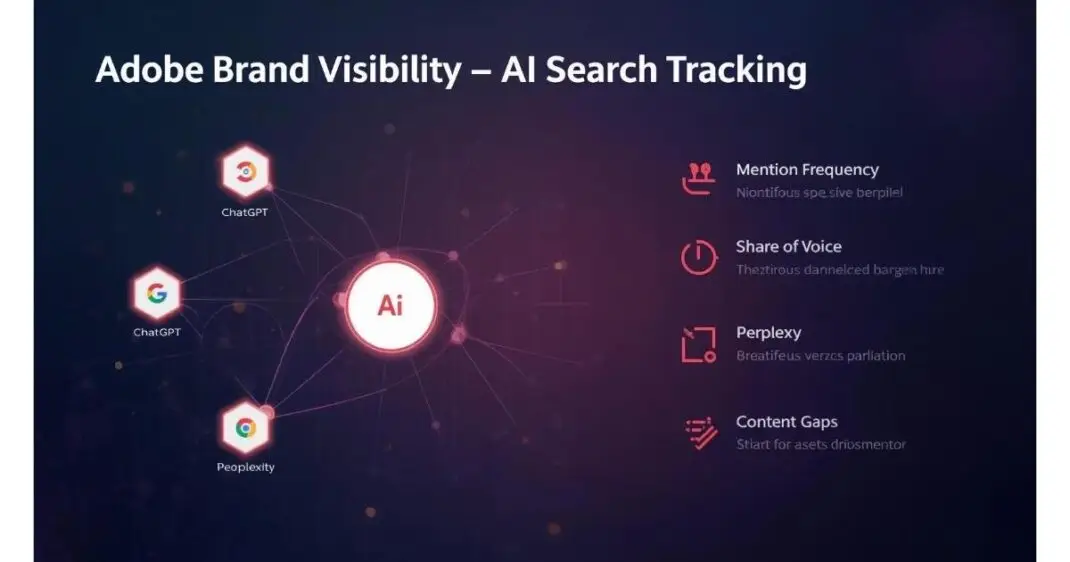
Adobe just changed that. On June 18, 2026, the company announced Adobe Brand Visibility — its first Generative Engine Optimization (GEO) product, built on nearly 300 million real-world AI search prompts and powered by Semrush data. Here is what it does, why it matters, and what the underlying data tells us about the AI search moment we are in.
The Problem Adobe Is Solving
As AI search engines — ChatGPT, Google AI Mode, Microsoft Copilot, Perplexity — become primary research tools for consumers, brand visibility has become increasingly difficult to measure and manage.
Traditional SEO tools track keyword rankings and organic search positions. However, AI search does not work like that. Instead of returning a list of ranked blue links, AI systems generate direct answers — citing some brands, ignoring others, and making recommendation decisions that are opaque to the brands involved.
As Adobe VP of Strategy and Product Loni Stark explained: “We used to get back the same thing — a SERP page with links on it. Now, the answers appear to be random, but they aren’t at scale. But companies don’t have tools to do it.”
That last sentence is the key. AI search outputs are not actually random — they reflect systematic patterns in how AI systems evaluate brand authority, content quality, and topical relevance. However, identifying those patterns has required enormous amounts of data that most brands simply did not have access to.
What Adobe Brand Visibility Actually Does
Adobe Brand Visibility is part of Adobe CX Enterprise — Adobe’s broader agentic AI system for customer lifecycle management. The product combines two existing capabilities into one unified platform:
- Adobe LLM Optimizer — Adobe’s tool for optimizing content for large language model visibility
- Semrush AI Optimization — Semrush’s AI search visibility tracking tool, now integrated under Adobe following the May 2026 acquisition
Together, they draw on nearly 300 million real-world AI search prompts — which Adobe claims is the largest global database of its kind for AI search behaviour. Combined with Adobe’s own first-party signals from owned channels, this gives marketers a direct view into how their brands appear across the four major AI search surfaces:
- ChatGPT
- Google AI Mode
- Microsoft Copilot
- Perplexity
What Metrics the Platform Tracks
Adobe Brand Visibility measures four core dimensions of AI search presence:
| Metric | What It Shows |
|---|---|
| Mention frequency | How often does your brand appear in AI-generated responses |
| Audience reach | How many users are seeing AI responses that mention your brand |
| Competitive share of voice | How your AI visibility compares to competitors in your category |
| Content gaps | Where your brand should be appearing but isn’t — and why |
Beyond tracking, the platform uses AI agents to surface prioritized recommendations — specific actions teams can take to close visibility gaps — and measures the direct impact of those changes within the platform itself.
The Competitive Intelligence Layer
One of the most practically useful elements of Adobe Brand Visibility is its competitive analysis capability. Marketers can benchmark their AI search presence against specific competitors, identifying:
- Where competitor brands are being cited in AI responses
- Which prompts and topics trigger competitor recommendations over theirs
- How brand mention trends have changed over time
- Where content investments are most likely to close competitive gaps
This fills a significant intelligence gap that has existed since AI search began scaling. Most brands currently have no systematic way to know whether a competitor is being recommended by ChatGPT more frequently or which specific topic areas are driving that advantage.
The Semrush Data Foundation
The platform’s SEO intelligence layer is powered by Semrush data — and the scale of that dataset is worth noting: 28.5 billion keywords and 43 trillion backlinks collected over 17 years.
This is significant because it directly addresses one of the most important findings from recent AI search research: traditional SEO authority signals — specifically backlink profiles and topical authority — remain strong predictors of AI search citation patterns. A site’s existing search authority should be generating AI citations for the topics it covers authoritatively — and identifying gaps between where authority exists and where AI citations are missing is one of the most actionable things a marketer can do right now.
Adobe Brand Visibility maps exactly this gap: where your existing SEO authority should be producing AI visibility but is not — and what content investments would close those gaps across both traditional search and AI channels simultaneously.
Why These Traffic Numbers Matter
The growth statistics Adobe released alongside the product announcement deserve to stand on their own for a moment.
1,324% growth in AI traffic to retail sites over 19 months. 2,215% in travel. These are not the numbers of a gradual, manageable channel shift. They represent an explosive acceleration in how a significant and growing segment of consumers is using AI systems as their primary product research and discovery tool.
For brands that are not actively tracking their AI search presence, these numbers represent a growing blind spot in their marketing visibility data. Traffic that was previously captured through tracked organic search is increasingly arriving through AI-mediated channels — often without clear source attribution in analytics tools.
Furthermore, brands that are cited positively in AI responses are likely capturing a disproportionate share of this growing channel, while brands that are absent or negatively represented are losing ground without necessarily seeing clear signals of it in their existing dashboards.
How This Fits Into the Broader AI Visibility Picture
Adobe Brand Visibility arrives at a moment when the SEO and digital marketing industries are actively building the measurement infrastructure needed to compete in AI search. Several patterns from recent research inform why this tool matters now:
Citation does not equal recommendation. As documented in research covered here at TheTechCursor, being cited as a source in an AI Overview is different from being recommended as the answer. Brand Visibility’s distinction between mention frequency and share of voice reflects this important nuance.
Third-party authority drives AI recommendations. Brands widely mentioned across independent sources consistently win recommendation slots in AI search. The competitive share of voice metric directly measures this dynamic.
Content gaps are the actionable lever. Knowing that you have authority on a topic but are not being cited for it points to a specific, fixable problem — either content structure, depth, or format is preventing your authoritative content from being surfaced. Adobe Brand Visibility specifically tracks this gap.
Who Should Be Using This
Adobe Brand Visibility is positioned for enterprise brands and larger marketing teams — particularly those in retail, travel, and other consumer categories where AI traffic growth has been most dramatic. However, the underlying measurement need applies to virtually any brand that depends on search visibility for customer acquisition.
At minimum, every marketing team should now be tracking where their brand appears in AI search responses across the major platforms — ChatGPT, Google AI Mode, Copilot, and Perplexity — and benchmarking that presence against competitors.
Whether through Adobe Brand Visibility or other AI visibility tools entering the market, the brands that build this measurement capability earliest will have the clearest picture of where the next wave of search traffic is going — and how to capture their share of it.
Bottom Line
Adobe Brand Visibility addresses a genuine and growing gap in marketing measurement. As AI traffic scales at triple-digit annual growth rates across major consumer categories, the brands that can systematically track, benchmark, and optimize their AI search presence will have a significant and compounding advantage over those still measuring only traditional SEO metrics.
The platform’s combination of 300 million real-world AI prompts, Semrush’s 17-year SEO dataset, and cross-platform tracking across the four major AI search engines makes it one of the most comprehensive AI visibility tools announced to date.