
Published: June 20, 2026
Read time: 6 min
When Google launched its AI performance reporting in Search Console in June 2026, the SEO community celebrated — finally, data on how content performs in AI Overviews and AI Mode. However, there was a quiet irony in that moment: Microsoft had already been providing AI performance data in Bing Webmaster Tools since February — four months earlier.
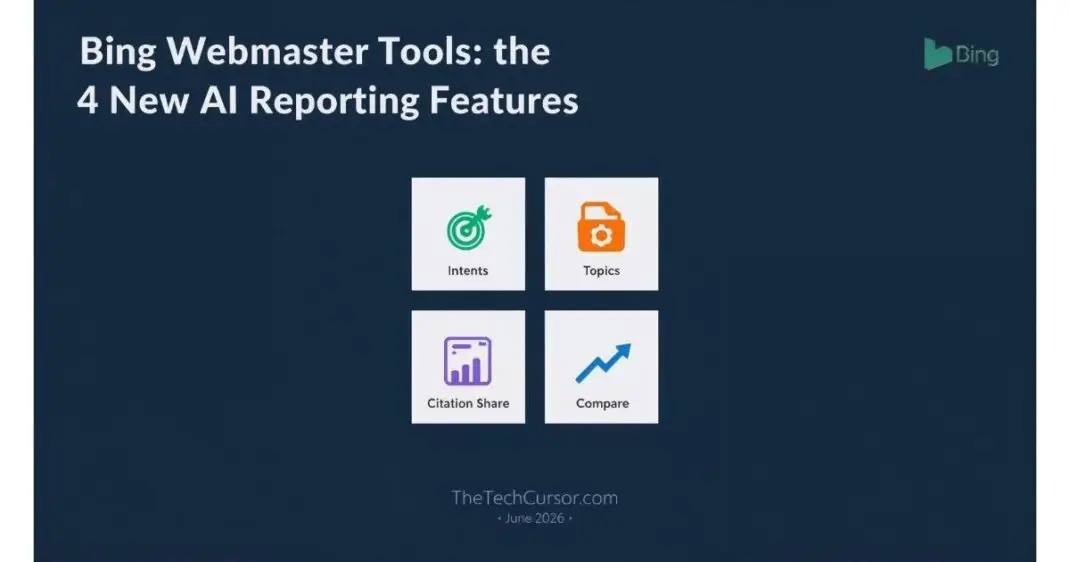
Now, Microsoft is making that advantage even clearer. On June 16, 2026, Bing Webmaster Tools began rolling out a significant preview update to its AI performance report — adding four new capabilities: Intents, Topics, Citation Share, and Compare.
Here is what each feature does, why it matters, and what it means for your AI search visibility strategy.
The Context: Microsoft vs Google on AI Reporting
Before diving into the features, the competitive timeline is worth understanding:
| Platform | AI Performance Reporting Launch |
|---|---|
| Bing Webmaster Tools | February 2026 |
| Google Search Console | June 2026 |
| Bing Webmaster Tools v2 (Intents, Topics, Citation Share, Compare) | June 16, 2026 |
Microsoft launched AI search performance reporting four months before Google. Furthermore, just as Google was launching its basic AI reporting, Microsoft was already expanding its reporting with four additional sophisticated features.
This is a meaningful reversal from the traditional dynamic where Google led and Microsoft followed. In AI search transparency tools, Microsoft is currently setting the pace.
Feature 1: Intents — Understanding Why Your Content Is Being Surfaced
The new Intents feature classifies the grounding queries in the AI Performance Report into broader intent categories. These include:
- Informational
- Commercial
- Navigational
- Learn and Solve
- Research
- Creation
- Local
- And more
Why this matters: Previously, Bing’s AI Performance Report showed which queries triggered citations of your content — but not the context or purpose behind those queries. Intents add that critical layer of meaning.
For example, an e-commerce publisher might discover that their content is being cited primarily in comparison-oriented or shopping-focused AI interactions — a Commercial intent signal. An educational publisher, by contrast, might find their content frequently surfaced in Research or Learn and Solve interactions.
This helps publishers align content structure and depth with the actual types of AI experiences where their content is already performing — and identify intent categories where they are underrepresented despite having relevant content.
Feature 2: Topics — Thematic Clusters That Mirror How AI Thinks
The Topics feature groups related grounding queries into broader thematic clusters — organizing your AI visibility data the way AI systems themselves organize information, rather than around isolated keywords.
How it works: Rather than showing you that you received citations for “solar panels,” “solar energy efficiency,” and “residential solar installation” as three separate data points, Topics groups all three under a single thematic cluster: Solar Energy.
Microsoft explains the reasoning clearly: AI systems reason across concepts and themes rather than isolated keywords. Topics help publishers understand their visibility in the same thematic structure that modern AI systems use to organize information.
Why this matters for content strategy: Content teams and editorial teams naturally think in terms of themes, topics, and audience interests — not keyword lists. Topics bridge the gap between how publishers think about their content and how AI systems actually evaluate and surface it.
One important note from Microsoft: during the preview phase, some topic labels may still be broad — particularly for highly specialized or niche domains. However, the system is already revealing meaningful thematic patterns that were previously invisible in keyword-level reporting.
Feature 3: Citation Share — How Much of the Visibility Space Do You Own?
Citation Share is perhaps the most strategically significant new feature. It measures how much of the citation space your site receives for a specific grounding query — calculated as the percentage of citations attributed to your site out of all citations shown across all sites for that same query.
What this tells you: Not just whether you were cited, but how much visibility you received within the full set of cited sources for that query. A site cited once out of ten citations for a query has a very different position than a site cited eight times out of ten.
Microsoft is careful to frame Citation Share as an observational metric rather than a competitive scoreboard. It does not expose competitor domains, does not represent traffic share, and does not assign quality scores to content. Furthermore, citation patterns are inherently dynamic — they shift due to changes in user behaviour, evolving AI models, freshness signals, and broader web changes.
However, used correctly, Citation Share provides a directional view of where your content has strong and growing representation in AI-generated experiences — and where visibility is more fragmented across many sources, signalling an opportunity to strengthen topical authority.
Feature 4: Compare — Track How Your AI Visibility Changes Over Time
The Compare feature allows you to overlay a previous time period directly onto the current reporting view — enabling direct before-and-after comparisons of citation activity, intent patterns, and topic visibility.
Why this matters practically: AI citation activity is influenced by many factors — evolving AI models, competing content, freshness signals, partner refresh cycles, and shifts in user demand. Without a comparison tool, understanding whether changes in your AI visibility are improvements, declines, or simply natural fluctuations is extremely difficult.
Compare gives publishers the ability to observe how citation patterns evolve specifically in response to content changes, making it genuinely possible to measure the impact of AI search optimization efforts over time.
What Is Still Missing — And What to Watch For
Microsoft is transparent about what these reports do not yet provide. Click data and click-through rates for AI citations are missing from both Bing Webmaster Tools and Google Search Console.
This is a significant gap. Citation data tells you whether your content appeared in an AI response. It does not tell you how many users saw that citation, clicked through to your site, or converted. Until click data arrives, AI performance reporting gives publishers visibility into presence — but not yet into the full commercial impact of that presence.
Microsoft’s Krishna Madhavan noted that the team is continuing to build on this foundation. Given the pace of additions — from basic citation data in February to four new features in June — further improvements are likely in the coming months.
How to Use These Features in Your SEO Strategy
For SEO professionals and digital marketers now thinking about AI search visibility, these four features enable several specific strategic actions:
Use Intents to identify content gaps. If your content is heavily cited in Informational intent but barely cited in Commercial intent — despite having product pages — that signals your commercial content needs restructuring to better match how AI systems surface buying-intent queries.
Use Topics to audit your thematic coverage. Are there topic clusters where you have relevant content but low citation visibility? Topic data helps identify where content depth or quality improvements could close that gap.
Use Citation Share to prioritize. Focus improvement efforts on queries where you already appear but with low citation share — these are areas where you have established relevance but have not yet earned dominant citation presence.
Use Compare to measure impact. After making content changes — improving depth, adding structured data, consolidating thin pages — use Compare to track whether citation patterns actually changed in the weeks following those updates.
Bottom Line
Bing Webmaster Tools’ new AI reporting features — Intents, Topics, Citation Share, and Compare — represent a meaningful step forward in giving publishers actionable data about their AI search visibility. Microsoft is currently leading Google in the depth and sophistication of AI search reporting tools available to publishers.
For SEO professionals, the practical implication is clear: Bing Webmaster Tools is now worth setting up and monitoring regularly — not just as a secondary search console, but as a genuinely useful source of AI visibility intelligence that can inform content strategy across all AI search platforms.