
Read time: 7 min
Table of Contents
- What Is R4T-Diffusion?
- Why Query Fan-Out Matters for AI Search
- How R4T-Diffusion Works — Plain English
- The Three Pillars of R4T Training
- The Latency Breakthrough — 12 to 20x Faster
- What Distillation Means and Why It Matters
- Beyond Search — Discover, YouTube, and Creative Tasks
- Has Google Deployed R4T-Diffusion?
- What This Means for SEO
- Bottom Line
Google announced a new query fan-out framework called R4T-Diffusion — Retrieve-for-Train Diffusion Model. The system is faster, cheaper, and produces higher-quality query fan-outs than previous approaches. Furthermore, Google says it delivers “production-ready” search at scale.
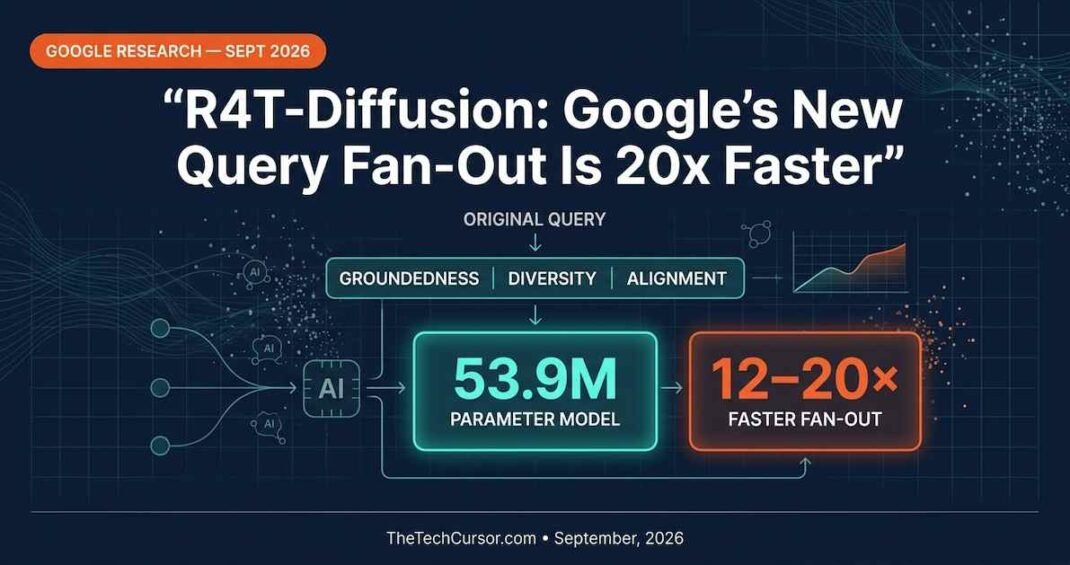
The announcement matters for SEO professionals because query fan-out is the mechanism behind how AI search systems understand what you are really asking. A faster, better query fan-out system means AI search can handle more complex, conversational queries more effectively — which directly affects which content gets retrieved and cited.
1. What Is R4T-Diffusion?
R4T-Diffusion stands for Retrieve-for-Train Diffusion Model. It is a three-stage framework that combines reinforcement learning training, synthetic data generation, and a small generative neural network.
(cite index=”9-1″>The new system is a three-stage setup that combines reinforcement learning (RL) training, synthetic data generation, and a small generative neural network — a 53.9M-parameter diffusion model.</cite>
The core approach is elegant in its simplicity. First, Google trained a large, expensive model to produce excellent query fan-outs. Then it saved examples of those high-quality outputs. Finally, it trained a significantly smaller model to replicate the behaviour of the larger one. The small model learns to do what the large model does — but much faster and at lower cost.
2. Why Query Fan-Out Matters for AI Search
To understand why R4T-Diffusion matters, it helps to understand what query fan-out actually does in AI search.
When a user submits a query like “best running shoes for overpronators who also hike on weekends,” a traditional search engine would match keywords and return results. An AI search system does something different. It expands the original query into multiple related sub-queries — the fan-out — and retrieves content that addresses each dimension of what the user is really asking.
The query fan-out guide explains how this process creates sub-queries that individually have zero search volume but collectively address the full intent behind a complex search. Furthermore, research has shown that approximately 95% of these sub-queries have no individual search volume — making them completely invisible to traditional keyword research tools.
A better query fan-out system means AI search can generate more diverse, relevant sub-queries faster. Consequently, it can retrieve and synthesize better answers from more sources. This directly affects which content gets cited in AI Overviews and AI Mode responses.
3. How R4T-Diffusion Works — Plain English
The technical architecture of R4T-Diffusion can be summarized in three steps.
Step 1: Train a large model to do excellent fan-outs. Google first trained a large, computationally expensive model using reinforcement learning to generate high-quality query fan-outs. This model knows how to expand a query into relevant, diverse sub-queries that actually retrieve useful content.
Step 2: Collect the best examples. The system collects examples of the best query fan-outs the large model generates. These examples become training data for the next step.
Step 3: Distil the behaviour into a small, fast model. The examples from Step 2 are used to train a much smaller model — 53.9 million parameters — to replicate what the large model does. The small model learns from the large model’s best outputs rather than learning from scratch. Consequently, it achieves similar quality at a fraction of the computational cost.
This is the essence of the technique called distillation — transferring knowledge from a large model to a small one.
4. The Three Pillars of R4T Training
The reinforcement learning training in Step 1 optimizes the model against three competing objectives simultaneously.
(cite index=”9-1″>” For our open-ended abstract retrieval tasks, this composite reward is a weighted balance of three competing pillars: Groundedness — penalizes distance to the database manifold, ensuring every generated sub-query corresponds to a real, retrievable item in the database. Diversity — measured using the Vendi Score over the entire set of sub-queries, forcing the model to explore broad semantic breadth. Alignment — anchors candidate sub-queries to the original broad prompt to prevent semantic drift.”</cite>
In plain terms:
Groundedness ensures sub-queries are not hallucinated — they correspond to content that actually exists in Google’s index. This prevents the fan-out system from generating irrelevant or nonsensical sub-queries that waste retrieval resources.
Diversity ensures the sub-queries genuinely explore different aspects of the original query. Without this pillar, a fan-out system might generate many similar synonyms rather than substantively different angles on the original question.
Alignment ensures sub-queries stay connected to what the user originally asked. Without this constraint, the system might drift into related topics that are interesting but not what the user wanted.
5. The Latency Breakthrough — 12 to 20x Faster
The most dramatic headline from R4T-Diffusion is its speed improvement.
(cite index=”9-1″>” By distilling that learned behaviour into the 53.9M-parameter Retrieve-for-Train diffusion model, we successfully smashed the latency bottleneck. Because the diffusion model generates all target directions simultaneously in a single, non-autoregressive parallel pass in continuous embedding space, it delivers a massive 12 to 20 speedup over autoregressive approaches. At scale, while autoregressive fan-out latency expands linearly to nearly 50 seconds under large context batches, Retrieve-for-Train-Diffusion stays between sub-second and a few seconds, delivering production-ready, expert-level search at a fraction of the computational cost.”</cite>
The comparison is stark. Traditional autoregressive approaches — where the model generates one sub-query at a time sequentially — can take up to 50 seconds at scale. R4T-Diffusion generates all sub-queries simultaneously in a single parallel pass. The result is sub-second to a few seconds at the same scale.
This is not a marginal improvement. It is a fundamental architectural change that makes quality query fan-out economically viable at production scale. Previously, generating high-quality fan-outs was simply too slow and too expensive for real-time search. R4T-Diffusion removes that constraint.
6. What Distillation Means and Why It Matters
The distillation technique at the heart of R4T-Diffusion deserves specific attention because it is increasingly central to how AI systems scale.
Neural network knowledge distillation is the process of transferring what a large, capable model has learned into a smaller, faster model. The smaller model does not learn from the original training data. Instead, it learns from the outputs of the larger model. Consequently, it inherits the larger model’s capabilities without requiring the same computational resources to operate.
For search specifically, distillation solves a fundamental tension. The models that produce the best query fan-outs are too slow and expensive for real-time search. The models that are fast enough for real-time search are not good enough to produce quality fan-outs. Distillation bridges this gap.
R4T-Diffusion’s 53.9 million-parameter model is tiny by modern AI standards. However, because it was trained on the outputs of a much larger reinforcement-learning model, it produces fan-outs of comparable quality. Furthermore, because it generates all sub-queries simultaneously in a single parallel pass rather than one at a time, it achieves its 12 to 20x speed advantage.
7. Beyond Search — Discover, YouTube, and Creative Tasks
One of the most strategically interesting aspects of R4T-Diffusion is that Google explicitly notes its applicability beyond traditional search.
(cite index=”9-1″>The research paper explains that R4T is particularly relevant for “real-world applications where fan-out retrieval is desirable but autoregressive generation is prohibitively expensive, including recommendation systems, creative search, and exploratory information access.”</cite>
Recommendation systems in this context mean Google Discover and YouTube recommendations. The same fan-out approach that expands a search query into relevant sub-queries can expand a user’s interest profile into relevant content suggestions. R4T-Diffusion could therefore improve both how Google Discover selects content for users and how YouTube recommendations work.
Furthermore, the researchers note potential applications in planning and “creative generation” — tasks that go beyond pure information retrieval. This suggests R4T-Diffusion is not just an upgrade to existing search infrastructure but a foundation for more capable AI systems across Google’s product portfolio.
8. Has Google Deployed R4T-Diffusion?
This is the question the SEO community most wants answered — and the honest answer is: probably, but not confirmed.
The Google blog post describes R4T-Diffusion as delivering “production-ready” query fan-outs. This language is specifically chosen. Production-ready means the system is capable of operating in Google’s demanding, scaled, real-world search environment — not just in a research context.
Additionally, the timing is notable. The research paper was published in March 2026. The blog post announcing it publicly appeared on September 15, 2026 — six months later. This gap suggests Google used the intervening months to test, refine, and potentially deploy the system before making a public announcement.
Furthermore, some community members have reported noticing what appears to be an unannounced Google update — increases in traffic, more links shown in AI Mode responses. These observations are not confirmed evidence of R4T-Diffusion deployment. However, they are consistent with what a better query fan-out system might produce.
The researchers themselves added a cautionary note. The system performed well for fashion and music, but they expressed concern about potential bias amplification in sensitive contexts. They recommended domain-specific bias audits before deploying in sensitive areas. This suggests deployment may have been selective — applied in contexts where bias risk is lower — rather than universally across all query types.
9. What This Means for SEO
R4T-Diffusion’s improvements to query fan-out have direct implications for SEO strategy — particularly for content that targets AI search visibility.
More diverse fan-outs benefit comprehensive content. R4T-Diffusion’s Diversity pillar ensures the system generates sub-queries that genuinely explore different aspects of a topic rather than synonyms. Content that addresses a topic comprehensively — covering multiple angles, use cases, and related questions — is better positioned to be retrieved for more of those diverse sub-queries.
The query templates and topical authority guide covers exactly this principle. Content organized around query patterns rather than individual keywords aligns naturally with how improved fan-out systems explore topic space.
Groundedness rewards indexed, retrievable content. The Groundedness pillar ensures sub-queries correspond to content that actually exists in Google’s index. This reinforces the importance of technical SEO fundamentals — content that is crawlable, indexable, and properly structured. Specifically, content that cannot be retrieved cannot be cited regardless of how relevant it is to a fan-out sub-query.
Alignment rewards topically focused content. The Alignment pillar ensures sub-queries stay connected to the original user intent. This means content that is clearly focused on a specific topic — not generically broad — is better aligned with the sub-queries R4T generates. Topically focused content with clear entity associations is more likely to be retrieved for the right sub-queries.
Faster fan-outs mean more queries processed with AI. Perhaps the most significant practical implication is scale. If R4T-Diffusion makes quality query fan-outs economically viable for many more queries, Google can extend AI Overview coverage to query types that were previously too expensive to process this way. Consequently, the percentage of searches that generate AI Overviews may increase significantly as R4T-Diffusion scales across Google’s search index.
10. Bottom Line
R4T-Diffusion represents a meaningful technical advance in how AI search systems process complex queries. A 12 to 20x speedup that makes quality query fan-out economically viable at production scale is not a minor optimization. It is a fundamental infrastructure improvement that enables better AI search responses at significantly lower cost.
What This Means Practically
For SEO professionals, the practical implication is consistent with the direction AI search has been moving. Content that comprehensively addresses topics from multiple angles, is technically accessible for crawling and indexing, and is clearly focused on specific subject areas is better positioned as query fan-out systems improve.
Furthermore, if R4T-Diffusion’s deployment increases AI Overview coverage across more query types, the strategic importance of AI search visibility grows accordingly. The GEO pillars framework and the AI visibility dashboard become more important tools as AI search expands its footprint.
The research paper was published six months before the public announcement. The blog post used production-ready language. The circumstantial evidence points toward deployment. Whether confirmed or not, the direction is clear — Google’s AI search infrastructure is getting significantly faster and more capable. Build content strategies accordingly.