
Read time: 4 min
Table of Contents
- What Google Just Announced
- The Timeline — Two Weeks to Full Rollout
- What Spam Updates Target
- The 2026 Spam Update Pattern
- What to Check If Your Site Is Affected
- What to Do If You Were Not Affected
- Bottom Line
Google released the September 2026 spam update on September 24, 2026. The update applies globally and to all languages. Google confirmed the rollout may take up to two weeks to complete.
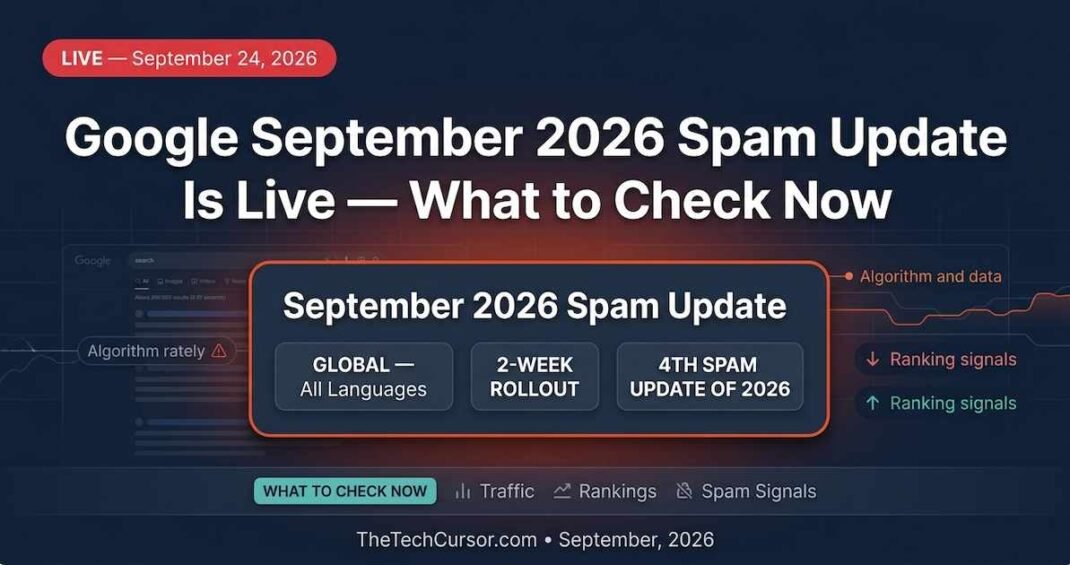
This is the fourth Google spam update announced in 2026. The previous one was the August 2026 spam update. Furthermore, if your site was not impacted by previous spam updates, that is a positive signal — but it does not guarantee safety from this one.
1. What Google Just Announced
Google posted the update announcement to its Search Status Dashboard. The official statement reads:
“Released the September 2026 spam update, which applies globally and to all languages. The rollout may take up to two weeks to complete.”
No additional detail was provided about the specific spam signals this update targets. Google rarely discloses the specific focus of spam updates. This is intentional — detailed disclosures would help spammers adapt their tactics more quickly.
However, the pattern of 2026 spam updates points toward consistent enforcement themes that are worth understanding.
2. The Timeline — Two Weeks to Full Rollout
The two-week rollout timeline is standard for Google spam updates. During this period, ranking changes from the update are gradually applied across Google’s index.
Several practical implications follow from this timeline.
First, do not panic if you see fluctuations in the first few days after an update. Initial turbulence during a rollout does not necessarily reflect your site’s outcome. Consequently, waiting until the full rollout completes before concluding your site’s performance is the right approach.
Second, do not make major site changes during a rollout. Changes made mid-rollout are difficult to assess because it becomes unclear whether ranking changes reflect the update or your modifications. Furthermore, large-scale changes during algorithm updates can amplify negative signals rather than resolve them.
Third, monitor your Search Console data daily during the rollout window. Significant drops in impressions or clicks that appear and persist — rather than fluctuating — are more likely to indicate a genuine algorithmic impact.
3. What Spam Updates Target
Google’s spam updates enforce its spam policies — the set of guidelines that define what content and site behaviours Google considers manipulative or low-quality.
The primary spam categories Google’s systems target include:
Cloaking — showing different content to Googlebot than to users. This is one of the most serious spam violations and can result in complete de-indexing rather than just ranking loss.
Scaled content abuse — producing large volumes of low-quality content primarily to occupy search rankings rather than serve users. This category has been increasingly targeted in 2026, particularly for AI-generated content deployed at scale without editorial oversight. The Google old low-value pages recovery guide covers exactly what recovery from this type of violation involves.
Link spam — manipulating PageRank through artificial link schemes. This includes purchased links, link exchanges at scale, and other patterns that do not reflect genuine editorial choices.
Sneaky redirects — redirecting users or bots to different pages than where they expected to land.
Hidden text and links — placing keyword-stuffed or link-heavy content in ways invisible to users but visible to search engine crawlers.
Site reputation abuse — a newer spam category targeting sites that host content from third parties primarily to exploit the host domain’s authority rather than to serve users.
4. The 2026 Spam Update Pattern
Four spam updates in a single calendar year is notable. It reflects Google’s increased investment in spam enforcement — and the increased sophistication of spam techniques that make more frequent updates necessary.
The August 2026 spam update completed its rollout shortly before this September update began. Sites that escaped August unaffected should not treat that as immunity from September’s update. Each spam update may target different patterns or apply existing policies more precisely.
The frequency of 2026 spam updates also reflects two broader trends. First, AI content generation tools have made it dramatically easier to produce large volumes of content quickly. Consequently, the volume of content Google needs to evaluate for spam patterns has increased. Second, link buying and manipulation schemes have continued to evolve, requiring more frequent enforcement cycles.
5. What to Check If Your Site Is Affected
If you see a significant drop in rankings or traffic following the September 2026 spam update, follow this investigation sequence.
Check Google Search Console for manual actions. Navigate to Security & Manual Actions → Manual Actions. A manual action notice here confirms that a human reviewer found a specific spam violation on your site. Manual actions require explicit remediation and reconsideration requests.
Check for algorithmic signals. If no manual action appears, the impact may be algorithmic rather than manual. Review your Google Search Console coverage report for any significant changes in indexed pages. Furthermore, check for 404 errors, crawl anomalies, or indexing issues that might indicate a technical problem unrelated to spam.
Audit your content for quality. If your site produces high volumes of content — particularly AI-assisted or programmatic content — audit the most recent additions for quality signals. Thin content, duplicate patterns, or low-information pages that may have accumulated are worth reviewing. The Google 14-point content quality checklist provides a structured framework for this audit.
Audit your backlink profile. Use Google Search Console’s Links report or a third-party tool to review your inbound link profile for unnatural patterns. Sudden spikes in links from irrelevant or low-quality sites can trigger spam signals even when you did not actively build those links.
Wait for the rollout to complete. If you see ranking fluctuations but no clear evidence of a spam violation, wait for the two-week rollout to complete before making significant changes. Not all fluctuations during a rollout indicate a lasting penalty.
6. What to Do If You Were Not Affected
If your site emerges from the September 2026 spam update without ranking or traffic changes, that is good news. However, it is worth briefly reviewing what kept your site safe — to ensure those protections remain in place.
Review your content production process. Confirm that your content production workflow includes genuine human expertise, editorial review, and quality standards that would satisfy Google’s guidelines. A workflow that is producing good results now may be at risk if quality shortcuts are introduced to increase production speed.
Review your link profile. Confirm that your inbound link profile does not contain patterns that might trigger future spam updates. Links that look manipulative — even if they were not built by you — can be addressed proactively through the Google Search Console disavow tool in extreme cases.
Stay current on spam policy updates. Google occasionally updates its spam policies documentation to clarify or expand the categories it enforces. Monitoring Google’s spam policies page directly ensures you are aware of policy changes before they are enforced in a major update.
7. Bottom Line
The September 2026 spam update is the fourth spam update Google has released this year. It applies globally, covers all languages, and will take up to two weeks to complete.
Key Actions Based on Your Situation
If your rankings dropped, check Search Console for manual actions first. Then audit your content quality and backlink profile. Wait for the full rollout before drawing conclusions or making major changes.
If your rankings held, review your content and link practices to confirm they remain within Google’s guidelines. Furthermore, stay informed about Google’s spam policy documentation for any upcoming enforcement shifts.
The best protection against spam updates remains consistent: publish content that genuinely serves users, avoid manipulative link practices, and maintain technical site health. Sites built on those foundations rarely have reason to worry about any single spam update.
Pingback: Google's SAFE AI Spam Detector: What SEOs Should Know - The Tech Cursor
Pingback: Google September 2026 Spam Update Is Done: What's Next - The Tech Cursor