
Category: Google Algorithm | SEO | Spam Update
Published: June 24, 2026
Read time: 4 min
Site: TheTechCursor
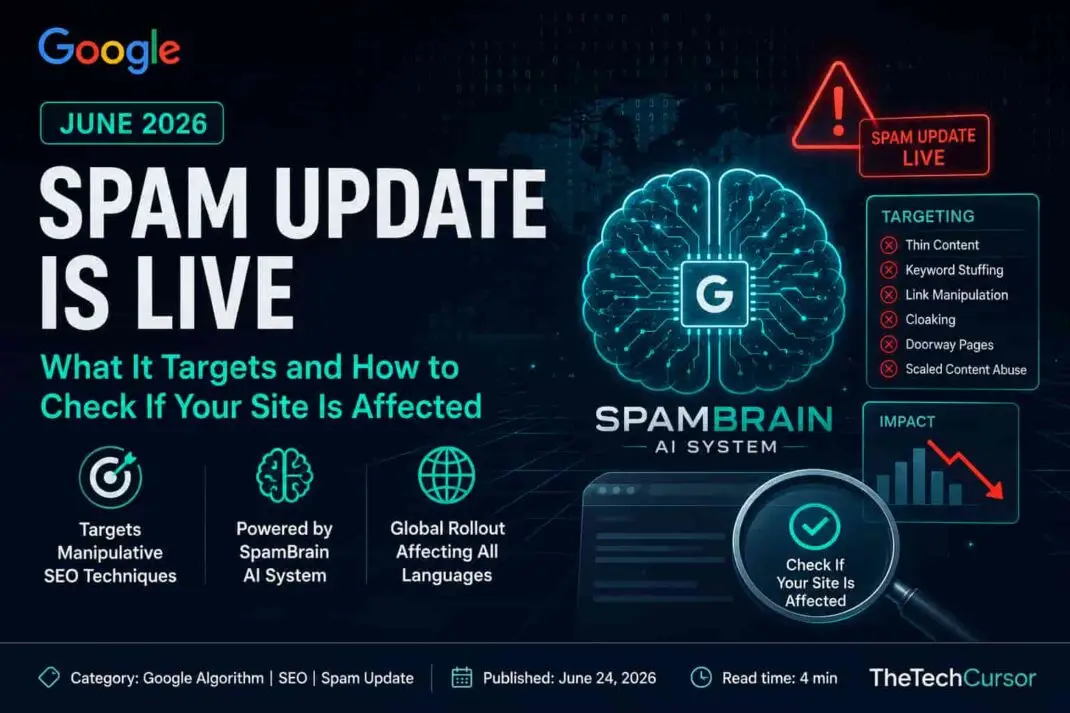
Google has released another search ranking update — and this one is moving fast. The June 2026 Spam Update went live today, June 24, 2026, at around noon ET. Unlike a core update, which can take up to two weeks to fully roll out, this spam update is expected to complete within just a few days.
Here is what it targets, who should be concerned, and exactly what to check if you see unexpected ranking changes in the coming days.
Table of Contents
- What Google Said
- 2026 Google Update Timeline
- What Spam Updates Actually Target
- Who Should Be Concerned
- What to Do If Your Rankings Drop
- The Bigger Picture — AI Search Era
- Bottom Line
What Google Said
Google’s official statement is brief and direct:
Released the June 2026 spam update, which applies globally and to all languages. The rollout may take a few days to complete.”
Global scope, all languages, fast rollout. That combination means any site using manipulative ranking techniques could see impact within days — not weeks.
2026 Google Update Timeline — Where This Fits
This spam update arrives as part of a busy year of Google algorithm activity. Here is the full 2026 update timeline so far:
| Month | Update Type |
|---|---|
| February 2026 | Google Discover Core Update |
| March 2026 | March 2026 Core Update |
| March 2026 | March 2026 Spam Update |
| May 2026 | May 2026 Core Update (completed June 2) |
| June 2026 | June 2026 Spam Update ← Live now |
TheTechCursor covered the May 2026 Core Update in detail — including who was impacted and what recovery looks like. This spam update is a separate system targeting different types of manipulation.
What Spam Updates Actually Target
Spam updates are not the same as core updates. A core update recalibrates Google’s quality signals broadly. A spam update specifically targets sites using manipulative techniques to abuse the ranking algorithm — what Google calls “search spam.”
Google’s SpamBrain — its AI-powered spam detection system — is the engine behind these updates. SpamBrain is continuously operating, but occasional significant improvements to its detection capabilities are released as named spam updates.
Common spam techniques, spam updates target:
- Link spam — buying, selling, or artificially generating backlinks to manipulate PageRank
- Cloaking — showing different content to Google than to users
- Scraped or auto-generated content — content produced purely to generate pages at scale without genuine value
- Hidden text or links — content visible to crawlers but not to users
- Keyword stuffing — unnaturally overloading content with target keywords
- Doorway pages — pages created purely to rank for specific queries and redirect users elsewhere
- AI-generated spam — low-quality, mass-produced AI content created purely for ranking manipulation
That last point is particularly relevant in 2026. As AI content generation has scaled dramatically, Google has invested significantly in SpamBrain’s ability to distinguish genuinely useful AI-assisted content from content produced purely to game rankings.
Who Should Be Concerned
Google is direct about this: if your site is not using manipulative techniques, you should not be affected. Spam updates are not quality assessments — they are enforcement actions against specific policy violations.
You should review your site carefully if:
- You have purchased or engaged in link schemes — including paying for placements or exchanging links purely for SEO benefit
- Your site has large volumes of AI-generated content produced without genuine editorial oversight or value-add
- You have used content scraping, spinning, or auto-generation at scale
- Your site relies heavily on doorway pages or thin affiliate content
You are likely unaffected if:
- Your content is genuinely created for users, not algorithms
- Your link profile consists of earned, editorial links from relevant sources
- You have not engaged in any black-hat or grey-hat SEO techniques
What to Do If Your Rankings Drop
If you see significant ranking changes in the next few days that correlate with this spam update, here is how to approach recovery:
Step 1: Check Google Search Console. Look for manual actions first — a manual penalty is separate from an algorithmic spam update but may coincide. Check the Manual Actions report in Search Console for any notifications.
Step 2: Review Google’s Spam Policies. Google’s documentation explicitly recommends that sites seeing changes after a spam update review their spam policies for compliance. Be honest in this review — not just checking whether you technically violated rules, but whether the spirit of the policies applies.
Step 3: Understand the link spam caveat. Google specifically notes that for link spam updates, making changes may not generate improvement. When Google’s systems remove the effects of spammy links, any ranking benefit those links previously provided is lost — and cannot be regained simply by removing the links. Recovery from link spam impact requires building legitimate authority over time.
Step 4: Make genuine improvements. Unlike core update recovery, which requires broad quality improvements, spam update recovery requires identifying and stopping the specific manipulative practice causing the issue. This may involve disavowing toxic links, removing thin or auto-generated content, or restructuring pages that function as doorways.
Step 5: Be patient. Google notes that improvements take time — automated systems need months to learn that a site now complies with policies. There is no quick fix for spam-related ranking drops.
The Bigger Picture — Spam Updates in an AI Search Era
This update arrives at a moment when the stakes around content quality have never been higher. As covered extensively across TheTechCursor’s AI search content series, Google’s AI systems — powering AI Overviews, AI Mode, and entity understanding — draw directly from the same index that spam updates help clean up.
A site that loses visibility due to spam enforcement does not just lose traditional organic traffic. It loses its position in the input data that Google’s AI systems use to generate recommendations and answers. In the AI search era, spam enforcement has compounding consequences that extend well beyond keyword rankings.
Bottom Line
The Google June 2026 Spam Update is live and rolling out fast. If your site relies on manipulative techniques, expect to see changes within days. If your site is built on genuine, user-first content and earned authority, you have nothing to worry about.
Check your Search Console today. Monitor your rankings over the next 48-72 hours. And if you see drops, review your practices against Google’s spam policies before concluding.